
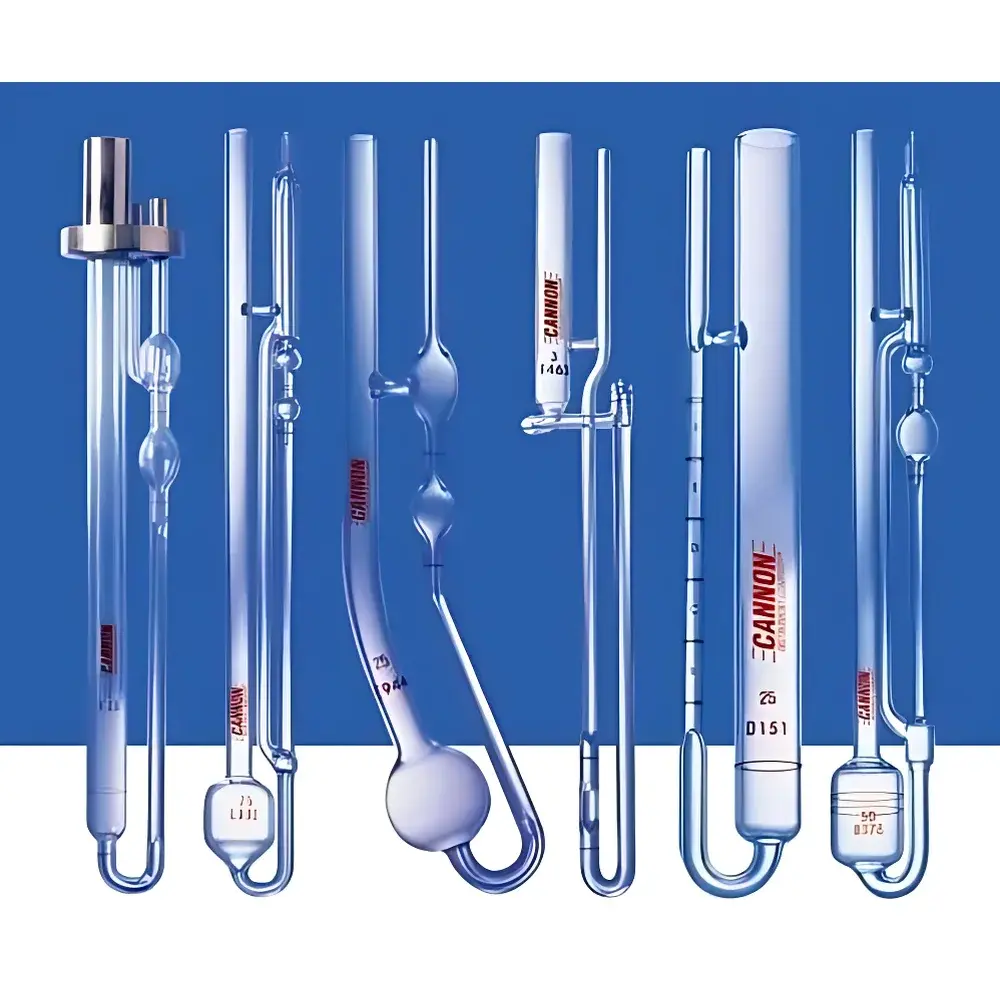
Cannon-Fenske Routine Viscometer Model 9721-A/B
| Brand | Cannon |
|---|---|
| Origin | USA |
| Instrument Type | Falling-Ball Viscometer |
| Compliance | ASTM D445, ASTM D446, ISO 3104, ISO 3105 |
| Kinematic Viscosity Range | 0.5–100,000 mm²/s (cSt) |
| Sample Volume | 7 mL |
| Calibration | Individually certified per ASTM D446 with traceable viscometer constant and calculation formula |
| Construction | Borosilicate glass, precision-bore capillary |
Overview
The Cannon-Fenske Routine Viscometer Model 9721-A/B is a precision-engineered glass capillary viscometer designed for the accurate determination of kinematic viscosity of transparent Newtonian liquids in accordance with internationally recognized standards. Based on the principle of gravity-driven laminar flow through a calibrated capillary tube, this instrument operates under Poiseuille’s law—where kinematic viscosity (ν) is calculated as the product of the viscometer constant (C) and the efflux time (t): ν = C × t. Its robust borosilicate glass construction ensures thermal stability, chemical resistance, and long-term dimensional integrity—critical for repeatable measurements across laboratory, quality control, and regulatory environments. Unlike rotational or vibrational viscometers, the Fenske Routine design eliminates moving parts and electronic dependencies, delivering inherently stable, low-maintenance performance ideal for routine QC testing in petroleum refining, lubricant formulation, solvent manufacturing, and polymer solution analysis.
Key Features
- Precision-calibrated borosilicate glass capillary with individually assigned, NIST-traceable viscometer constants certified per ASTM D446
- Available in 13 standard size variants (25–700), each covering a defined kinematic viscosity range from 0.5 to 100,000 mm²/s (cSt)
- Optimized geometry for consistent meniscus positioning and minimal surface tension effects during timing
- Designed for use with standard stopwatch-based timing protocols or automated timing systems compatible with ASTM D445 procedures
- No power supply, electronics, or calibration drift concerns—ideal for audit-ready GLP/GMP workflows
- Includes comprehensive operation manual, cleaning instructions, and ASTM-compliant validation guidance
Sample Compatibility & Compliance
The Cannon-Fenske Routine Viscometer is validated exclusively for homogeneous, particle-free, transparent Newtonian fluids—including hydrocarbon solvents, base oils, refined fuels, glycols, and low-concentration polymer solutions. It is not suitable for non-Newtonian, opaque, or highly volatile samples requiring temperature-controlled bath immersion beyond ±0.02 °C. All units comply with ASTM D445 (Standard Test Method for Kinematic Viscosity of Transparent and Opaque Liquids), ASTM D446 (Specification for Glass Capillary Kinematic Viscometers), ISO 3104 (Petroleum products — Determination of kinematic viscosity), and ISO 3105 (Glass capillary kinematic viscometers — Specifications). Each viscometer is supplied with a factory-issued calibration certificate listing its certified constant, uncertainty budget, reference standard traceability, and applicable temperature correction factors.
Software & Data Management
As a passive mechanical instrument, the Cannon-Fenske Routine Viscometer does not incorporate embedded firmware or proprietary software. However, it integrates seamlessly into regulated digital workflows via third-party LIMS or ELN platforms that support ASTM D445-compliant data entry templates. When used with automated timing systems (e.g., photoelectric sensors or video-based efflux analyzers), raw efflux times can be exported in CSV or XML formats for statistical process control (SPC), trend analysis, and 21 CFR Part 11–compliant audit trails. The included calibration certificate provides all necessary metadata for full traceability in FDA, EPA, or ISO/IEC 17025-accredited laboratories.
Applications
- Refinery QC: Monitoring kinematic viscosity of diesel fuel, jet fuel (Jet A/A-1), and lubricating base stocks per ASTM D975, D1655, and D2270
- Chemical manufacturing: Verification of solvent consistency (e.g., toluene, xylene, ethyl acetate) prior to batch release
- Research labs: Benchmarking viscosity-temperature behavior of novel bio-based fluids and ionic liquids
- Standards laboratories: Primary calibration reference for rotational viscometer verification per ISO 17025 Clause 6.5
- Educational settings: Teaching fundamental rheological principles, capillary flow dynamics, and metrological traceability
FAQ
What is the minimum sample volume required for a valid measurement?
A nominal volume of 7 mL is sufficient to fully fill the reservoir and capillary bulb while ensuring proper meniscus formation at the timing marks.
Can this viscometer be used for non-Newtonian fluids?
No. The Fenske Routine design assumes laminar, time-independent flow governed by Newton’s law of viscosity; deviations due to shear-thinning or thixotropy invalidate results.
How often must the viscometer be recalibrated?
Per ASTM D446, recalibration is not required unless physical damage occurs or the instrument undergoes thermal shock exceeding manufacturer specifications; periodic verification using certified reference oils is recommended annually.
Is temperature control mandatory during testing?
Yes. Kinematic viscosity is highly temperature-dependent; measurements must be conducted in a thermostatically controlled bath stabilized to ±0.02 °C at the specified test temperature (commonly 40 °C or 100 °C per ASTM D445).
Does the instrument meet FDA 21 CFR Part 11 requirements?
The viscometer itself is hardware-only and exempt from electronic signature regulations; however, its integration with compliant timing and data capture systems supports full Part 11 implementation in validated environments.



