
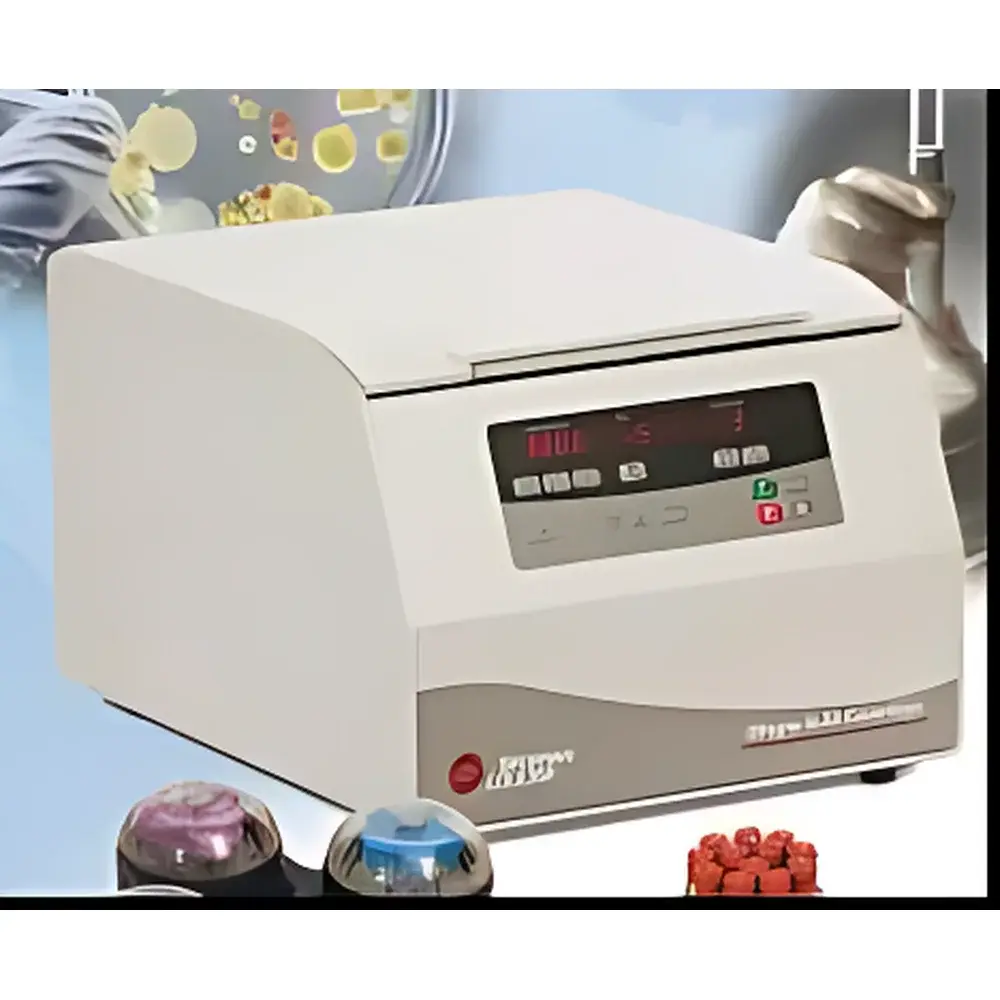
Beckman Coulter Allegra X-30 and Allegra X-30R Benchtop Multifunction Centrifuges
| Brand | Beckman Coulter |
|---|---|
| Origin | USA |
| Model | Allegra X-30 / Allegra X-30R |
| Maximum Capacity | 4 × 400 mL (horizontal rotor) or 6 × 85 mL (fixed-angle rotor) |
| Maximum Speed | 18,000 rpm |
| Relative Centrifugal Force (RCF) | 29,756 × g |
| Temperature Range | –20 °C to +40 °C |
| Cooling Time | ≤10 min to reach 4 °C from ambient |
| Dimensions (H × W × D) | 550 × 355 × 460 mm |
| Drive Type | Brushless Induction Motor |
| Acceleration/Deceleration Profiles | 10 independent settings each |
| Safety Features | Automatic door interlock, real-time imbalance detection, reinforced steel perimeter containment ring |
| Noise Level | <65 dBA at maximum speed |
Overview
The Beckman Coulter Allegra X-30 and Allegra X-30R are high-performance benchtop centrifuges engineered for versatility, precision, and operational safety in demanding laboratory environments. Designed around a brushless induction motor architecture, these instruments eliminate carbon brush wear—ensuring long-term rotational stability, minimal maintenance, and consistent torque delivery across the full speed range (up to 18,000 rpm). The X-30R variant incorporates active refrigeration with a temperature control range of –20 °C to +40 °C and achieves rapid thermal equilibration—reaching 4 °C from ambient in under 10 minutes—critical for preserving thermolabile biological samples during prolonged runs. Both models comply with IEC 61010-1 safety standards for laboratory equipment and integrate mechanical and electronic safeguards including automatic door interlock, real-time rotor imbalance monitoring, and a reinforced steel perimeter containment ring to mitigate risk during high-RCF operation.
Key Features
- Brushless induction motor delivering high reproducibility and extended service life without brush replacement or commutator maintenance
- Dual-rotor compatibility: Supports both high-capacity horizontal rotors (4 × 400 mL) and high-speed fixed-angle rotors (6 × 85 mL), enabling protocol flexibility across cell pelleting, plasma separation, and nucleic acid purification workflows
- Precise temperature management (X-30R only): Digital PID-controlled refrigeration system with ±1 °C accuracy over the full –20 °C to +40 °C range
- Programmable run modes: Continuous, timed (up to 9 h 59 min), or short-pulse centrifugation; ideal for gradient separations, quick spin-downs, or intermittent sample processing
- 10 independently configurable acceleration and deceleration profiles—optimized for sensitive samples (e.g., avoiding resuspension of fragile pellets) or rapid throughput (e.g., stepwise braking for high-volume clinical batches)
- Low-noise design (<65 dBA at max speed) achieved through balanced rotor dynamics, vibration-damping chassis, and acoustic enclosure engineering—suitable for shared lab spaces and ISO Class 5 cleanroom-adjacent environments
Sample Compatibility & Compliance
The Allegra X-30/X-30R accommodates standard centrifuge tubes (1.5–50 mL conical, 15–50 mL Falcon-style), microplates (24-/48-/96-well), and custom adapters for specialized vessels. Rotors are certified to ISO 21501-4 for particle size distribution validation and conform to ASTM F2119 for centrifuge rotor fatigue testing. All configurations meet GLP and GMP documentation requirements when paired with Beckman Coulter’s optional audit-trail-enabled software (see Software & Data Management). The instrument’s electrical safety certification includes UL 61010-1, CSA C22.2 No. 61010-1, and CE marking per Directive 2014/30/EU (EMC) and 2014/35/EU (LVD).
Software & Data Management
While the front-panel interface supports standalone operation with intuitive rotary encoder navigation and LCD status feedback, full traceability is enabled via optional integration with Beckman Coulter’s CentriLog™ software suite. CentriLog provides FDA 21 CFR Part 11-compliant electronic records—including user authentication, parameter change logs, run history export (CSV/PDF), and time-stamped event tracking for audit readiness. Data integrity is preserved through encrypted local storage and role-based access controls. Exported datasets retain metadata such as rotor ID, actual RCF, temperature deviation, and imbalance alerts—facilitating root-cause analysis during QC investigations or regulatory submissions.
Applications
These centrifuges serve core functions across academic research, clinical diagnostics, biopharmaceutical development, and quality control laboratories. Typical use cases include: isolation of peripheral blood mononuclear cells (PBMCs) using Ficoll density gradients; clarification of bacterial lysates prior to chromatography; recovery of extracellular vesicles from cell culture supernatants; preparation of serum/plasma for ELISA or mass spectrometry; and high-yield pelleting of recombinant protein expression cultures. The X-30R’s sub-zero capability supports cryopreservation workflows, mitochondrial isolation protocols requiring cold-active enzyme stabilization, and RNA extraction where RNase inhibition is temperature-dependent.
FAQ
What is the difference between the Allegra X-30 and X-30R models?
The X-30R includes a fully integrated refrigeration system with programmable temperature control; the X-30 is a non-refrigerated version optimized for ambient-temperature applications requiring high RCF and large-volume capacity.
Are rotor certifications included with purchase?
Yes—each rotor ships with a serialized certificate of conformance, including maximum rated speed, RCF, and compliance statements per ISO 21501-4 and ASTM F2119.
Can the centrifuge be validated for GxP environments?
When used with CentriLog™ software and documented IQ/OQ protocols (available from Beckman Coulter Field Service), the system supports full GMP/GLP validation including installation qualification, operational qualification, and performance verification reports.
Is remote monitoring supported?
CentriLog™ enables networked deployment via Ethernet; real-time status, alarm notifications, and historical run data can be accessed through secure web browser interfaces or integrated into LIMS via API endpoints.
What maintenance intervals are recommended?
Routine inspection every 6 months is advised; brushless motor design eliminates scheduled brush replacement; vacuum grease application on rotor threads is required annually per manufacturer guidelines.



