
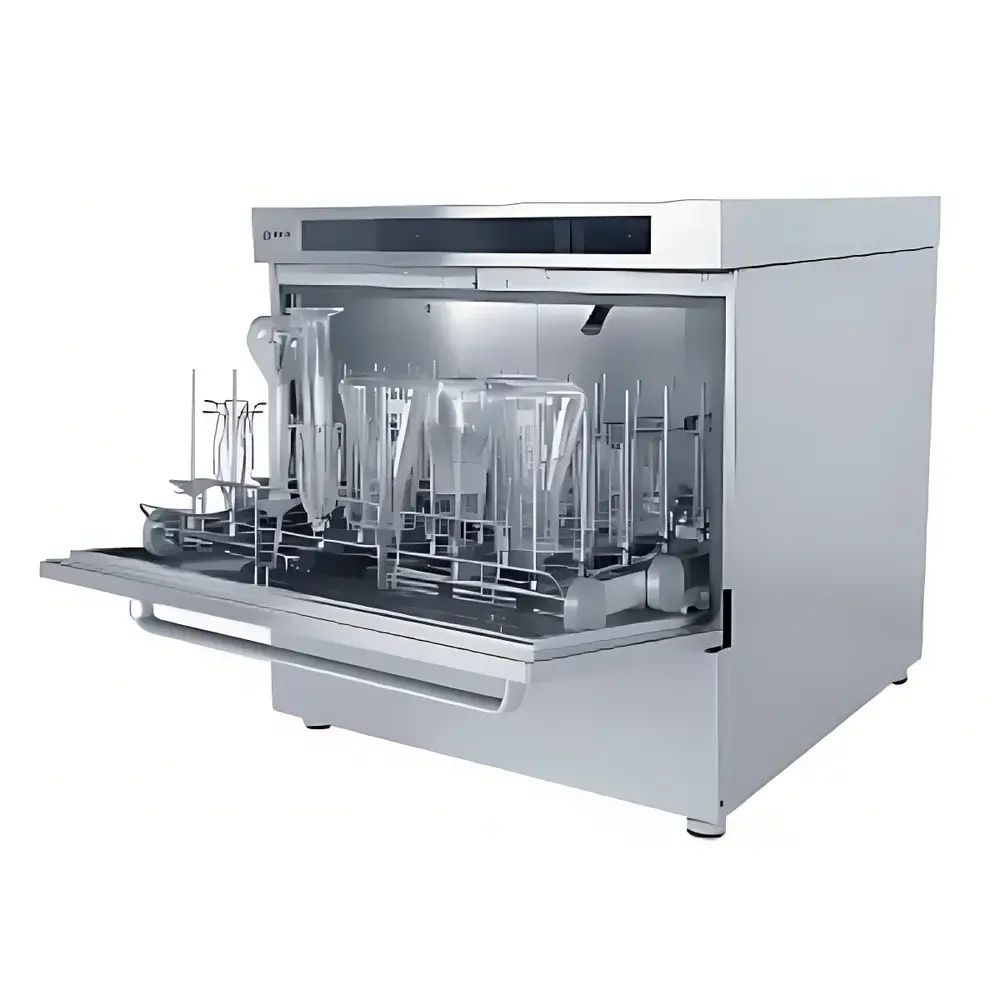
STIER T20/T20D Benchtop Laboratory Glassware Washer
| Brand | STIER |
|---|---|
| Origin | Guangdong, China |
| Manufacturer Type | Authorized Distributor |
| Country of Origin | China |
| Model | T20/T20D |
| Chamber Volume | 110 L (T20) / 190 L (T20D) |
| Heating Power | 3 kW |
| Cleaning Solution Compatibility | Compatible with neutral, alkaline, and acidic detergents |
| External Dimensions (L×W×H) | 600 × 600 × 690 mm |
| Construction | 304 Stainless Steel Exterior (anti-fingerprint finish), 316 Stainless Steel Interior Chamber |
| Drying Method | Residual-heat drying and optional forced-air drying |
| Power Supply | 220 V AC, 50 Hz |
| Wash Pump Power | 0.3 kW |
| Total Power Consumption | 3.3 kW |
| Water Supply | Cold water, hot water (≤95 °C), or purified water (e.g., DI or WFI) |
| Inlet Connection | Standard ISO quick-connect fittings |
| Minimum/Maximum Inlet Pressure | 0.04–1.00 MPa |
| Sound Pressure Level | ≤70 dBA (at 1 m) |
| Net Weight | 55 kg |
| Optional Accessories | HEPA-filtered recirculation module, conductivity sensor, RFID rack tracking, programmable detergent dosing unit, Ethernet-enabled process logging |
Overview
The STIER T20 and T20D are compact, benchtop laboratory glassware washers engineered for precision cleaning and thermal disinfection of reusable labware in small- to mid-sized research, quality control, and clinical laboratories. Based on validated thermodynamic cleaning principles—combining controlled temperature cycles, precisely metered detergent delivery, high-pressure spray dynamics, and multi-stage rinse protocols—these units deliver reproducible, traceable cleaning outcomes compliant with ISO 15883-1 (washer-disinfectors for medical devices) and aligned with GLP/GMP expectations for instrument qualification (IQ/OQ/PQ). Unlike generic industrial washers, the T20/T20D integrates laboratory-specific load configurations—including dedicated racks for volumetric flasks, graduated cylinders, autosampler vials, Petri dishes, pipette tips, and surgical instruments—ensuring uniform exposure to wash media and minimizing shadowing effects. The dual-chamber variants (T20D) support parallel processing or segregated workflows (e.g., clean vs. contaminated zones), enhancing throughput without compromising validation integrity.
Key Features
- Corrosion-resistant chamber constructed from ASTM A240 Grade 316 stainless steel—resistant to chloride-induced pitting and compatible with aggressive alkaline and acidic cleaning chemistries.
- Electropolished interior surfaces reduce biofilm adhesion and facilitate visual inspection per USP and environmental monitoring requirements.
- Programmable multi-step cycles (pre-wash, main wash, intermediate rinse, final rinse, drying) with adjustable temperature profiles (up to 95 °C) and dwell times.
- High-efficiency axial-flow wash pump (0.3 kW) generating consistent spray pressure across all nozzle zones—validated at ≥1.2 bar at nozzle exit under nominal flow conditions.
- Integrated thermal disinfection mode meeting AOAC-defined “log-6 microbial reduction” criteria when operated at ≥90 °C for ≥1 minute, supporting compliance with EN ISO 15883-4 for critical reprocessing.
- Modular electrical architecture with CE-marked components, EMI shielding, and overtemperature/overpressure safety interlocks certified to IEC 61000-6-2 and IEC 61000-6-4.
Sample Compatibility & Compliance
The T20/T20D accommodates standard ANSI/SLAS-compliant labware up to 400 mm in height, including Class A volumetric flasks (up to 2 L), borosilicate glass bottles with screw caps, polycarbonate centrifuge tubes, stainless-steel forceps and scissors, and silicone-sealed Petri dish stacks. Racks are configurable with adjustable dividers and non-slip elastomeric inserts to prevent collision damage during agitation. All cycle parameters—including temperature ramp rates, hold durations, and final rinse conductivity thresholds (<1.0 µS/cm)—are recordable and exportable for audit purposes. The system supports 21 CFR Part 11–compliant electronic signatures when paired with optional STIER Connect software and networked authentication modules.
Software & Data Management
Cycle execution is managed via a 7-inch capacitive touchscreen HMI running embedded Linux with real-time clock synchronization and NTP support. Each run generates a timestamped log file containing inlet water temperature/pressure, detergent concentration (if dosing module installed), chamber temperature curves, pump current draw, and final rinse conductivity (when sensor equipped). Logs are stored locally on encrypted SD card (≥32 GB) and optionally mirrored to FTP/SFTP servers or cloud-based LIMS interfaces via Ethernet or Wi-Fi (802.11ac). Audit trails include user ID, parameter modifications, alarm events, and calibration timestamps—all retained for ≥12 months per ALCOA+ data integrity guidelines.
Applications
These washers serve analytical chemistry labs requiring residue-free preparation of HPLC vials and GC sample containers; pharmaceutical QC units performing extractables/leachables testing on primary packaging components; microbiology facilities reprocessing Petri dishes and inoculation loops between sterility assays; and academic core facilities supporting shared instrumentation with documented cleaning SOPs. The T20D’s dual-chamber configuration is particularly suited for labs implementing risk-based segregation strategies—e.g., separate processing of cytotoxic compounds versus general-purpose glassware—or for validation studies requiring simultaneous reference and test runs.
FAQ
What regulatory standards does the T20/T20D comply with?
It meets mechanical and electrical safety requirements per IEC 61010-1 and incorporates design elements aligned with ISO 15883-1 for washer-disinfectors, though formal medical device certification requires site-specific IQ/OQ/PQ and local regulatory review.
Can the unit be integrated into an existing laboratory water purification system?
Yes—it accepts feed water from central DI, WFI, or PW systems via standard 1/2″ BSP or NPT quick-connect fittings, with built-in pressure regulation and flow monitoring.
Is validation support documentation available?
STIER provides a comprehensive Validation Support Package including URS templates, FAT/SAT checklists, IQ/OQ protocol drafts, and raw data examples upon request.
What maintenance intervals are recommended?
Daily: filter cleaning and door gasket inspection. Quarterly: spray arm alignment verification and pump seal integrity check. Annually: full thermal calibration and conductivity sensor verification using NIST-traceable standards.
Does the system support remote diagnostics?
With optional STIER Connect firmware and network connectivity, authorized service engineers can perform secure remote diagnostics, firmware updates, and log analysis—subject to customer IT security policies.



