
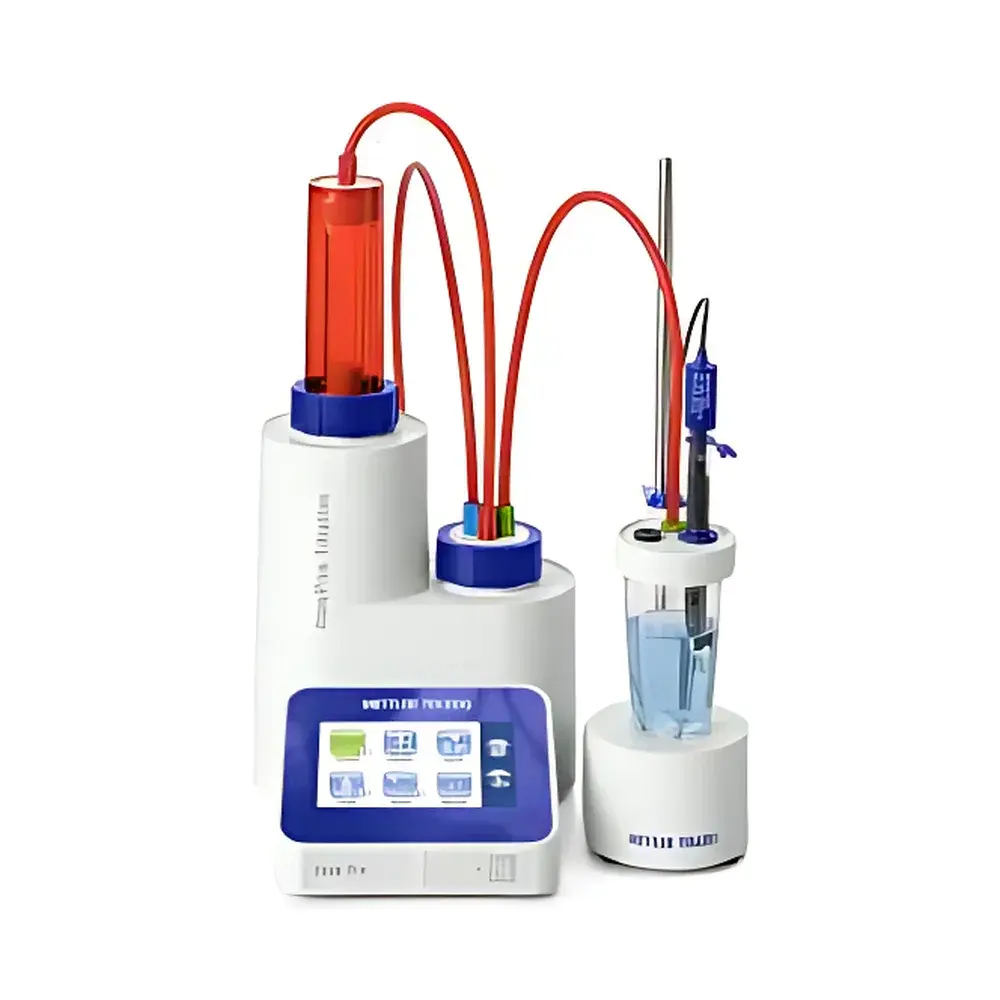
METTLER TOLEDO EasyPlus ET28 Automatic Potentiometric Titrator
| Brand | METTLER TOLEDO |
|---|---|
| Origin | Switzerland |
| Model | ET28 |
| pH Range | 1–14 |
| pH Accuracy | ±0.2% of full scale |
| pH Resolution | 0.01 |
| Titration Precision | ±0.3% RSD |
| Instrument Type | General-purpose Automatic Potentiometric Titrator |
| Electrode Configuration | Integrated Ag/AgCl composite ring electrode |
Overview
The METTLER TOLEDO EasyPlus ET28 Automatic Potentiometric Titrator is an entry-level, application-optimized potentiometric titration system engineered for robustness, repeatability, and operational simplicity in routine quality control and regulatory-compliant laboratories. Based on classical potentiometric endpoint detection—measuring potential difference (mV) across a redox- or ion-selective electrode pair as titrant is incrementally added—the ET28 implements the fundamental Nernst equation principle to determine stoichiometric equivalence points with high reproducibility. Its architecture centers on a precision burette drive mechanism, integrated temperature compensation, and real-time potential monitoring at up to 10 Hz sampling frequency. Designed specifically for precipitation titrations—including argentometric methods such as Mohr, Volhard, and Fajans—the ET28 delivers traceable, auditable results without requiring advanced electrochemical expertise. The instrument complies with core principles outlined in ISO 8655-3 (burette accuracy), ASTM E2087 (standard practice for potentiometric titration), and supports alignment with GLP and GMP documentation requirements through structured data handling protocols.
Key Features
- Integrated Ag/AgCl composite ring electrode optimized for chloride, bromide, iodide, and thiols/sulfides determination—eliminates electrode pairing complexity and minimizes junction potential drift.
- Intuitive, application-driven touchscreen interface with guided workflow navigation—no programming knowledge required; method setup completed in under 90 seconds.
- iTitrate™ intelligent parameter assistance automatically recommends optimal titrant addition increments, endpoint detection thresholds, and stabilization criteria based on sample matrix history and analyte class.
- USB-host connectivity supporting direct output to METTLER TOLEDO USB-P25 thermal printers for immediate hard-copy reporting compliant with internal SOPs.
- Modular design compatible with EasyDirect™ PC software for automated data export (CSV, PDF, XML), audit trail generation, and electronic signature support per FDA 21 CFR Part 11 Annex 11 requirements.
- Calibration management system with timestamped, user-attributed calibration logs and automatic validation alerts prior to analysis initiation.
Sample Compatibility & Compliance
The ET28 accommodates aqueous, alcoholic, and low-polarity solvent systems (e.g., acetonitrile, chloroform) commonly used in silver nitrate-based titrations. It supports samples ranging from clear filtrates (e.g., drinking water extracts) to moderately turbid matrices (e.g., digested food homogenates, acid-dissolved metal alloys), provided particulates are removed via filtration (≤0.45 µm). For sulfur-containing compounds in lubricants, the instrument operates effectively with non-aqueous titration media using lithium perchlorate electrolyte. All measurements adhere to ISO 9047 (determination of chloride in water), AOAC Official Method 971.25 (salt in foods), and ASTM D4294 (sulfur in petroleum products by energy-dispersive XRF correlation). The system’s firmware includes preloaded method templates validated against USP , EP 2.2.20, and JP 6.06 standards.
Software & Data Management
EasyDirect™ software provides centralized control, remote monitoring, and full lifecycle data governance. Each titration run generates a secure, tamper-evident result file containing raw mV vs. volume curves, first-derivative plots, equivalence point interpolation residuals, and operator metadata. Audit trails record all user actions—including method edits, calibration events, and result overrides—with time stamps, IP addresses (when networked), and digital signatures. Export formats meet LIMS integration requirements: CSV for statistical process control (SPC) engines, PDF/A-1b for archival, and XML for ELN ingestion. All data files are SHA-256 hashed and stored with immutable timestamps to satisfy ISO/IEC 17025 clause 7.5.2.
Applications
- Determination of chloride concentration in potable water, wastewater effluents, and desalination brines per ISO 9297.
- Quantification of NaCl content in dairy products, meat preparations, and canned vegetables following AOAC 971.25.
- Analysis of reactive sulfur species (e.g., mercaptans, sulfides) in crude oil fractions and turbine lubricants using potentiometric back-titration with standardized AgNO₃.
- Assay of silver content in electroplating baths and dissolved silver catalysts via direct argentometric titration in nitric acid medium.
- Verification of halide impurities in pharmaceutical excipients per ICH Q5C and USP .
FAQ
Does the ET28 support non-argentometric titrations such as acid-base or redox?
Yes—it accepts interchangeable electrodes (e.g., pH glass, Pt, ORP) and supports custom method creation for acid-base, redox, complexometric, and precipitation titrations, though default configurations prioritize argentometry.
Is temperature compensation mandatory for accurate results?
Temperature input is optional but recommended for sub-0.5% RSD performance; built-in NTC sensor enables automatic correction of electrode slope and activity coefficients per Nernst equation.
Can the ET28 be integrated into a laboratory network for centralized data archiving?
Yes—via Ethernet or Wi-Fi (with optional adapter), enabling connection to shared network drives, SQL databases, or cloud-based ELN platforms with TLS 1.2 encryption.
What maintenance intervals are recommended for long-term reliability?
Burette piston lubrication every 6 months; electrode storage in KNO₃ solution; annual verification of volumetric accuracy per ISO 8655-3 using certified standard solutions.
How does the system ensure compliance during regulatory audits?
Through synchronized electronic records, role-based access control, immutable audit trails, and configurable electronic signatures aligned with FDA 21 CFR Part 11 and EU Annex 11.




