
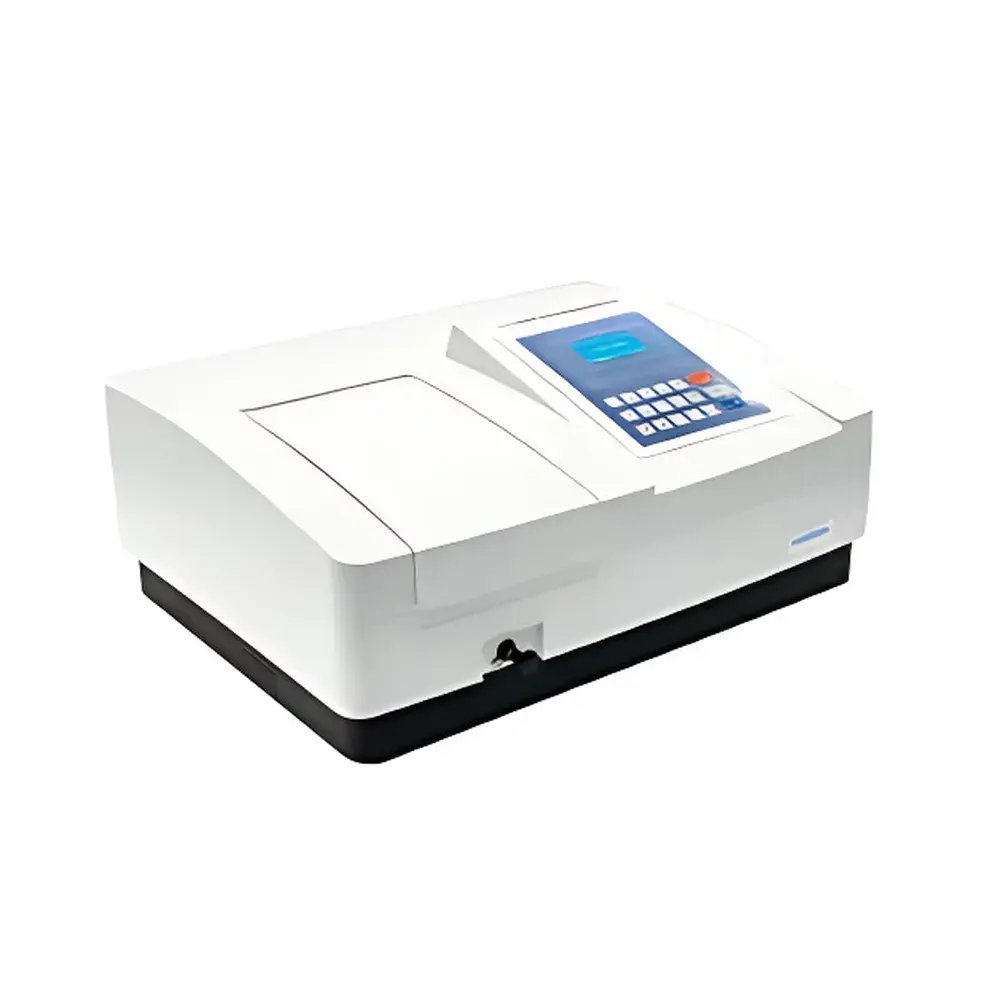
Mupu UV-3200 Scanning Ultraviolet-Visible Spectrophotometer
| Origin | Shanghai, China |
|---|---|
| Manufacturer Type | Authorized Distributor |
| Origin Category | Domestic (China) |
| Model | UV-3200 |
| Price Range | USD 1,400–2,800 |
| Optical Design | Pseudo-Double-Beam |
| Detector | Silicon Photodiode |
| Wavelength Range | 190–1100 nm |
| Wavelength Accuracy | ±0.3 nm |
| Spectral Bandwidth | 1.8 nm |
| Stray Light | ≤0.03% T at 220 nm and 360 nm |
| Wavelength Repeatability | ≤0.2 nm |
| Photometric Accuracy | ±0.2% T (0–100% T), ±0.002 A (0–0.5 A), ±0.004 A (0.5–1 A) |
| Photometric Repeatability | ≤0.15% T (0–100% T), ±0.001 A (0–0.5 A), ±0.002 A (0.5–1 A) |
| Baseline Flatness | ±0.0015 A (200–1000 nm) |
| Drift | ±0.001 A/h at 500 nm |
| Noise | ±0.0005 A |
| Display | 320 × 240 LCD |
| Scan Speed Options | High/Medium/Low (up to 3800 nm/min) |
| Data Interface | USB |
| Print Interface | Parallel Port |
| Power Supply | AC 220 V/50 Hz or AC 110 V/60 Hz |
| Dimensions | 590 × 420 × 260 mm |
| Weight | 20 kg |
Overview
The Mupu UV-3200 Scanning Ultraviolet-Visible Spectrophotometer is a precision optical instrument engineered for quantitative and qualitative analysis across research laboratories, quality control environments, and educational institutions. Based on the fundamental principle of Beer–Lambert absorption spectroscopy, the UV-3200 measures the attenuation of ultraviolet and visible light as it passes through a sample solution—enabling determination of analyte concentration, purity assessment, spectral characterization, and kinetic monitoring. Its pseudo-double-beam architecture compensates for source intensity fluctuations and detector drift in real time, significantly improving measurement stability and photometric reproducibility compared to single-beam systems. The instrument operates over a broad spectral range (190–1100 nm), covering deep UV (e.g., nucleic acid detection at 260 nm), visible (e.g., dye quantification at 540 nm), and near-IR regions (e.g., carbohydrate analysis at 980 nm), making it suitable for diverse applications in pharmaceuticals, environmental testing, food science, and materials chemistry.
Key Features
- High-resolution optical system featuring a 1200 lines/mm holographic grating and precision-aligned collimating optics—optimized for spectral fidelity and minimal aberration.
- Imported long-life deuterium and tungsten-halogen lamps with intelligent lamp-hour monitoring; ozone-reduced deuterium source enhances laboratory safety and operational longevity.
- Modular, socket-type lamp design eliminates the need for post-replacement optical recalibration—reducing downtime and technician dependency.
- Large 320 × 240 graphical LCD display supports real-time visualization of absorbance/transmittance spectra, kinetic curves, multi-wavelength scans, and calibration plots—all rendered in intuitive English-language interface.
- Extended sample compartment accommodates cuvettes from 5 mm to 100 mm pathlength—including standard 10 mm quartz, glass, or plastic cells—facilitating both routine QC assays and low-concentration trace analysis.
- Three selectable scan speeds (up to 3800 nm/min) enable optimization between throughput and signal-to-noise ratio depending on application requirements.
- Integrated GLP self-validation module allows on-demand verification of wavelength accuracy (using holmium oxide or didymium filters) and photometric linearity—generating timestamped compliance reports traceable to internal standards.
Sample Compatibility & Compliance
The UV-3200 accepts liquid samples in standard spectrophotometric cuvettes (quartz, fused silica, or high-transmission glass), as well as solid thin films mounted on reflective holders (with optional accessories). It supports common solvent systems including water, methanol, ethanol, acetonitrile, and buffered saline solutions. Instrument performance adheres to internationally recognized specifications aligned with ISO 9001 manufacturing controls and meets essential metrological criteria referenced in ASTM E275 (Standard Practices for Describing and Measuring Performance of UV-Vis Spectrophotometers) and USP (Spectrophotometry and Light-Scattering). While not certified for regulated GMP production environments out-of-the-box, its audit-ready data logging, user-accessible calibration history, and configurable password protection provide foundational support for laboratories implementing FDA 21 CFR Part 11–compliant workflows when paired with validated Mapada scanning software.
Software & Data Management
The UV-3200 interfaces seamlessly with Mapada Professional Spectroscopy Software via USB connection. This Windows-based application enables full remote control—including method setup, multi-point calibration (linear/nonlinear), spectral subtraction, derivative analysis, peak identification, and time-resolved kinetics. All acquired data—including raw spectra, processed curves, and metadata (operator ID, date/time stamp, instrument serial number)—are stored in vendor-neutral CSV and XML formats. The software supports export to PDF, PNG, and Excel-compatible files for reporting and integration into LIMS or ELN platforms. Internal memory retains up to 200 methods and 500 spectra, while external USB storage extends archival capacity indefinitely. Audit trails record all parameter changes, file exports, and calibration events—meeting minimum requirements for GLP documentation integrity.
Applications
- Pharmaceutical assay validation and dissolution testing per USP monographs.
- Enzyme kinetics (e.g., NADH/NADPH oxidation at 340 nm) and protein quantification (Bradford, Lowry, BCA).
- Water quality analysis: nitrate (220 nm), phosphate (880 nm), COD (via dichromate reduction), and heavy metal chelates.
- Food and beverage QA: color index (CIELAB), anthocyanin content (520 nm), and preservative concentration (sorbic acid at 264 nm).
- Nanoparticle characterization: gold colloid size estimation via surface plasmon resonance peak position and width.
- Educational labs: teaching Beer’s law, spectral identification, and instrumental error analysis.
FAQ
What is the difference between pseudo-double-beam and true double-beam operation?
The UV-3200 uses a time-shared single-detector configuration with a rotating mirror to alternate between reference and sample beams. This differs from a true double-beam design that employs two simultaneous detectors—but achieves comparable baseline stability and drift compensation at lower mechanical complexity and cost.
Can the UV-3200 be used for quantitative analysis in regulated environments?
Yes—when operated with validated Mapada software, documented calibration procedures, and appropriate reference standards, it fulfills core analytical requirements for non-GMP R&D, stability studies, and pre-clinical testing. Full 21 CFR Part 11 compliance requires additional IT infrastructure and procedural controls beyond the instrument itself.
Is the instrument compatible with third-party software or APIs?
Native communication is limited to Mapada’s proprietary protocol over USB virtual COM port. While no official SDK is provided, ASCII command sets are documented in the technical manual, enabling custom integration via Python, LabVIEW, or MATLAB using serial emulation libraries.
How often should wavelength accuracy be verified?
Per ISO/IEC 17025 recommendations, wavelength verification should occur before each analytical session involving critical peak identification—or at least daily during continuous operation. Holmium oxide filters are recommended for routine checks between 200–650 nm.
What maintenance is required for long-term reliability?
Routine cleaning of the sample compartment and optical window with lens-grade tissue and isopropanol; annual lamp replacement (deuterium: ~1000 h, tungsten: ~2000 h); biannual verification of stray light and photometric linearity using certified neutral density filters.
Related Products






