
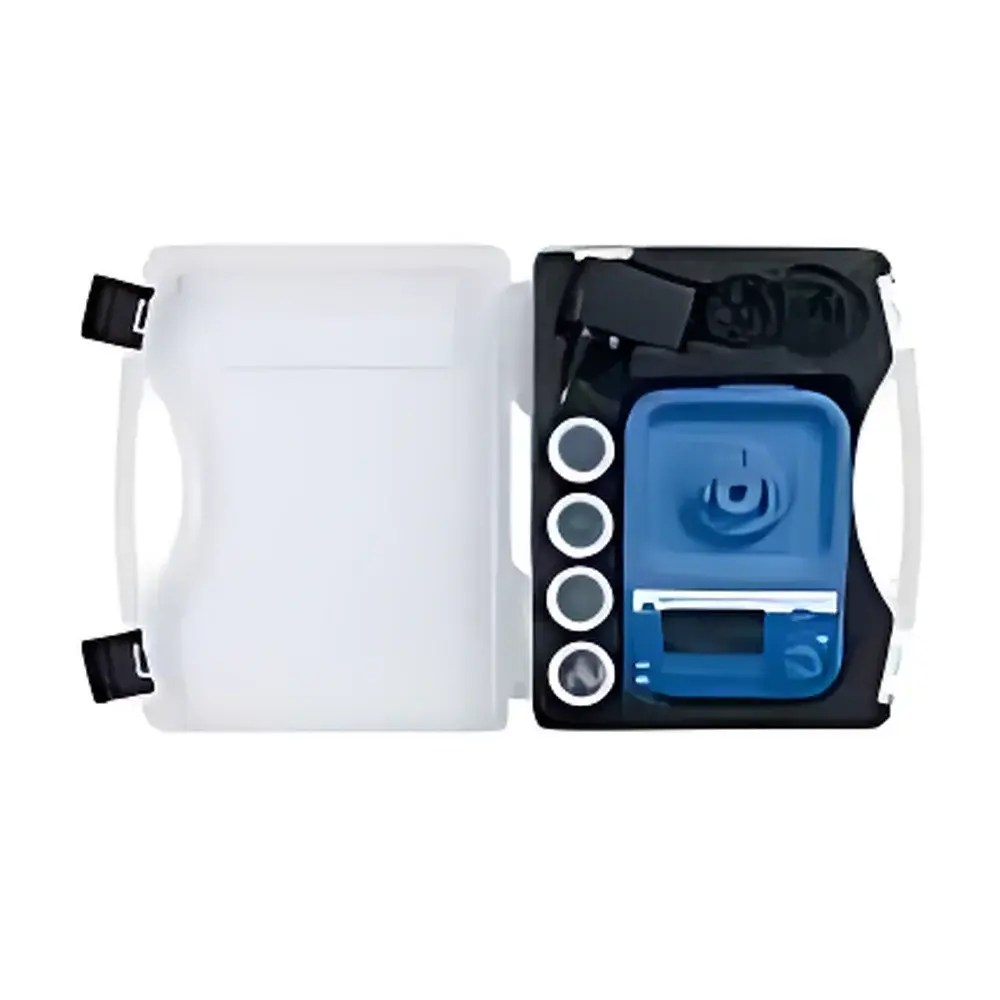
IKA UTTD Controlled Tube Dispersion System Kit
| Brand | IKA |
|---|---|
| Origin | Germany |
| Model | UTTD Kit |
| Motor Input Power | 28 W |
| Motor Output Power | 17 W |
| Max. Viscosity | 5000 mPa·s |
| Speed Range | 400–8000 rpm |
| Speed Accuracy | ±3 % |
| Speed Control Resolution | 10 rpm steps |
| Reversibility | Yes |
| Timer | Yes, OLED-displayed |
| Display | OLED screen with multilingual UI |
| USB Interface | Yes (for remote control & data logging) |
| Protection Rating | IP20 (DIN EN 60529) |
| Operating Temperature | 5–40 °C |
| Relative Humidity Limit | ≤80 % RH |
| Dimensions (W×H×D) | 122 × 178 × 54 mm |
| Weight | 0.9 kg |
| Input Voltage | 100–240 V AC, 50/60 Hz |
| DC Supply | 24 V = 800 mA |
| Noise Level (no dispersing head) | 50 dB(A) |
| Process Type | Batch |
| Tube Options | 2–15 mL (small) and 15–50 mL (large) |
| Sterilization | γ-irradiated disposable tubes |
| Tube Material | Chemically resistant polymer |
| Safety | 24 V low-voltage operation, leak containment tray, puncturable membrane cap, anti-entanglement design |
| Compliance | Designed for GLP/GMP-aligned workflows |
Overview
The IKA® UTTD Controlled Tube Dispersion System Kit is an integrated, benchtop solution engineered for precise, safe, and contamination-free sample processing in regulated laboratory environments. Based on high-speed rotor-stator dispersion mechanics within sealed, single-use tubes, the system enables simultaneous homogenization, mixing, emulsification, and bead-based grinding — all within a closed architecture that eliminates operator exposure to biohazardous, toxic, or malodorous samples. Its core principle relies on controlled angular momentum transfer from a magnetically coupled drive shaft to interchangeable tube-mounted rotors, generating shear rates sufficient for cell lysis, tissue disruption, nanoparticle dispersion, and suspension stabilization. Unlike open-beaker homogenizers, the UTTD’s fully enclosed workflow meets stringent biosafety Level 2 (BSL-2) handling requirements and aligns with ISO 13485 and CLIA pre-analytical best practices for clinical and diagnostic labs.
Key Features
- Modular, single-use tube platform supporting two volume ranges: 2–15 mL (BMT-20 G/S small tubes) and 15–50 mL (DT-20 large tubes), both γ-irradiated and certified sterile
- OLED touchscreen interface with intuitive multilingual menu navigation, real-time parameter visualization (speed, time, direction), and programmable method storage
- Precision speed control in 10 rpm increments across 400–8000 rpm range, with ±3% repeatability under load — validated per ISO 21502 for rotational equipment accuracy
- Bi-directional rotation programming with adjustable forward/reverse dwell times, enabling optimized particle deagglomeration and uniform suspension formation
- Dedicated “Turbo” button for transient acceleration during critical dispersion phases — especially effective for viscous or fibrous matrices
- Integrated leak containment tray beneath the drive unit prevents fluid ingress into electronics, extending service life and ensuring compliance with IP20 environmental protection standards
- 24 V DC low-voltage operation enhances electrical safety in wet-lab and cleanroom settings, meeting IEC 61010-1 Class I requirements
- USB 2.0 port enables external PC synchronization, automated protocol execution, timestamped event logging, and export of raw operational metadata for 21 CFR Part 11-compliant audit trails
Sample Compatibility & Compliance
The UTTD system accommodates diverse biological, pharmaceutical, and industrial matrices — including whole blood, tissue biopsies, bacterial cultures, plant extracts, cosmetic emulsions, and polymer suspensions — without cross-sample carryover. All contact surfaces utilize chemically inert, USP Class VI-certified polymers resistant to ethanol, acetone, sodium hypochlorite, and common buffer systems. Disposable tubes feature laser-perforated polypropylene membranes that maintain pressure equilibrium during high-shear processing while preventing aerosol release. The system supports traceable processing under GLP and GMP frameworks: each run logs speed profile, duration, direction sequence, and error codes; USB-exported logs include firmware version, serial number, and calibration timestamp. It is routinely deployed in ISO/IEC 17025-accredited food safety labs and EU IVDR-classified IVD development facilities.
Software & Data Management
No proprietary software installation is required. The UTTD communicates natively via standard CDC ACM USB serial protocol, allowing direct integration with LabVantage, STARLIMS, or custom Python-based LIMS interfaces using PySerial libraries. Logged parameters include start/stop timestamps, cumulative runtime, peak current draw, thermal drift alerts, and rotor engagement status. All data fields are UTF-8 encoded and CSV-exportable with optional SHA-256 hash signatures for integrity verification. Audit mode retains the last 100 run records onboard, each with unique UUID and operator ID field (configurable via keyboard input). Firmware updates are delivered via signed .bin files verified against embedded public key infrastructure — consistent with NIST SP 800-193 guidelines for resilient device firmware.
Applications
This system serves as a primary sample preparation tool across translational research and quality control domains. In molecular diagnostics, it achieves >99.7% DNA yield consistency from FFPE tissue sections prior to qPCR. In vaccine development, it ensures uniform antigen distribution in adjuvant formulations (e.g., aluminum hydroxide gels) without denaturation. Food testing labs use it for rapid mycotoxin extraction from grain composites, reducing prep time from 45 to <90 seconds per sample. Cosmetics R&D leverages its reproducible shear history to benchmark emulsion stability across surfactant variants. Regulatory submissions supported by UTTD-generated data include FDA IND filings for novel biologics and EFSA dossiers for nanomaterial safety assessments.
FAQ
Does the UTTD system require routine calibration?
Yes — annual speed and timer calibration is recommended using NIST-traceable tachometers and stopwatches; certificate templates are provided in the service manual.
Can third-party tubes be used with the UTTD?
No — only IKA-certified BMT-20 G/S and DT-20 tubes ensure mechanical compatibility, pressure containment, and rotor alignment; non-OEM tubes void warranty and compromise biosafety certification.
Is the USB interface compatible with macOS and Linux?
Yes — the CDC ACM class driver is natively supported on macOS 12+, Ubuntu 20.04+, and RHEL 8.5+ without additional kernel modules.
What maintenance does the drive unit require?
None beyond periodic wipe-down with 70% isopropanol; the brushless DC motor and magnetic coupling are sealed and lifetime-lubricated per DIN 51825 KB 100 specifications.
How is method validation performed for regulatory submissions?
IKA provides IQ/OQ documentation packages aligned with ASTM E2500-13 and EU Annex 15; users perform PQ testing using reference standards such as NIST SRM 2004a (viscosity) and ISO 8573-1 Class 2 particulate challenge tests.



