
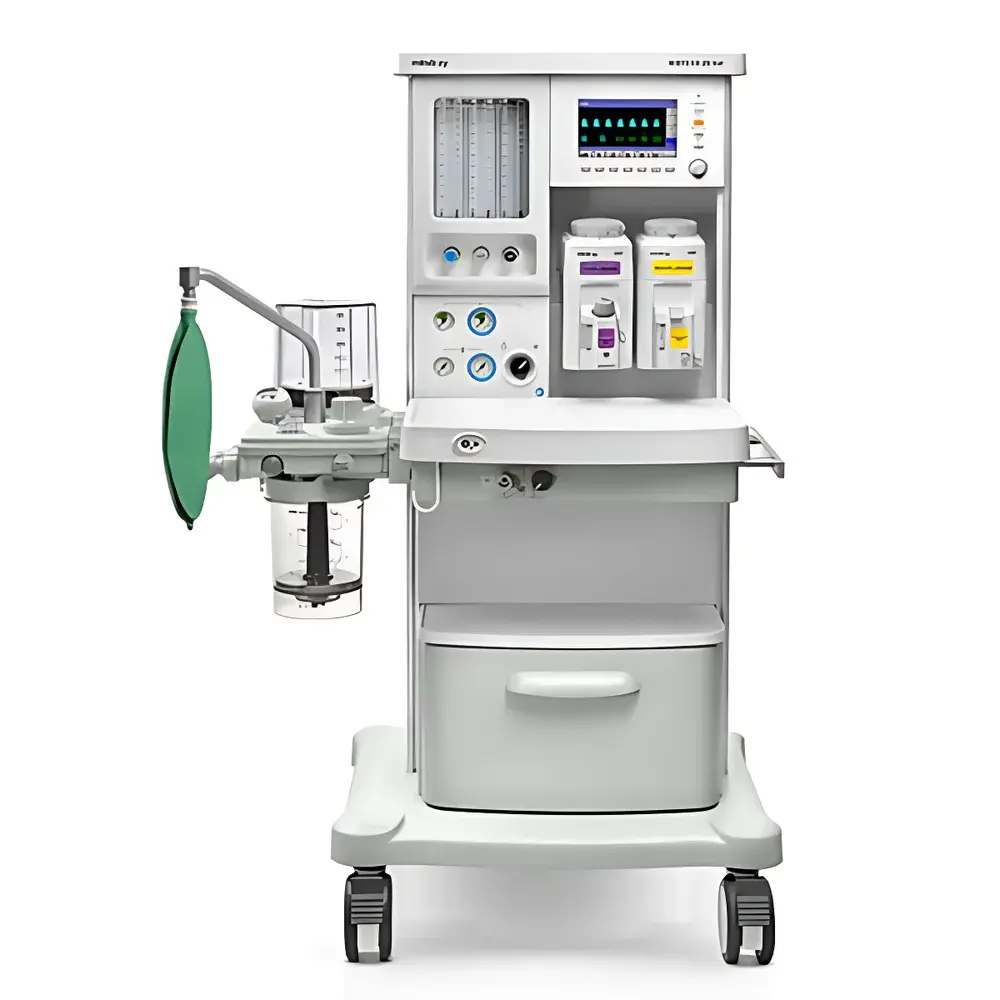
Mindray WATO EX-20Vet Veterinary Anesthesia Machine
| Brand | Mindray |
|---|---|
| Origin | Shanghai, China |
| Manufacturer Type | Authorized Distributor |
| Country of Manufacture | China |
| Model | WATO EX-20Vet |
| Instrument Type | Veterinary Anesthesia Delivery System |
| Compliance | Designed to meet ISO 80601-2-13 (Medical Electrical Equipment – Part 2-13: Particular Requirements for Anesthesia Equipment) and IEC 60601-1 safety standards |
Overview
The Mindray WATO EX-20Vet Veterinary Anesthesia Machine is a CE-marked, Class IIb medical device engineered for precision delivery of inhaled anesthetic agents and controlled mechanical ventilation in laboratory and clinical veterinary settings. Built upon Mindray’s clinically validated anesthesia platform architecture, the system employs dual-stage vaporizer temperature compensation, real-time gas concentration monitoring via infrared spectroscopy (IR), and pressure-controlled/pressure-support ventilation modes compliant with veterinary respiratory physiology requirements. It supports spontaneous, assisted, and controlled breathing patterns across species ranging from rodents to large canines and felines—enabling reproducible anesthetic management during surgical, imaging (e.g., MRI-compatible workflows), and longitudinal preclinical studies. The device integrates seamlessly with standard veterinary anesthesia circuits (e.g., rebreathing and non-rebreathing configurations), CO₂ absorbers, and external O₂ supply systems, ensuring operational continuity under GLP-compliant animal research protocols.
Key Features
- Integrated dual-gas IR analyzers for real-time, cross-calibrated measurement of sevoflurane, isoflurane, and desflurane concentrations (±0.1% vol accuracy) with automatic barometric pressure and temperature compensation
- Microprocessor-controlled variable-bypass vaporizers featuring active thermal regulation to maintain ±5% output stability across ambient temperatures (15–35°C) and flow rates (0.5–10 L/min)
- Three ventilation modes: Volume-Controlled Ventilation (VCV), Pressure-Controlled Ventilation (PCV), and Spontaneous Breathing with Pressure Support (PSV), each configurable with adjustable rise time, inspiratory pause, and expiratory sensitivity
- Dual independent oxygen sensors (paramagnetic + electrochemical) providing redundant O₂ concentration monitoring (21–100%) and fail-safe hypoxia alarms per ISO 80601-2-13 Clause 201.12.4.101
- Touchscreen interface with customizable waveform display (flow, pressure, volume, capnography), trend logging (≥72 h), and password-protected user-level access control (operator, technician, administrator)
- Integrated high-flow O₂ flush (≥35 L/min), adjustable APL (adjustable pressure-limiting) valve, and anti-hypoxic linkage between O₂ concentration and nitrous oxide flow
Sample Compatibility & Compliance
The WATO EX-20Vet is validated for use with common laboratory and companion animal species—including mice, rats, rabbits, guinea pigs, dogs, cats, and swine—across weight ranges from 0.02 kg to 80 kg. Its tidal volume range (10–2000 mL), respiratory rate (1–99 bpm), and I:E ratio (1:1 to 1:4) accommodate both small-animal high-frequency ventilation and large-animal conventional ventilation. All software firmware adheres to IEC 62304 Class B safety lifecycle requirements. Data audit trails comply with ALCOA+ principles (Attributable, Legible, Contemporaneous, Original, Accurate), supporting regulatory submissions under FDA Guidance for Industry (2022) on Nonclinical Laboratory Studies and EMA CHMP Guideline on Good Pharmacological Practice. Device documentation includes full Declaration of Conformity to EU MDR 2017/745 and technical files available upon request for institutional QA review.
Software & Data Management
The embedded anesthesia management software (v3.2.1+) supports encrypted local storage of procedure logs, alarm history, and ventilator parameter snapshots. Export formats include CSV and PDF (with digital signature capability). Optional HL7 v2.5 integration enables bidirectional data exchange with institutional veterinary information systems (VIS) or electronic lab notebooks (ELN). Audit trail functionality records all parameter changes, user logins, alarm acknowledgments, and system resets with timestamp, user ID, and IP address—fully traceable for 21 CFR Part 11 compliance when deployed with validated network authentication infrastructure. Firmware updates are delivered via secure USB media with SHA-256 hash verification; no cloud-based remote update capability is implemented to preserve air-gapped laboratory integrity.
Applications
- Preclinical surgical models requiring stable hemodynamic and respiratory control during neurosurgery, orthopedic implantation, or tumor resection
- Longitudinal functional imaging studies (fMRI, PET, CT) where precise anesthetic depth titration minimizes physiological confounders
- Toxicology and pharmacokinetic studies demanding repeatable anesthetic exposure across dosing cohorts
- Veterinary teaching laboratories performing hands-on training in inhalant anesthetic delivery, circuit assembly, and intraoperative monitoring interpretation
- GLP-certified contract research organizations conducting OECD 407, 422, or 452-compliant repeat-dose toxicity studies
FAQ
Is the WATO EX-20Vet approved for use in FDA-regulated nonclinical studies?
Yes—the device is manufactured under Mindray’s ISO 13485:2016-certified quality management system and meets essential requirements of IEC 60601-1 and IEC 60601-2-13. While not individually 510(k)-cleared for U.S. human use, its design and validation data support acceptance in FDA-reviewed IND/IDE-enabling animal studies per Guidance for Industry: Nonclinical Safety Evaluation of Pharmaceutical Ingredients (2020).
Can the machine be integrated with third-party physiological monitors?
Yes—via analog outputs (0–10 V) for EtGas, Paw, and flow signals, and RS232/USB serial interfaces supporting ASCII-based protocol for synchronization with commercial biopotential or hemodynamic acquisition systems.
What maintenance intervals are recommended for routine calibration?
Gas analyzers require annual verification using NIST-traceable calibration gases; vaporizers undergo biannual output verification per manufacturer SOP 2023-VET-04. Full system performance verification is advised prior to GLP study initiation.





