
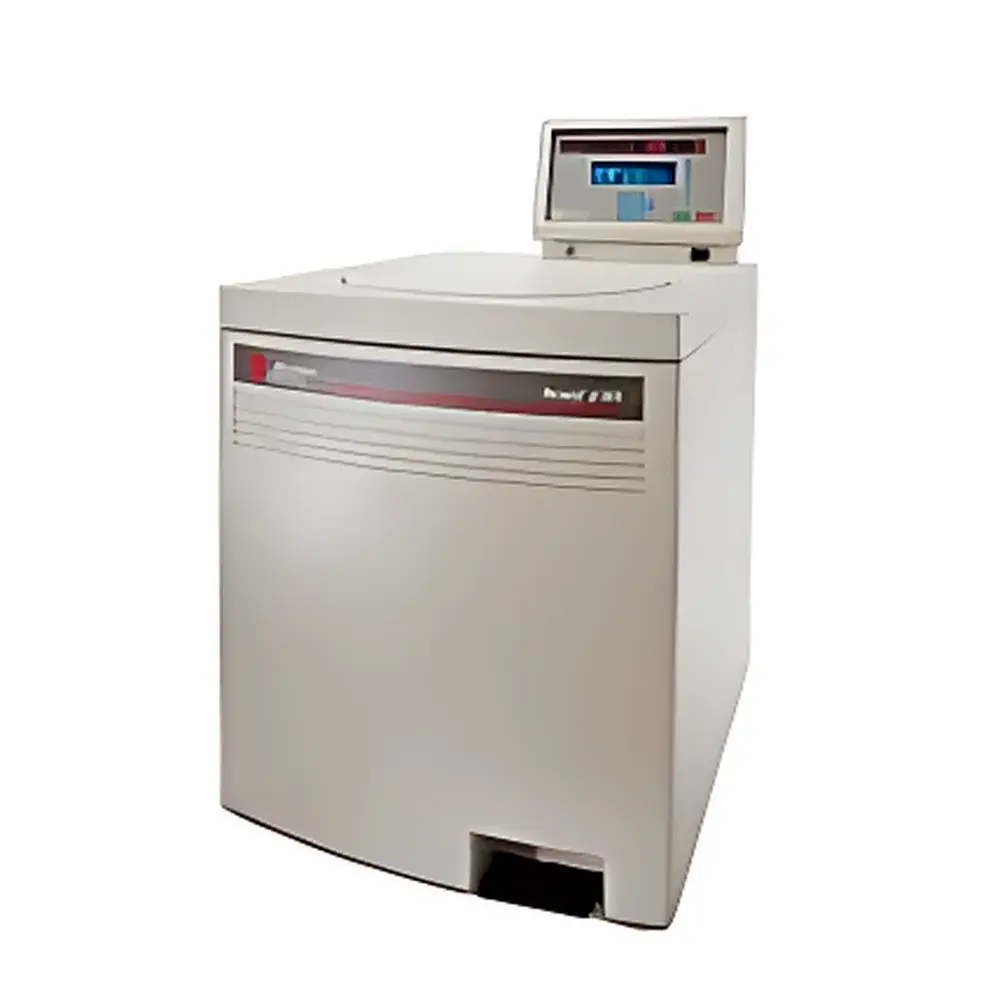
Beckman Coulter Avanti J-30I High-Speed Refrigerated Centrifuge
| Brand | Beckman Coulter |
|---|---|
| Origin | USA |
| Instrument Type | Floor-standing centrifuge |
| Category | High-speed refrigerated centrifuge (10,000–30,000 rpm) |
| Max Speed | 30,000 rpm |
| Max RCF | 110,500 × g |
| Max Capacity | 4 L |
| Temperature Range | −20 °C to 40 °C |
| Drive System | Microprocessor-controlled variable reluctance drive |
| Refrigerant | CFC-free |
| Speed Accuracy | ±10 rpm |
| Acceleration Profiles | 12 settings |
| Deceleration Profiles | 13 settings |
| Timer Range | 1 min – 99 hr 59 min, continuous mode |
| Sample Volume Range | 1.5–1000 mL |
| Heat Output | 2.0 kW (6,900 BTU/hr) |
| Dimensions (H×W×D) | 86.5 cm × 71.0 cm × 87.6 cm |
| Weight | 310 kg |
| Noise Level | <57 dBA |
Overview
The Beckman Coulter Avanti J-30I is a high-performance, floor-standing refrigerated centrifuge engineered for demanding preparative and analytical applications in academic, pharmaceutical, and biotechnology laboratories. Operating on the principle of sedimentation under controlled gravitational force, the J-30I delivers precise, reproducible separation of biological macromolecules, subcellular organelles, viruses, and large-volume microbial pellets. Its maximum rotational speed of 30,000 rpm and peak relative centrifugal force (RCF) of 110,500 × g bridge the performance gap between standard high-speed and ultracentrifugation systems—enabling rapid isolation of ribosomes, membrane vesicles, and viral particles without requiring dedicated ultracentrifuge infrastructure. The instrument’s microprocessor-controlled variable reluctance drive system ensures smooth, low-vibration acceleration and deceleration, while its CFC-free refrigeration maintains thermal stability across extended runs—from cryogenic purification of nucleic acids to temperature-sensitive protein fractionation.
Key Features
- Variable Reluctance Drive Technology: Delivers rapid acceleration (as fast as 12 selectable profiles) and controlled deceleration (13 profiles), minimizing total run time while preserving sample integrity and rotor longevity.
- Vacuum-Assisted Bearing System: Reduces mechanical friction and heat generation during operation, contributing to lower energy consumption (2.0 kW max) and extended maintenance intervals.
- Precision Temperature Control: Maintains setpoint accuracy within ±1 °C across the full range of −20 °C to 40 °C, critical for thermolabile samples such as enzyme complexes or lipid nanoparticles.
- Intuitive Dual-Program Memory: Stores up to 30 user-defined protocols with dual-step capability—ideal for multi-phase separations including pre-clearing spins followed by high-RCF pelleting.
- Acoustic & Vibration Dampening: Enclosed rotor chamber and structural isolation reduce operational noise to <57 dBA at 1 m, meeting ISO 15707 acoustic emission standards for shared laboratory environments.
- Comprehensive Safety Architecture: Includes real-time imbalance detection, lid interlock verification, automatic rotor recognition, and overtemperature/overpressure shutdown—all compliant with IEC 61010-2-020 safety requirements for centrifuges.
Sample Compatibility & Compliance
The Avanti J-30I supports a broad spectrum of sample formats and volumes—from 1.5 mL microtubes to 4 L bacterial culture harvests—via Beckman Coulter’s full portfolio of certified rotors. Compatible configurations include fixed-angle (e.g., JA-30.50 Ti, 30,000 rpm, 108,860 × g), swinging-bucket (e.g., JS-24.38, 24,000 rpm, 103,900 × g), continuous-flow (JCF-Z series), and microplate (JS-5.9, 10-well plate capacity) options. All rotors are validated per ASTM F2119 and ISO 15707 for mechanical integrity and RCF calibration traceability. The system meets FDA 21 CFR Part 11 requirements when paired with Beckman Coulter’s CytoFLEX software suite, supporting electronic signatures, audit trails, and secure data archiving for GLP/GMP workflows.
Software & Data Management
Controlled via the intuitive Avanti J-30I touchscreen interface or optional CytoFLEX PC software, the centrifuge enables full protocol automation, real-time parameter monitoring, and export of timestamped run logs in CSV or PDF format. Cybersecurity features include role-based access control (administrator/operator/user tiers), encrypted local storage, and TLS 1.2-compliant network communication. Audit trail records capture operator ID, parameter changes, rotor ID scans, start/stop timestamps, and any system alerts—fully aligned with ALCOA+ data integrity principles. Exported datasets integrate natively with LIMS platforms through standard HL7 or ASTM E1384 interfaces.
Applications
- Preparative isolation of mitochondria, lysosomes, and Golgi fractions via rate-zonal centrifugation using JS-24.38 or JS-7.5 rotors
- High-yield harvesting of E. coli, yeast, or mammalian cells using JLA-9.1000 (4 × 1,000 mL) at 16,800 × g
- Routine purification of plasmid DNA from 96-well plates using JS-5.9 rotor
- Concentration and clarification of monoclonal antibodies and viral vectors in bioprocessing development
- Continuous-flow processing of cell lysates for scalable protein purification (JCF-Z series)
- Subcellular fractionation workflows compliant with NIH Common Fund SPARC and Human Cell Atlas protocols
FAQ
What is the minimum and maximum sample volume supported?
The Avanti J-30I accommodates volumes from 1.5 mL (in microcentrifuge tubes with JA-25.15 rotor) up to 4 L (with JLA-9.1000 rotor), covering bench-scale research through pilot-scale bioprocessing.
Does the system support 21 CFR Part 11 compliance?
Yes—when operated with CytoFLEX software v3.2 or later and configured with enabled audit trail, electronic signature, and user authentication modules.
Can I use third-party rotors?
No. Only Beckman Coulter–certified rotors are approved for use; unauthorized rotors void warranty and violate IEC 61010-2-020 safety certification.
What refrigerant is used, and is it environmentally compliant?
The system employs R-513A—a low-global-warming-potential (GWP = 631), non-ozone-depleting refrigerant—fully compliant with EPA SNAP and EU F-Gas Regulation No. 517/2014.
How often does the vacuum bearing system require maintenance?
Under typical usage (≤8 hrs/day, 5 days/week), scheduled inspection is recommended every 12 months; full service interval is 24 months or 5,000 operating hours—whichever occurs first.



