
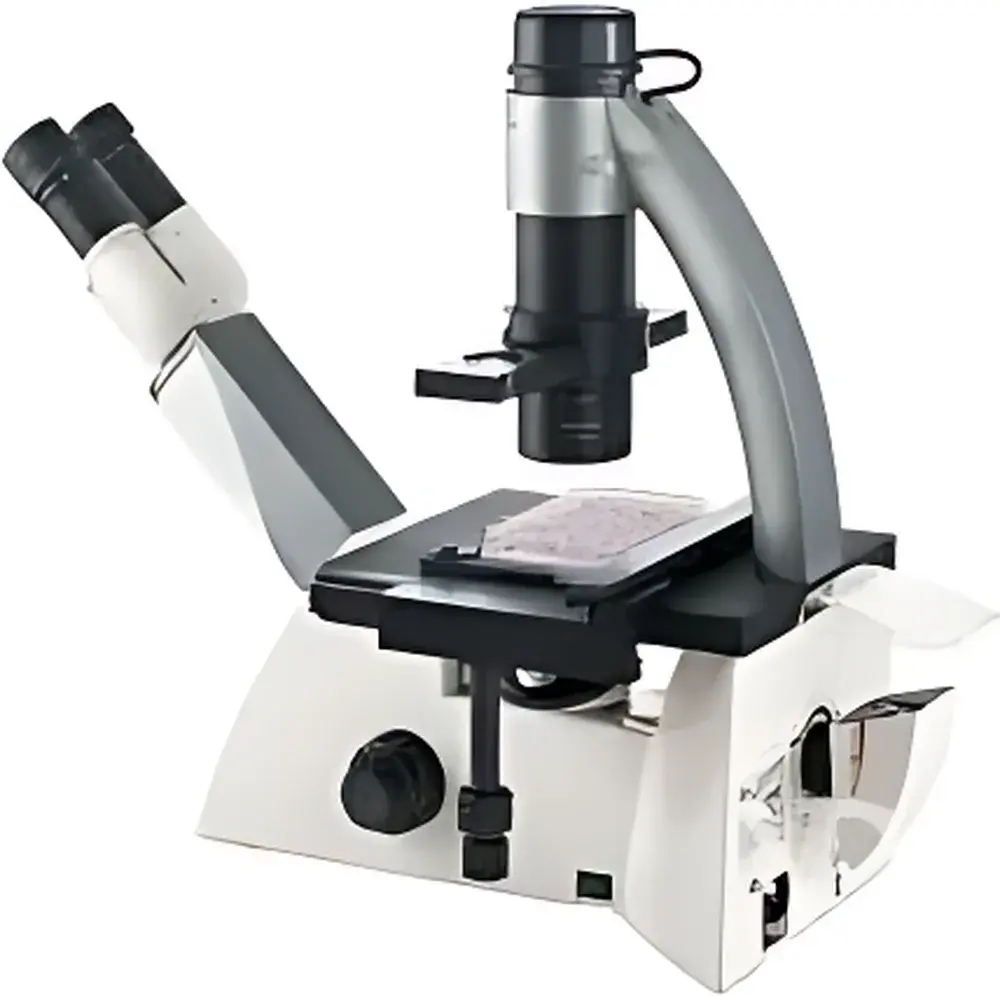
Leica DMi1 Inverted Biological Microscope
| Brand | Leica |
|---|---|
| Origin | Germany |
| Model | DMi1 |
| Type | Inverted Microscope |
| Illumination | 5 W LED with Constant Color Temperature (5600 K) |
| Working Distance Options | 40–50 mm (S40 Condenser) or 80 mm (S80 Condenser) |
| Phase Contrast Compatibility | PH1 Annulus for 10×, 20×, and 40× Objective Lenses |
| Camera Options | Integrated 2.5 MP or 5 MP HDMI Camera with SD Card Storage |
| Compliance | Designed for GLP/GMP-aligned workflows |
Overview
The Leica DMi1 is a purpose-engineered inverted biological microscope optimized for routine live-cell observation, cell culture monitoring, and basic in vitro imaging applications in academic, clinical, and industrial life science laboratories. Its optical architecture follows classical inverted design principles—objective lenses positioned beneath the specimen stage, while illumination and condenser systems reside above—enabling unobstructed access to culture vessels including Petri dishes, multi-well plates, and T-flasks. The system employs high-transmission achromatic-achromat objectives with anti-reflection coatings to deliver high-contrast, color-balanced phase contrast (PH1) and brightfield imagery across 10×, 20×, and 40× magnifications. Unlike conventional setups requiring manual annulus alignment per objective, the DMi1 integrates a fixed PH1 phase ring compatible with all three phase contrast objectives—eliminating mechanical recalibration and reducing user-induced variability. Its solid, low-center-of-gravity chassis—constructed primarily from precision-machined aluminum and stainless steel—minimizes micro-vibrational artifacts during extended observation sessions, supporting reproducible morphological assessment over time.
Key Features
- Intelligent light intensity sensor embedded directly in the phase contrast slider—automatically adjusts LED output when switching between brightfield and phase contrast modes, ensuring consistent photometric exposure and reducing eye fatigue.
- Dual-condenser modularity: S40 condenser (40–50 mm working distance) provides optimal clearance for standard culture dishes and 96-well plates; S80 condenser (80 mm working distance) accommodates taller flasks and bioreactor-compatible vessels—interchangeable without disassembly of the illumination arm.
- Energy-efficient 5 W LED illumination with stable 5600 K color temperature across full intensity range; eliminates warm-up delays, bulb degradation, and thermal drift—critical for maintaining focus stability during long-term live-cell imaging.
- Integrated camera variants (2.5 MP or 5 MP) mounted on the rear port—enabling direct HDMI output to monitors, SD card-based image/video capture without PC dependency, and remote-triggered acquisition via handheld controller.
- Ergonomic, tool-free stage adjustments with anti-scratch ceramic-coated mechanical stage; modular accessory rail system supports standardized sample holders for flasks, dishes, and multi-well formats.
Sample Compatibility & Compliance
The DMi1 is validated for use with standard ANSI/SLAS-compliant cell culture consumables—including polystyrene and glass-bottom dishes (e.g., MatTek, Ibidi), 6–96-well plates, and vented or non-vented T-flasks up to 225 cm² surface area. Its adjustable condenser height and lateral centering mechanism ensure Köhler illumination alignment across variable vessel thicknesses (0.15–2.0 mm). While not certified as medical device hardware under ISO 13485, the instrument’s mechanical robustness, traceable optical calibration paths, and compatibility with Leica’s LAS software suite support documentation practices aligned with GLP (Good Laboratory Practice) and foundational GMP (Good Manufacturing Practice) requirements. Optional LAS Core software provides timestamped image metadata, measurement annotations, and export formats compliant with internal lab SOPs.
Software & Data Management
The integrated camera variant includes embedded firmware for lossless JPEG/H.264 encoding, real-time HDMI streaming, and autonomous SDHC/SDXC storage (up to 128 GB). For post-acquisition analysis, the bundled LAS Core software (Windows-compatible) delivers calibrated linear measurements, region-of-interest annotation, basic histogram analysis, and batch export to TIFF/PNG/AVI. LAS Core supports audit trail generation—including operator ID, acquisition timestamp, objective/condenser configuration, and exposure parameters—facilitating traceability in regulated environments. No cloud connectivity or proprietary subscription model is required; all processing occurs locally, preserving data sovereignty.
Applications
- Routine confluence assessment and morphology screening in adherent mammalian cell lines (e.g., HEK293, HeLa, CHO).
- Quality control of primary cell isolates and stem cell cultures prior to passaging or differentiation induction.
- Time-lapse documentation of wound-healing assays, migration studies, or drug-response kinetics in multi-well plate formats.
- Teaching laboratory instruction—HDMI output enables real-time projection for classroom demonstration without intermediate computing hardware.
- Pre-screening of transfection efficiency or reporter gene expression prior to high-resolution confocal or super-resolution follow-up.
FAQ
Does the DMi1 support fluorescence imaging?
No—the DMi1 is configured exclusively for transmitted-light modalities (brightfield and phase contrast). It lacks excitation filters, dichroic mirrors, or high-sensitivity detectors required for epifluorescence or epi-illumination applications.
Can third-party cameras be attached to the DMi1?
Yes—via the standard C-mount port located at the trinocular port position. However, native HDMI/SD functionality and remote triggering are exclusive to Leica’s integrated camera modules.
Is the LED illumination intensity programmable or stepless?
Intensity is continuously adjustable via rotary dial with 100 discrete steps; output remains spectrally stable (±50 K CCT deviation) across the entire dimming range.
What is the expected lifetime of the LED module under typical lab usage?
Rated for ≥50,000 hours at nominal output—equivalent to ~20 years assuming 40 hours/week operation—without measurable lumen depreciation or spectral shift.
Does the DMi1 meet any international safety or EMC standards?
Yes—it complies with IEC 61010-1 (Safety Requirements for Electrical Equipment for Measurement, Control, and Laboratory Use) and IEC 61326-1 (EMC Requirements for Laboratory Equipment). Declaration of Conformity is provided with each unit shipped from Leica Microsystems’ German manufacturing facility.
Related Products




