
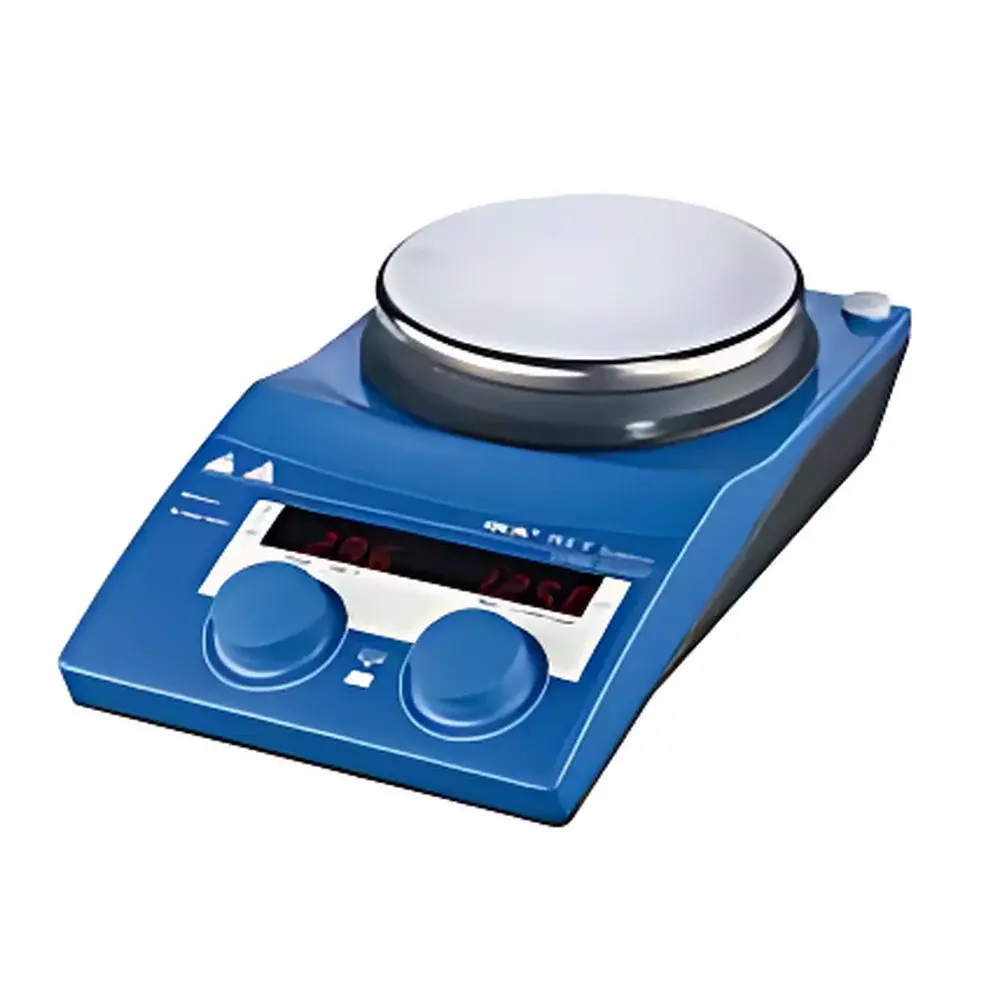
IKA RET Basic Magnetic Hotplate Stirrer
| Brand | IKA |
|---|---|
| Origin | Germany |
| Model | RET Basic |
| Stirrer Type | Magnetic Hotplate Stirrer |
| Max. Stirring Volume (H₂O) | 20 L |
| Speed Range | 0/50–1700 rpm |
| Heating Temperature Range | Ambient to 340 °C |
| Heating Power | 600 W |
| Plate Material | Stainless Steel 1.4301 (AISI 304) |
| Plate Diameter | 135 mm |
| Dimensions (W × D × H) | 160 × 95 × 270 mm |
| Weight | 2.5 kg |
| Protection Class | IP42 (DIN EN 60529) |
| Input Voltage | 220–230 V / 115 V / 100 V, 50/60 Hz |
| Total Input Power | 630 W |
| Motor Output Power | 9 W |
| Motor Input Power | 16 W |
| Max. Stir Bar Length | 80 mm |
| Temp. Control Accuracy (with PT1000 sensor) | ±1 K |
| Medium Temp. Stability | ±1 K |
| Adjustable Safety Temp. Limit | 50–360 °C |
| External Sensor Interface | PT1000 |
| Display | LED (speed & temp.) |
| Speed Control | Continuously Variable |
| Heating Rate | ~7 K/min (in 1 L H₂O, H15 vessel) |
| Operating Ambient | 5–40 °C, ≤80% RH |
Overview
The IKA RET Basic Magnetic Hotplate Stirrer is an entry-level yet robust benchtop instrument engineered for reliable heating and magnetic stirring of laboratory samples in glass or stainless-steel vessels. Designed around Couette flow principles, it employs a rotating magnetic field generated by a permanent magnet rotor beneath a thermally stable stainless-steel plate to drive PTFE- or glass-coated stir bars within the sample container. Its integrated resistive heating element enables precise thermal control up to 340 °C—suitable for solvent reflux, dissolution testing, polymerization initiation, and high-temperature reaction monitoring. The unit complies with DIN EN 60529 (IP42 ingress protection), ensuring resistance to splashes and particulate ingress during routine lab use. As a CE-marked device manufactured under IKA’s German quality system, it meets essential requirements of the EU Low Voltage Directive (2014/35/EU) and Electromagnetic Compatibility Directive (2014/30/EU).
Key Features
- Stainless-steel heating plate (material 1.4301/AISI 304) with 135 mm diameter for uniform heat distribution and corrosion resistance
- Continuously variable speed control (0/50–1700 rpm) with LED digital display for real-time monitoring of rotational velocity
- Independent LED temperature display and analog dial-based heating control, supporting operation without external sensors
- Dual-stage safety architecture: fixed low-limit (50 °C) and user-adjustable high-limit (50–360 °C) thermal cutoffs prevent overheating and vessel failure
- PT1000-compatible external temperature sensor interface enables closed-loop feedback control for enhanced thermal reproducibility (±1 K accuracy)
- Compact footprint (160 × 95 × 270 mm) and lightweight design (2.5 kg) facilitate integration into fume hoods, gloveboxes, or shared instrumentation benches
- 600 W heating power delivers rapid ramp rates (~7 K/min in 1 L water using standard H15 beaker), reducing experimental cycle time
Sample Compatibility & Compliance
The RET Basic accommodates standard laboratory glassware—including beakers (up to 20 L capacity), Erlenmeyer flasks, and round-bottom flasks—provided appropriate stir bar geometry (max. 80 mm length) and viscosity range are observed. It supports non-reactive media (aqueous, organic, and mildly acidic/basic solutions) but is not rated for explosive, highly corrosive (e.g., HF, fuming HNO₃), or vacuum applications. The unit conforms to GLP-relevant operational traceability standards through its dual-display interface and mechanical safety cutoffs. While it lacks RS232 or analog output for automated data logging, its thermal and rotational stability meets typical QC/QA criteria for ASTM E2912 (Standard Practice for Thermal Stability Testing) and USP environmental support workflows.
Software & Data Management
The IKA RET Basic operates as a standalone analog-digital hybrid instrument with no embedded firmware, network connectivity, or proprietary software dependency. All operational parameters—speed setpoint, heating setpoint, and safety limits—are adjusted manually via front-panel dials and confirmed via independent LED readouts. This architecture eliminates cybersecurity risks, firmware update dependencies, or validation overhead associated with computer-linked systems. For laboratories requiring audit-ready records, manual logbook entries synchronized with timer-controlled experiments remain the recommended practice. No FDA 21 CFR Part 11 compliance features are included, consistent with its classification as a general-purpose utility device rather than a regulated analytical instrument.
Applications
- Preparative chemistry: Homogenization of reagent mixtures prior to titration or spectroscopic analysis
- Materials science: Dispersion of nanoparticles in polymer melts or solvent systems at elevated temperatures
- Pharmaceutical QA: Dissolution medium conditioning per USP , including temperature equilibration of 900 mL buffers
- Environmental testing: Extraction of analytes from solid matrices using heated solvent agitation (e.g., Soxhlet pre-conditioning)
- Education labs: Demonstration of Arrhenius kinetics, viscosity–temperature relationships, and heat transfer fundamentals
- Food & beverage R&D: Controlled heating and mixing of emulsions, sauces, or dairy model systems
FAQ
Does the RET Basic support external temperature feedback control?
Yes—it features a dedicated PT1000 sensor input enabling closed-loop temperature regulation with ±1 K accuracy when paired with a compatible probe.
What is the maximum recommended viscosity for stable stirring at 1700 rpm?
For optimal performance and motor longevity, continuous operation above 1000 rpm is advised only for low-to-medium viscosity liquids (< 500 mPa·s); higher viscosities require reduced speeds and larger stir bars.
Can the unit be used inside a nitrogen-purged glovebox?
Yes—the absence of active cooling fans, sealed electronics housing, and IP42 rating permit safe operation in inert-atmosphere enclosures, provided voltage compatibility (100/115/230 V) is verified.
Is the heating plate surface resistant to strong acids like concentrated HCl or H₂SO₄?
The 1.4301 stainless steel plate offers good resistance to dilute mineral acids but is not suitable for prolonged exposure to hot, concentrated oxidizing acids; use ceramic-coated plates or alternative heater types for such applications.
How frequently should the unit undergo preventive maintenance?
No scheduled maintenance is required; however, periodic visual inspection of the plate surface for scratches or residue buildup—and cleaning with ethanol or mild detergent—is recommended to preserve thermal efficiency and stir bar traction.



