
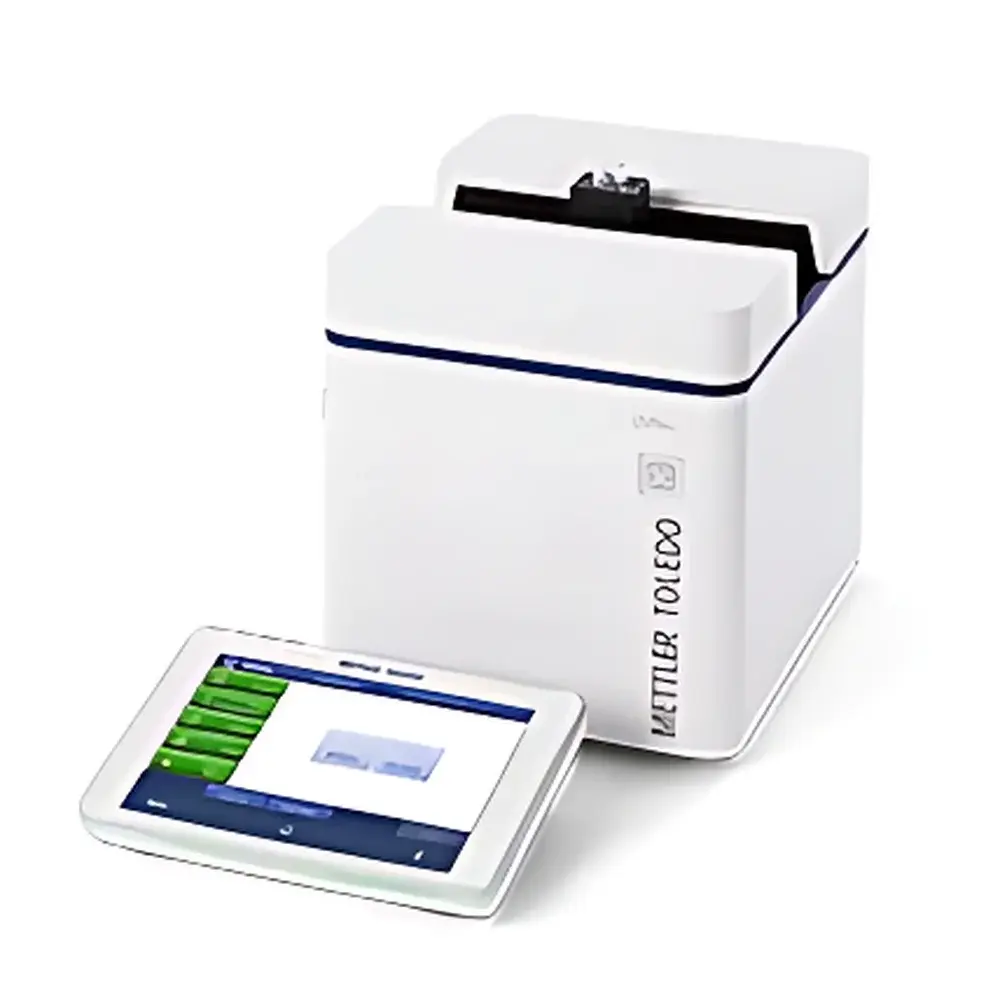
METTLER TOLEDO UV5 Ultraviolet-Visible Spectrophotometer
| Brand | METTLER TOLEDO |
|---|---|
| Origin | Switzerland |
| Manufacturer Type | Authorized Distributor |
| Import Status | Imported |
| Model | UV5 |
| Wavelength Range | 190–1100 nm |
| Detector Type | CCD (Charge-Coupled Device) |
| Optical Design | Dual-Wavelength |
| Wavelength Accuracy | ±1.0 nm |
| Measurement Speed | Full-spectrum scan in <1 second |
| Light Source | Xenon flash lamp |
| Warm-up Time | Zero |
| Automation Level | Fully automated wavelength selection and measurement execution |
| Sample Compartment | Open-access, motor-free design |
| Software Platform | LabX UV-Vis PC software (21 CFR Part 11 / EU Annex 11 compliant) |
Overview
The METTLER TOLEDO UV5 Ultraviolet-Visible Spectrophotometer is an engineered solution for routine and research-grade quantitative and qualitative analysis across pharmaceutical, chemical, food & beverage, and academic laboratories. Based on single-beam optical architecture with a high-intensity pulsed xenon lamp and CCD linear array detector, the UV5 delivers full-spectrum acquisition (190–1100 nm) in under one second—eliminating thermal drift and enabling true “measure-on-demand” operation without pre-warmup. Its dual-wavelength capability supports simultaneous monitoring at two user-defined wavelengths, facilitating kinetic assays, ratio-based quantitation (e.g., protein A260/A280), and reference-compensated measurements. The absence of moving optical components—no monochromator slits, no scanning gratings—enhances long-term photometric stability and mechanical robustness, aligning with ISO 17025 requirements for instrument reliability in accredited testing environments.
Key Features
- Zero warm-up operation: Xenon flash lamp provides instant spectral output; no stabilization delay required before measurement.
- Open-access sample compartment with tactile feedback and position-sensing lid detection to prevent erroneous measurements due to incomplete closure.
- One Click™ workflow interface: Preconfigured method shortcuts on the instrument’s touchscreen enable direct execution of common tasks (e.g., concentration, % transmittance, kinetics) without software navigation.
- Modular hardware design: Compact footprint (~A4 size) accommodates benchtop integration; optional accessories—including cuvette changers, micro-volume stands, and fiber-optic probes—are tool-free attachable and detachable.
- Standalone or networked operation: Functions independently via built-in OS and touchscreen; alternatively, integrates seamlessly with LabX UV-Vis software for centralized data management, audit trail generation, and electronic signature support.
- High photometric accuracy: Certified performance per ISO 6223 and ASTM E275, with absorbance accuracy ±0.01 A (using K2Cr2O7 standard) and stray light <2% at 198 nm (KCl filter).
Sample Compatibility & Compliance
The UV5 accepts standard 10-mm pathlength cuvettes (glass, quartz, plastic), as well as micro-volume adapters (0.5–2 µL) and flow cells for continuous monitoring. Its open sampling geometry minimizes handling errors and supports rapid throughput in QC labs processing hundreds of samples daily. Regulatory compliance is embedded at the system level: LabX UV-Vis software satisfies FDA 21 CFR Part 11 and EU Annex 11 requirements for electronic records and signatures—including role-based access control, immutable audit trails, and full traceability of method parameters, raw spectra, and processed results. Instrument firmware adheres to IEC 61010-1 for electrical safety and EN 61326-1 for electromagnetic compatibility in laboratory environments.
Software & Data Management
LabX UV-Vis software extends the UV5’s capabilities beyond basic spectrophotometry. Its graphical method editor supports multi-step workflows with conditional logic, custom calculations (e.g., molar absorptivity derivation, enzyme activity units), and automated report generation (PDF, CSV, Excel). All data—including raw intensity values, baseline-corrected spectra, and metadata (operator ID, timestamp, instrument serial number)—are stored in a secure, relational LabX database. Network deployment enables cross-instrument data aggregation, trend analysis over time, and remote validation of calibration status. Electronic signatures are enforced during critical actions (e.g., method approval, result release), fulfilling GLP and GMP documentation standards.
Applications
- Pharmaceutical QA/QC: Assay of active pharmaceutical ingredients (APIs), excipient identification, dissolution testing, and cleaning validation (residue detection at low µg/mL levels).
- Life sciences: Nucleic acid and protein quantification, enzyme kinetics (e.g., LDH, ALP), cell culture density monitoring (OD600), and ligand-binding studies.
- Chemical R&D: Reaction progress tracking, purity assessment via spectral deconvolution, and solvent compatibility screening.
- Food & agriculture: Colorimetric analysis (e.g., anthocyanins, chlorophyll), nitrate/nitrite determination, and antioxidant capacity (FRAP, DPPH assays).
- Environmental testing: Quantification of heavy metals (via complexometric colorimetry), COD/BOD surrogate measurements, and water quality indices.
FAQ
Does the UV5 require daily wavelength calibration?
No. The xenon lamp and fixed-grating CCD configuration provide inherent wavelength stability; periodic verification using holmium oxide or didymium filters is recommended per ISO/IEC 17025 internal calibration schedules—not daily recalibration.
Can the UV5 be used for kinetic measurements?
Yes. Its sub-second spectral acquisition enables high-temporal-resolution kinetic profiling (e.g., enzyme catalysis, photochemical reactions) with customizable time intervals and automatic curve fitting in LabX.
Is method transfer between UV5 and UV7 instruments possible?
Yes. LabX methods are platform-agnostic; identical protocols—including wavelength sets, slit functions, and calculation templates—execute consistently across UV5, UV7, and UV5Bio models.
What validation documentation is provided with the instrument?
Each UV5 ships with a Factory Acceptance Test (FAT) report, IQ/OQ documentation templates aligned with ASTM E2500, and a Certificate of Conformance to ISO 9001 and CE marking requirements.
How is data integrity ensured during offline operation?
All measurements performed standalone are timestamped, assigned unique IDs, and cached locally; upon reconnection to LabX, data syncs automatically with full audit trail preservation—including operator context and environmental metadata.





