
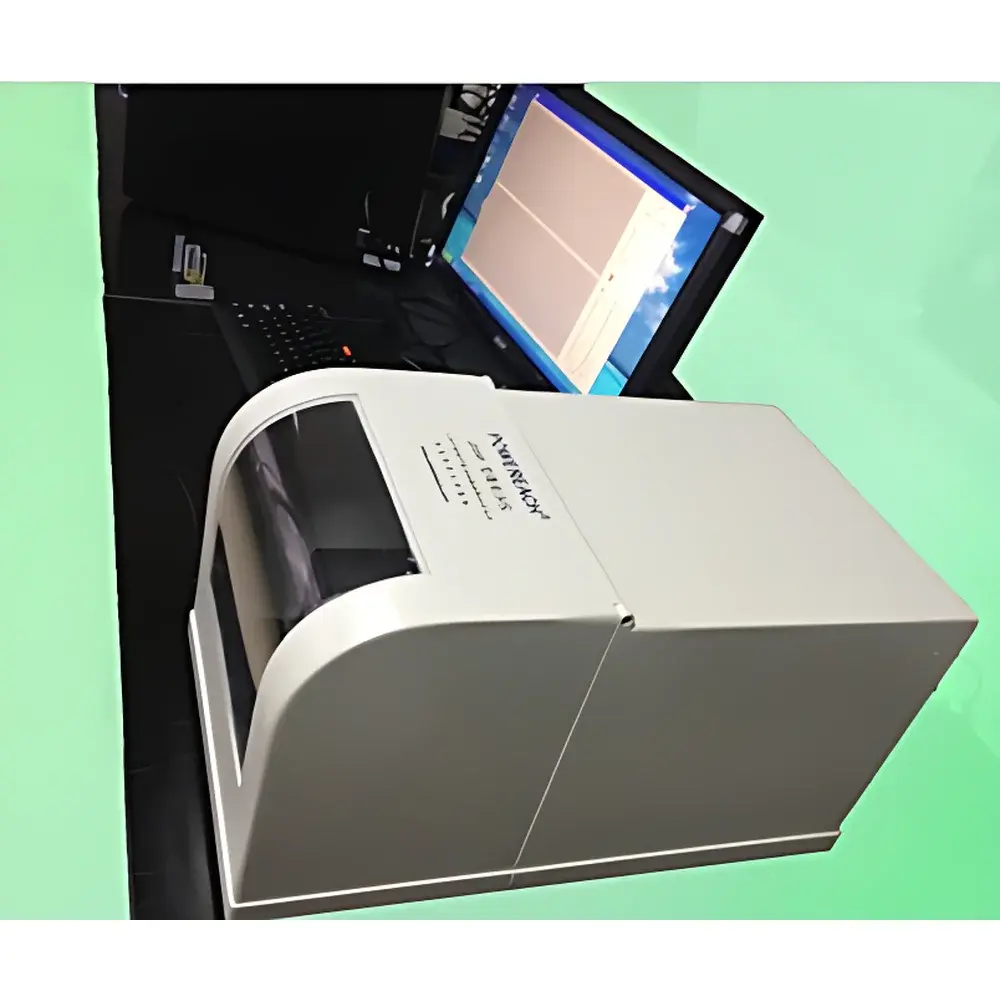
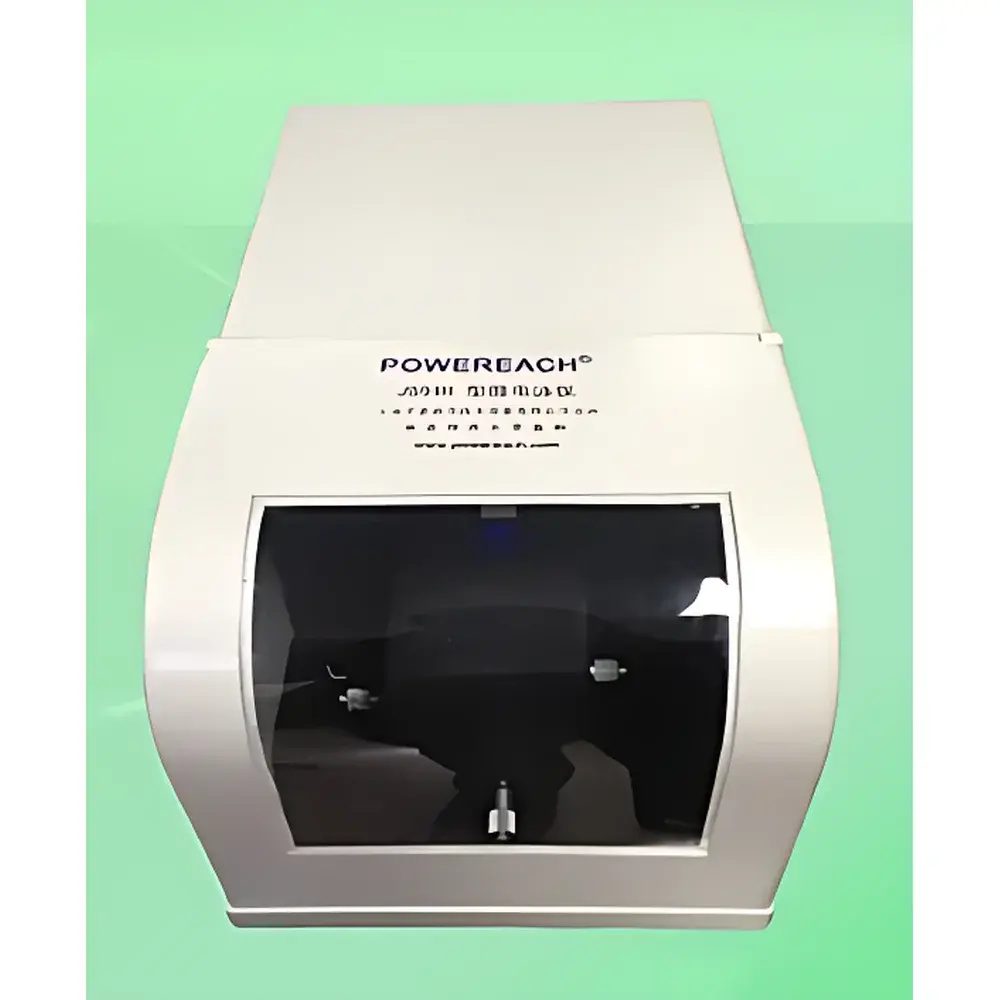
Zeta Potential Analyzer JS94H2M
| Brand | ZYKX |
|---|---|
| Origin | Beijing, China |
| Model | JS94H2M |
| Zeta Potential Range | ±3000 mV |
| Measurement Accuracy | ±5% |
| pH Range | 0.00–14.00 |
| pH Resolution | 0.1 pH |
| Zeta Resolution | 1 mV |
| Temperature Range | −5.0 to 105.0 °C (Accuracy: ±0.1 °C) |
| Optional Thermostatic Platform | −10 to 95 °C |
| Sample Volume per Test | 0.5 mL |
| Optical System | Semiconductor-based blue/green LED illumination (low-power, non-thermal) |
| Magnification | 1200× |
| Electrophoretic Cell | Integrated Ag/Pt/Ti electrodes in 0.5 cm-thick precision glass cuvette |
| Voltage Polarity Switching Time | 0.30–1.20 s (adjustable) |
| Sampling Duration | 3–10 s |
| Power Supply | 220 V, 50 Hz, 150 W |
Overview
The ZYKX JS94H2M Zeta Potential Analyzer is a laboratory-grade microelectrophoresis instrument engineered for precise determination of electrophoretic mobility and surface charge potential (ζ-potential) at solid–liquid and liquid–liquid interfaces. It operates on the principle of laser Doppler electrophoresis combined with high-magnification optical tracking of particle motion under controlled electric fields. By measuring the velocity of dispersed particles or droplets migrating in an applied DC field—and correcting for medium viscosity, dielectric constant, and temperature—the system calculates ζ-potential using the Smoluchowski or Henry equation, depending on particle size and medium conductivity. This enables rigorous quantification of colloidal stability, surface functionalization efficiency, and interfacial reactivity across aqueous and non-aqueous dispersions. Designed for research-grade reproducibility, the JS94H2M supports fundamental studies in colloid science, formulation development, and quality control in regulated environments.
Key Features
- Integrated electrophoretic cell with embedded Ag/Pt/Ti alloy electrodes housed in a 0.5 mm-thick borosilicate glass cuvette—optimized via computational microfluidic modeling to minimize edge effects and electro-osmotic flow.
- Low-power semiconductor optical system employing dual-wavelength (blue/green) LED illumination (tens of µW output), eliminating thermal drift and enabling stable imaging of submicron particles without photobleaching or convection artifacts.
- Real-time, computer-controlled image capture at 1200× magnification; four synchronized grayscale frames (two forward, two reverse polarity) acquired within 3–10 seconds for robust velocity vector calculation.
- Precision temperature monitoring via integrated Pt100 probe; automatic compensation of electrophoretic mobility for dynamic viscosity and dielectric permittivity changes across −5.0 to 105.0 °C.
- Adjustable voltage polarity switching (0.30–1.20 s intervals) with programmable amplitude to suppress electrode polarization while maintaining measurement speed and signal-to-noise ratio.
- Optical alignment assisted by calibrated crosshair target and motorized XYZ stage—ensuring accurate focal plane positioning and eliminating stationary layer uncertainty inherent in conventional capillary cells.
Sample Compatibility & Compliance
The JS94H2M accommodates particulate dispersions and emulsion droplets ranging from 0.5 µm to 50 µm in diameter, compatible with both polar (water, ethanol, glycerol/water mixtures) and non-polar media (toluene, xylene, silicone oils). Its design conforms to standard operational practices referenced in ISO 13099-2:2012 (Colloidal systems — Methods for zeta-potential determination — Part 2: Optical methods) and ASTM D7826-17 (Standard Guide for Zeta Potential Measurement of Nanoparticles in Aqueous Media). While not pre-certified for regulatory submissions, the instrument’s data acquisition architecture supports audit-trail-ready workflows when integrated with validated LIMS or ELN platforms compliant with FDA 21 CFR Part 11 requirements.
Software & Data Management
Bundled Windows-native software provides full instrument control, real-time visualization of electrophoretic motion, and automated ζ-potential computation using user-selectable theoretical models (Smoluchowski for high-conductivity media; Henry with adjustable f(κa) for low-ionic-strength or nanoscale systems). Raw image sequences, temperature logs, voltage profiles, and calculated mobility histograms are stored in HDF5 format with embedded metadata (timestamp, operator ID, sample ID, calibration checksums). Export options include CSV, PDF reports, and XML-compatible structured data for downstream statistical analysis or integration into QbD frameworks. The software supports GLP-aligned features including electronic signatures, version-controlled method templates, and change history logging.
Applications
- Formulation optimization in pharmaceutical colloids (liposomes, polymeric nanoparticles) and cosmetic emulsions (O/W, W/O, microemulsions).
- Surface charge characterization during silanization, polymer grafting, or surfactant adsorption on mineral fillers in papermaking, ceramics, and construction materials.
- Stability assessment of environmental colloids (clays, humic aggregates, engineered nanomaterials) under varying pH and ionic strength conditions.
- Teaching laboratories for undergraduate and graduate courses in physical chemistry, colloid and interface science, and materials engineering.
- Quality assurance of catalyst supports, pigment dispersions, and battery slurry components where interfacial charge governs rheology and electrode kinetics.
FAQ
What dispersion media are supported?
Aqueous buffers, organic solvents (e.g., ethanol, acetone, THF), and mixed-phase systems—including low-dielectric oils—provided conductivity remains within measurable range (typically 10−5 to 10−1 S/m). Viscosity up to 200 cP is accommodated with appropriate calibration.
Is the instrument suitable for GMP-regulated environments?
While the hardware and firmware do not carry formal GMP certification, its deterministic measurement protocol, traceable calibration routines, and software audit trail capabilities enable qualification per ICH Q5C and USP guidelines when deployed within a validated analytical procedure.
Can it measure zeta potential of biological cells or vesicles?
Yes—within the 0.5–50 µm size range and assuming sufficient optical contrast and electrophoretic mobility. Requires isotonic, low-conductivity buffers to avoid Joule heating and membrane damage; recommended operating field strength ≤ 5 V/cm.
How is electrode fouling mitigated?
Electrodes are fabricated from corrosion-resistant Ag/Pt/Ti alloys and undergo passivation treatment. Automatic polarity reversal and short-duration voltage pulses minimize deposition. Routine cleaning with dilute HNO3 followed by ultrasonic rinsing restores baseline performance.
Does the system require external vibration isolation?
Yes—optimal performance requires placement on a passive air-damped optical table or active vibration isolation platform, particularly for sub-1 µm particles where Brownian motion dominates signal detection.



