
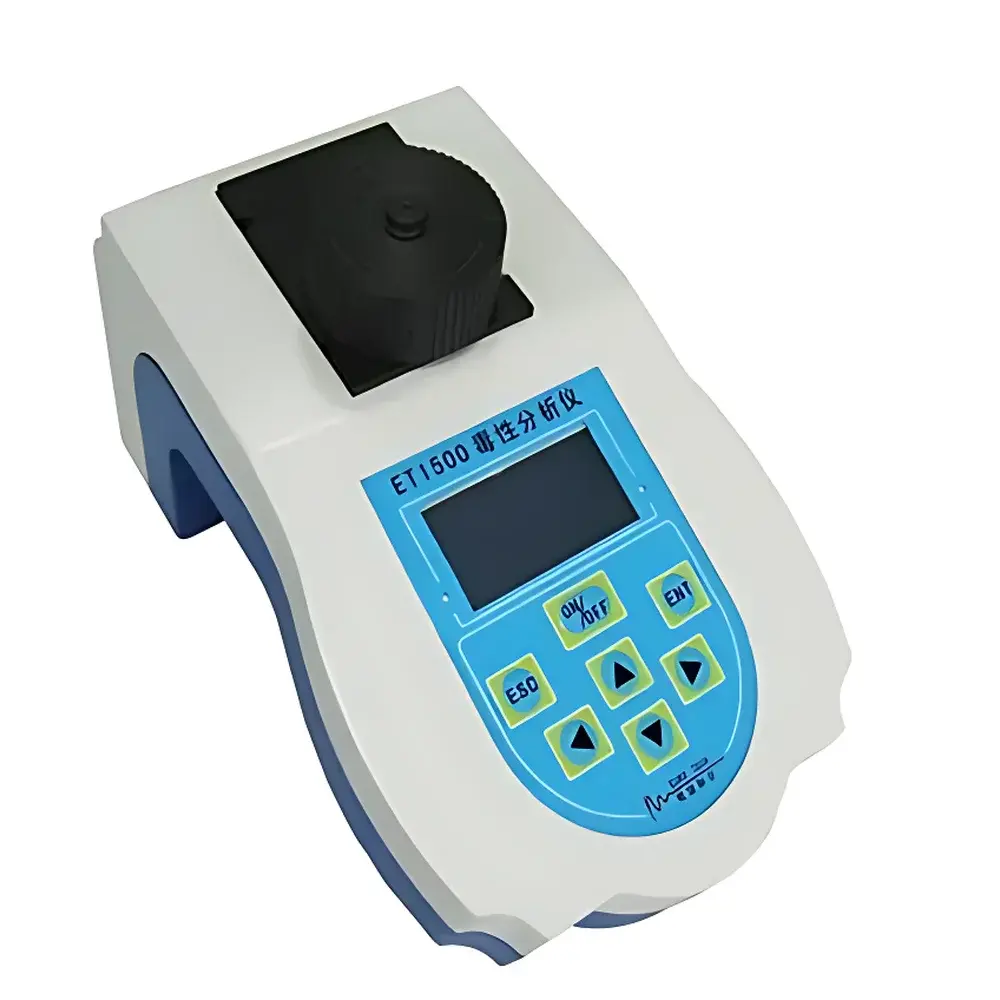
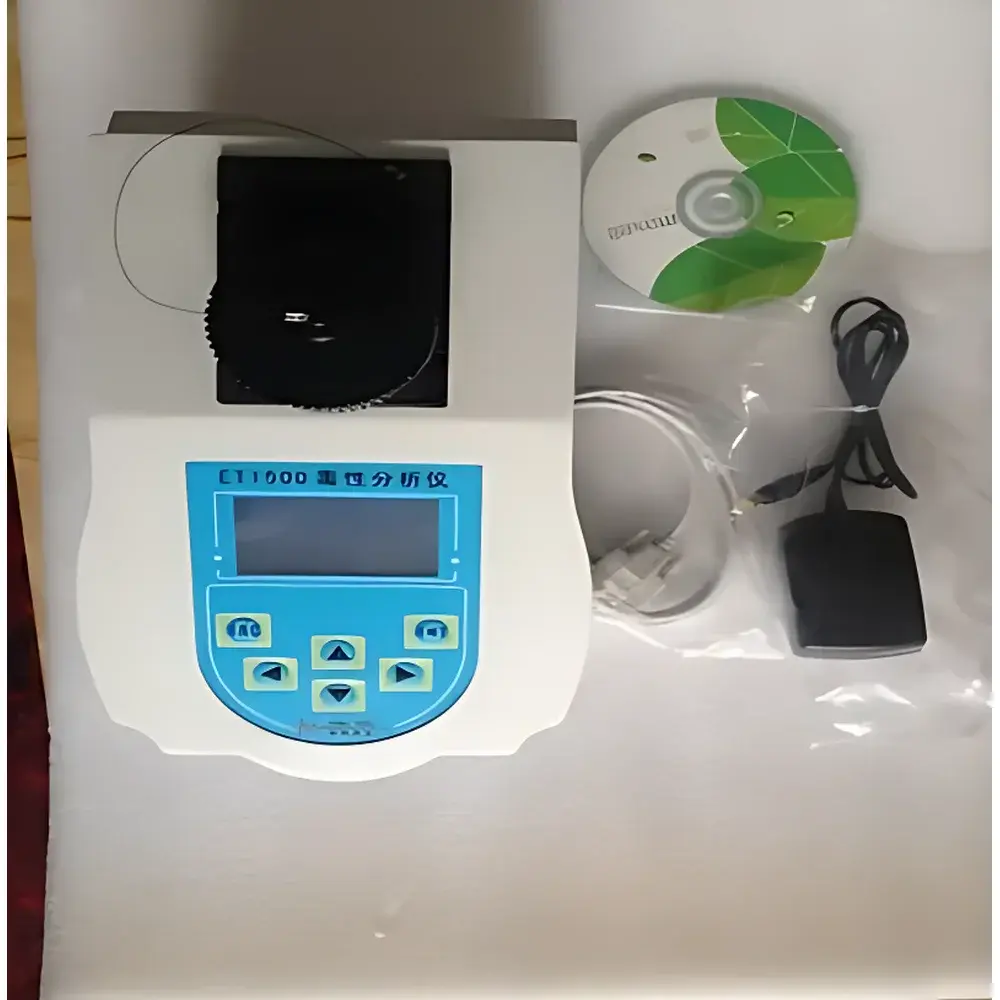
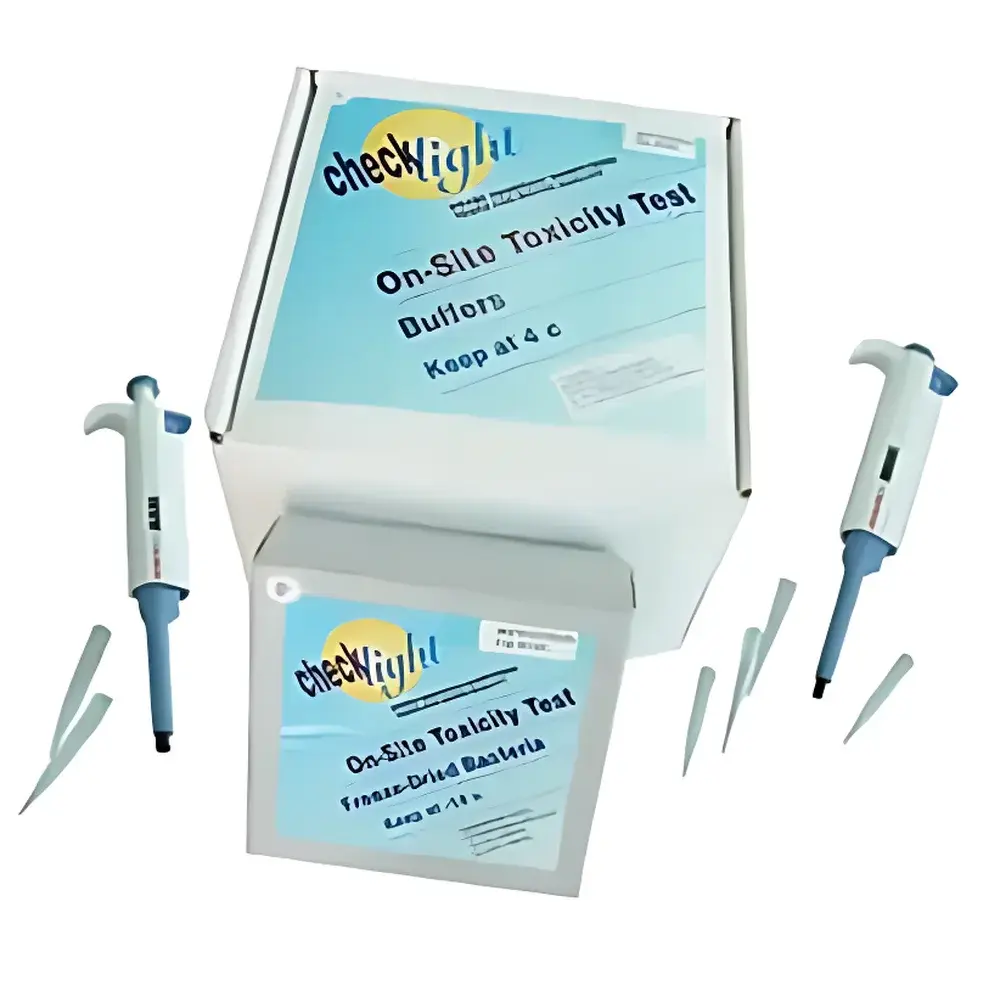
PTB-1500 Portable Bioluminescent Toxicity Analyzer
| Origin | Beijing, China |
|---|---|
| Manufacturer Type | Authorized Distributor |
| Origin Category | Domestic (PRC) |
| Model | PTB-1500 |
| Instrument Type | Portable |
| Biological Indicator | *Aliivibrio fischeri* (lyophilized bioluminescent bacteria) |
| Dynamic Range | ≥10⁶ |
| Sample Tube Dimensions | Ø12 mm × 47–75 mm |
| Communication Interface | RS-232C |
| Measurement Duration | 0–99 s (1 s increments) |
| Data Storage Capacity | ≥2,000 test records |
| Operating Temperature | 15–40 °C |
| Display | Backlit LCD |
| Power Supply | AC 220 V ±10%, 50 Hz, 35 W |
| Rechargeable Battery | 3.7 V, 5000 mAh Li-ion |
| Operating Humidity | 10–90% RH (non-condensing) |
| Dimensions (L×W×H) | 320 × 170 × 180 mm |
| Weight | 2.0 kg (including battery) |
| Reagent Shelf Life | Up to 7 days post-reconstitution at 4 °C |
Overview
The PTB-1500 Portable Bioluminescent Toxicity Analyzer is an engineered field-deployable instrument designed for rapid, on-site assessment of acute aquatic toxicity using standardized bioluminescent bacterial bioassays. It operates on the principle of *Aliivibrio fischeri* (formerly *Vibrio fischeri*) metabolic inhibition: viable, freeze-dried bacteria emit stable bioluminescence during cellular respiration; exposure to toxicants—including heavy metals (e.g., Cu²⁺, Cd²⁺, Hg²⁺), organic pollutants (e.g., phenols, pesticides, PAHs), and microbial toxins—disrupt electron transport and ATP synthesis, resulting in quantifiable luminescence suppression. The degree of signal reduction, measured in relative light units (RLU), correlates with toxicant concentration and is expressed as % inhibition or EC₅₀ values. This method conforms to internationally recognized protocols including ISO 11348-3 (2022), DIN 38412-L33, and EPA Method 100.1, enabling regulatory-compliant screening for emergency response, routine water quality surveillance, and pre-discharge verification.
Key Features
- Field-rugged design optimized for ambient environmental conditions: operational across 15–40 °C and 10–90% RH (non-condensing), with no requirement for climate-controlled labs or external gas supplies.
- Integrated high-sensitivity photomultiplier tube (PMT) detector with low-noise amplification circuitry, calibrated against NIST-traceable luminance standards to ensure inter-laboratory reproducibility.
- Dual-buffer assay capability: simultaneous use of heavy metal-specific and organic compound-specific buffering reagents enables preliminary toxicant class discrimination—supporting triage decisions without chromatographic confirmation.
- Onboard data logging with timestamped storage of ≥2,000 complete test records, including raw RLU values, inhibition percentages, dilution factors, and user-defined sample IDs.
- Intuitive Chinese-language interface with contextual help prompts and guided workflow navigation—reducing operator training time while maintaining full compliance with GLP documentation requirements.
- Extended field autonomy: rechargeable 3.7 V / 5000 mAh lithium-ion battery supports ≥8 hours of continuous operation (including measurement, display, and data transfer), with hot-swappable capability.
Sample Compatibility & Compliance
The PTB-1500 accepts liquid samples directly—raw surface water, treated drinking water, wastewater influent/effluent, leachates, and food extract supernatants—without filtration or pretreatment when turbidity remains below 50 NTU. For highly colored or particulate-laden matrices, optional centrifugation (≤3,000 × g, 5 min) or membrane filtration (0.45 µm PVDF) is recommended prior to analysis. All assays comply with ISO/IEC 17025:2017 general requirements for competence of testing laboratories. Reagent kits meet ISO 11348-3 specifications for lyophilized *A. fischeri*, including mandatory viability validation (≥80% luminescence recovery post-reconstitution) and batch-specific inhibition control charts. Instrument firmware supports audit trail generation per FDA 21 CFR Part 11 requirements when connected to compliant LIMS via RS-232C.
Software & Data Management
Data export is supported via RS-232C serial interface to Windows-based desktop software (included), enabling automated report generation in PDF or CSV formats. Software modules include dose–response curve fitting (logistic 4-parameter model), statistical outlier detection (Grubbs’ test), and batch calibration tracking. All measurement sessions are time-stamped and user-logged; electronic signatures may be applied for QA/QC sign-off. Raw RLU data and processed inhibition values are stored in encrypted binary format to prevent tampering. Firmware updates are delivered via secure HTTPS download and verified using SHA-256 checksums.
Applications
- Rapid response to accidental or intentional contamination events in municipal water distribution networks and source waters.
- Real-time monitoring of influent and effluent toxicity at wastewater treatment plants to assess biological treatment efficacy and detect shock loads.
- Screening of industrial discharge permits under national emission standards (e.g., China’s GB 8978-1996, EU WFD Annex X).
- Validation of advanced oxidation process (AOP) or activated carbon adsorption performance by tracking residual toxicity reduction.
- Food safety labs conducting rapid screening of beverage extracts, seafood homogenates, or agricultural runoff for non-target toxicants.
- Academic and regulatory research requiring standardized, low-cost, high-throughput ecotoxicological endpoints aligned with OECD TG 201 and ISO 6341.
FAQ
What bacterial strain is used in the PTB-1500 assay?
The system employs freeze-dried *Aliivibrio fischeri* NRRL B-11177, cultured and lyophilized under ISO 11348-3–compliant conditions to ensure consistent light output and sensitivity.
Can the instrument differentiate between heavy metals and organic toxicants?
Yes—by performing parallel assays with heavy metal buffer (e.g., EDTA-amended) and organic buffer (e.g., humic acid–stabilized), differential inhibition profiles allow preliminary classification of dominant toxicant classes.
How long can reconstituted bacteria remain viable?
When stored at 4 °C in dark conditions, reconstituted bacterial suspension maintains ≥70% baseline luminescence for up to 168 hours (7 days), validated per ISO 11348-3 Annex B.
Is calibration required before each use?
No daily calibration is needed; however, a positive control (copper sulfate standard) must be run at least once per testing session to verify assay responsiveness and instrument stability.
Does the PTB-1500 support regulatory reporting?
Yes—data files include full metadata (operator ID, location GPS coordinates if externally tagged, environmental conditions, reagent lot numbers), satisfying traceability requirements for ISO 17025 and China’s CNAS-CL01 accreditation framework.







