
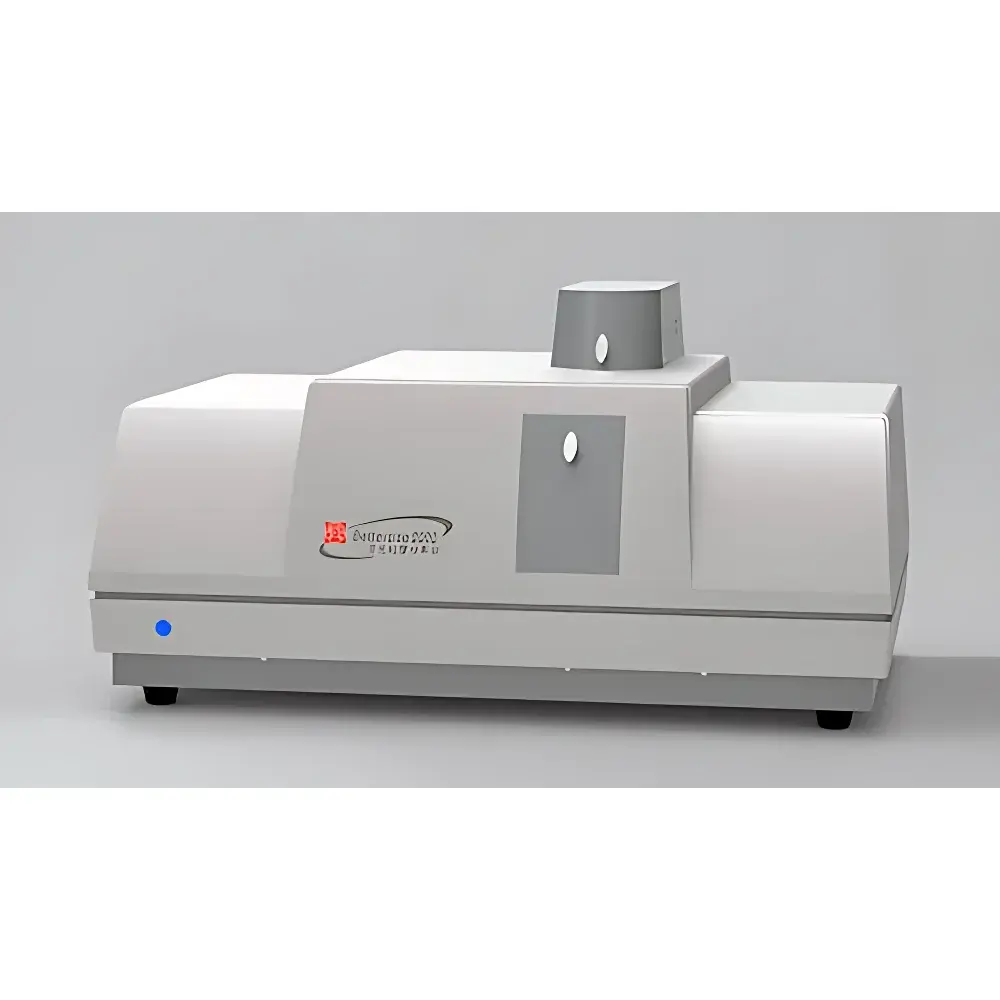
Bettersize2000 Advanced Laser Particle Size Analyzer
| Origin | Beijing, China |
|---|---|
| Manufacturer Type | Authorized Distributor |
| Model | Bettersize2000 |
| Price Range | USD 21,000–28,000 (FOB) |
| Dispersion Method | Wet Dispersion |
| Measurement Range | 0.02–2000 µm |
| Repeatability | <0.5% (D50 of NIST-traceable standard reference material) |
| Measurement Time | ≤10 s per run |
| Laser Source | Imported fiber-coupled semiconductor laser (lifetime ≥25,000 h) |
| Optical System | Dual-lens design with auto-alignment |
| Detector Array | 90-element high-sensitivity photodiode array |
| Ultrasonic Power | 50 W |
| Circulation Tank Volume | 600 mL |
| Flow Rate | 3000–8000 mL/min |
| Operating System Compatibility | Windows XP/7/8/10 |
| Interface | USB 2.0/3.0 |
| Power Supply | AC 220 V, 50/60 Hz |
| Dimensions & Weight | 800 × 500 × 410 mm, 45 kg |
Overview
The Bettersize2000 Advanced Laser Particle Size Analyzer is a fully automated, dual-lens optical instrument engineered for high-precision particle size distribution (PSD) analysis based on Mie scattering theory. It operates by illuminating a dispersed sample suspension with a collimated, fiber-coupled semiconductor laser beam and detecting angular intensity patterns of scattered light across a 90-element photodiode array. The dual-lens optical configuration—comprising a high-numerical-aperture Fourier lens and an auxiliary inverse-Fourier lens—enables simultaneous capture of forward- and backward-scattered light, significantly enhancing resolution in both submicron (100 µm) ranges. Designed for routine QC/QA and R&D environments, the system complies with ISO 13320:2009 for laser diffraction particle sizing and supports traceable calibration using NIST-certified reference materials (e.g., SRM 1963, SRM 2800). Its architecture integrates fluidic automation, real-time alignment feedback, and thermal-stable optomechanics to ensure long-term measurement integrity.
Key Features
- Fully automated operation: integrated SOP-driven workflow including auto-filling, degassing, dispersion, measurement, drainage, and cleaning—minimizing operator intervention and inter-user variability.
- Dual-lens optical path with active auto-alignment: continuously monitors and corrects optical axis deviation during operation, maintaining optimal signal-to-noise ratio and angular fidelity.
- High-speed acquisition: 3500 data captures per second enable robust statistical sampling, effectively suppressing outlier influence and supporting <0.5% D50 repeatability (per ISO 13320 Annex B).
- Stable excitation source: imported fiber-coupled semiconductor laser (wavelength: 638 nm ± 2 nm; power stability: ±0.5% over 8 h) ensures consistent scattering intensity and eliminates mode-hopping artifacts.
- Optimized wet dispersion module: 50 W ultrasonic probe, programmable duty cycle (10–100%), and adjustable flow rate (3–8 L/min) accommodate fragile nanoparticles and dense agglomerates without mechanical degradation.
- Comprehensive diagnostics: built-in dew-point sensor monitors ambient humidity effects on optical windows; real-time turbidity and bubble-detection algorithms flag suboptimal dispersion states prior to analysis.
Sample Compatibility & Compliance
The Bettersize2000 is validated for aqueous and organic suspensions of inorganic, organic, and composite particulates. It routinely characterizes non-metallic powders (e.g., calcium carbonate, kaolin, silica), metallic powders (Al, Zn, W, Mg alloys), battery cathode/anode materials (LiCoO₂, graphite), catalysts, pharmaceutical excipients, and ceramic precursors. All measurements adhere to ISO 13320:2009 requirements for instrument validation, including linearity verification, resolution testing, and repeatability assessment using certified reference materials. The software logs full audit trails—including user ID, timestamp, parameter settings, raw scattering data, and post-processing flags—to support GLP/GMP compliance and FDA 21 CFR Part 11 readiness when deployed with optional electronic signature modules.
Software & Data Management
The proprietary Bettersize Analysis Suite (v4.x) provides intuitive GUI navigation, multi-language support (English, Chinese, Spanish), and export formats compliant with ASTM E2917 and USP . Key capabilities include: real-time PSD visualization (volume-, surface-, and number-based distributions); customizable reporting templates with embedded uncertainty estimates; batch processing of up to 999 samples with automatic pass/fail flagging against user-defined specification limits; and raw data archiving in HDF5 format for third-party reprocessing. Data integrity safeguards include write-protected raw files, version-controlled algorithm updates, and encrypted local database storage. USB 2.0/3.0 interface ensures plug-and-play compatibility with modern Windows workstations.
Applications
This analyzer serves as a primary PSD characterization tool across regulated and industrial laboratories. In battery material development, it quantifies primary particle size and agglomerate stability under varying sonication energy. In pharmaceutical manufacturing, it verifies micronization efficiency of APIs and detects unintended crystallization during wet milling. For catalyst producers, it correlates pore structure (via PSD-derived specific surface area) with catalytic activity. In construction materials R&D, it monitors cement hydration kinetics through time-resolved changes in fine fraction (<10 µm). Additional use cases span pigment dispersion quality control in coatings, slurry homogeneity assessment in ceramic tape casting, and sediment transport modeling in environmental hydrology.
FAQ
What standards does the Bettersize2000 comply with?
It meets ISO 13320:2009 for laser diffraction methodology and supports validation protocols aligned with ASTM E2917 and USP . Calibration traceability is maintained via NIST SRMs.
Can the instrument measure dry powders?
No—the Bettersize2000 is configured exclusively for wet dispersion analysis. Dry powder measurement requires optional pneumatic dispersion accessories not included in this base configuration.
Is remote monitoring or network deployment supported?
Yes—software permits LAN-based client-server operation with centralized database management; however, cloud connectivity or IoT telemetry requires custom integration via OPC UA or REST API extensions.
How is optical alignment verified during daily use?
The auto-alignment subsystem performs continuous centroid tracking of the laser beam on the central detector element; deviation >±0.1 mm triggers real-time motorized correction without interrupting measurement sequences.
What maintenance is required for long-term reliability?
Recommended quarterly tasks include ultrasonic transducer inspection, circulation pump seal replacement, and optical window cleaning with spectroscopic-grade isopropanol; annual recalibration against SRM standards is advised for GMP environments.
Related Products



