
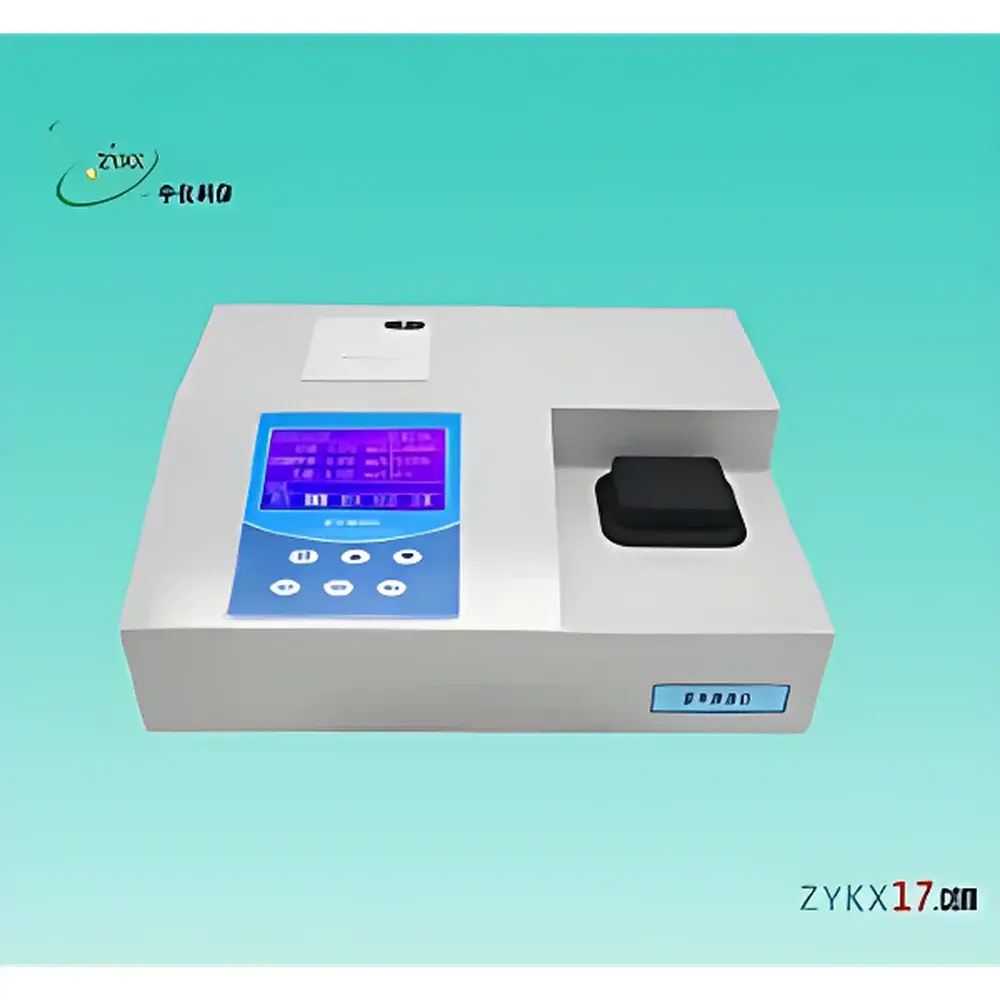
InLab-2500 UV Spectrophotometric Oil Content Analyzer
| Brand | ZYKX |
|---|---|
| Origin | Beijing, China |
| Model | InLab-2500 |
| Detection Method | UV Spectrophotometry (225 nm) |
| Extraction Solvent | n-Hexane |
| Compliance | HJ 970–2018 |
| Detection Limits | Petroleum Hydrocarbons ≤ 0.01 mg/L, Animal & Vegetable Oils ≤ 0.5 mg/L |
| Measurement Range | 0.01–100 mg/L |
| Repeatability | ≤1% (at 20 mg/L petroleum standard) |
| Linearity | R > 0.999 |
| Sample Throughput | Multi-sample capable (manual or optional auto-extraction) |
| Cell Type | 20 mm quartz cuvette |
| Data Storage | 10,000 records with power-loss protection |
| Interface | RS232 & USB |
| Operating Temp | 5–40 °C |
| Power | AC 220 V ±15%, 50 Hz, 28 W |
| Dimensions | 395 × 298 × 120 mm |
| Weight | 4.5 kg |
Overview
The InLab-2500 UV Spectrophotometric Oil Content Analyzer is a dedicated benchtop instrument engineered for the quantitative determination of petroleum hydrocarbons and animal/vegetable oils in aqueous environmental matrices. It implements the standardized ultraviolet absorption methodology specified in China’s national standard HJ 970–2018 — Water Quality — Determination of Petroleum Hydrocarbons — UV Spectrophotometric Method. Unlike legacy infrared-based methods relying on ozone-depleting solvents such as carbon tetrachloride (CTC), the InLab-2500 utilizes n-hexane as the primary extraction solvent—fully aligning with China’s commitment under the Montreal Protocol to phase out CTC in laboratory applications by 2019. The system operates on the principle that petroleum hydrocarbons exhibit characteristic absorbance at 225 nm following acidified (pH ≤ 2) n-hexane extraction and silica-magnesium adsorption cleanup. Animal and vegetable oils—comprising complex polar triglycerides and fatty acid esters—are selectively retained on the silica-magnesium column; their quantification is enabled via empirical calibration against representative reference mixtures, ensuring traceable proportionality between absorbance and concentration.
Key Features
- Triple-parameter measurement capability: simultaneous determination of petroleum hydrocarbons, animal/vegetable oils, and total oil content
- Standalone operation with integrated 240 × 128-pixel backlit LCD display and intuitive Chinese-language interface—no external PC required for routine analysis
- Onboard thermal printer for immediate hardcopy output of real-time and historical results
- Automatic calibration routines compute slope, intercept, and correlation coefficient (R²) in accordance with HJ 970–2018 protocol requirements
- Step-by-step operational guidance embedded in firmware to minimize operator dependency on advanced analytical training
- Dual communication interfaces (RS232 and USB) support bidirectional data transfer to laboratory information management systems (LIMS) or desktop workstations
- Robust optical architecture featuring long-life UV source and high-stability 20 mm quartz cuvette pathlength for reproducible photometric performance
- Extended memory capacity (10,000 measurement records) with non-volatile storage and battery-backed real-time clock (monthly drift < 10 s)
- Comprehensive self-diagnostic firmware enabling rapid identification of optical, thermal, or fluidic anomalies
- Low reagent consumption and energy-efficient design (28 W nominal power draw) supporting sustainable lab operations
Sample Compatibility & Compliance
The InLab-2500 is validated for use across diverse aqueous sample types including surface water, groundwater, seawater, and industrial wastewater. Its analytical scope adheres strictly to the matrix-specific applicability defined in HJ 970–2018. All procedural steps—including acidification (HCl or H₂SO₄), n-hexane liquid–liquid extraction, dehydration (anhydrous Na₂SO₄), and polar interferent removal (silica-magnesium column chromatography)—are fully compatible with GLP-aligned laboratory practice. While the instrument itself does not constitute a complete method kit, its optical engine and software logic are architected to support full traceability under ISO/IEC 17025-accredited testing environments. Optional auto-extraction modules (sold separately) facilitate integration into semi-automated workflows compliant with EPA Method 1664B equivalents where throughput and operator consistency are critical.
Software & Data Management
The InLab-2500 ships with free Windows-compatible data acquisition and reporting software. This application enables secure import of instrument-generated datasets—including timestamps, calibration parameters, raw absorbance values, and calculated concentrations—into CSV or Excel formats for statistical evaluation, trend analysis, or regulatory submission. Audit trail functionality captures user ID, measurement time, method version, and calibration history per analysis batch. Although native FDA 21 CFR Part 11 compliance is not embedded in firmware, the software supports export to validated third-party LIMS platforms that provide electronic signature, role-based access control, and immutable record retention—meeting GMP/GLP documentation expectations for environmental monitoring laboratories subject to CNAS or provincial ecological monitoring center audits.
Applications
- Regulatory compliance monitoring for municipal wastewater discharge permits (e.g., GB 8978–1996 effluent limits)
- Baseline and impact assessment of oil contamination near petrochemical facilities, refineries, and port zones
- Groundwater quality surveillance in agricultural catchments where diesel or lubricant leakage may occur
- Marine pollution response—rapid field-deployable screening of seawater samples during spill incidents
- Validation of oil–water separation efficiency in treatment plants using dissolved air flotation (DAF) or coalescing media
- Research applications involving biodegradation kinetics of hydrocarbon contaminants under controlled microcosm conditions
FAQ
Does the InLab-2500 comply with international standards beyond HJ 970–2018?
The instrument is designed specifically to meet the technical and procedural requirements of HJ 970–2018. While it does not claim formal equivalence to ASTM D7066 or ISO 9377-2, its fundamental measurement principle (UV absorbance at 225 nm post-n-hexane extraction) is scientifically aligned with those methods. Cross-method validation studies are recommended for multi-jurisdictional reporting.
Can the instrument be used for soil or sediment extracts?
HJ 970–2018 defines applicability exclusively for aqueous phases. Soil/sediment analysis requires prior leaching or Soxhlet extraction followed by aqueous-phase transfer—such adaptations fall outside the scope of factory validation and require method verification per ISO 17025 Clause 7.2.2.
Is n-hexane purity grade specified?
Yes—HJ 970–2018 mandates spectrophotometric-grade n-hexane (UV cutoff ≤ 200 nm, absorbance < 0.03 at 225 nm in 1 cm pathlength). Users must verify lot-specific certificates of analysis prior to use.
What maintenance intervals are recommended for optical components?
The UV lamp and quartz cuvette should be inspected quarterly; cleaning with lint-free wipes and spectroscopic-grade ethanol is sufficient. No recalibration is required unless physical damage or measurable drift (>2% RSD over 10 replicate blanks) is observed.
Are consumables like silica-magnesium columns supplied pre-packed?
Yes—factory-supplied silica-magnesium cartridges (10 mm i.d., 200 mm effective height) are included in the standard configuration. Alternative packing materials (e.g., Florisil®) may be substituted but require re-validation of breakthrough volume and recovery efficiency.
Related Products







