
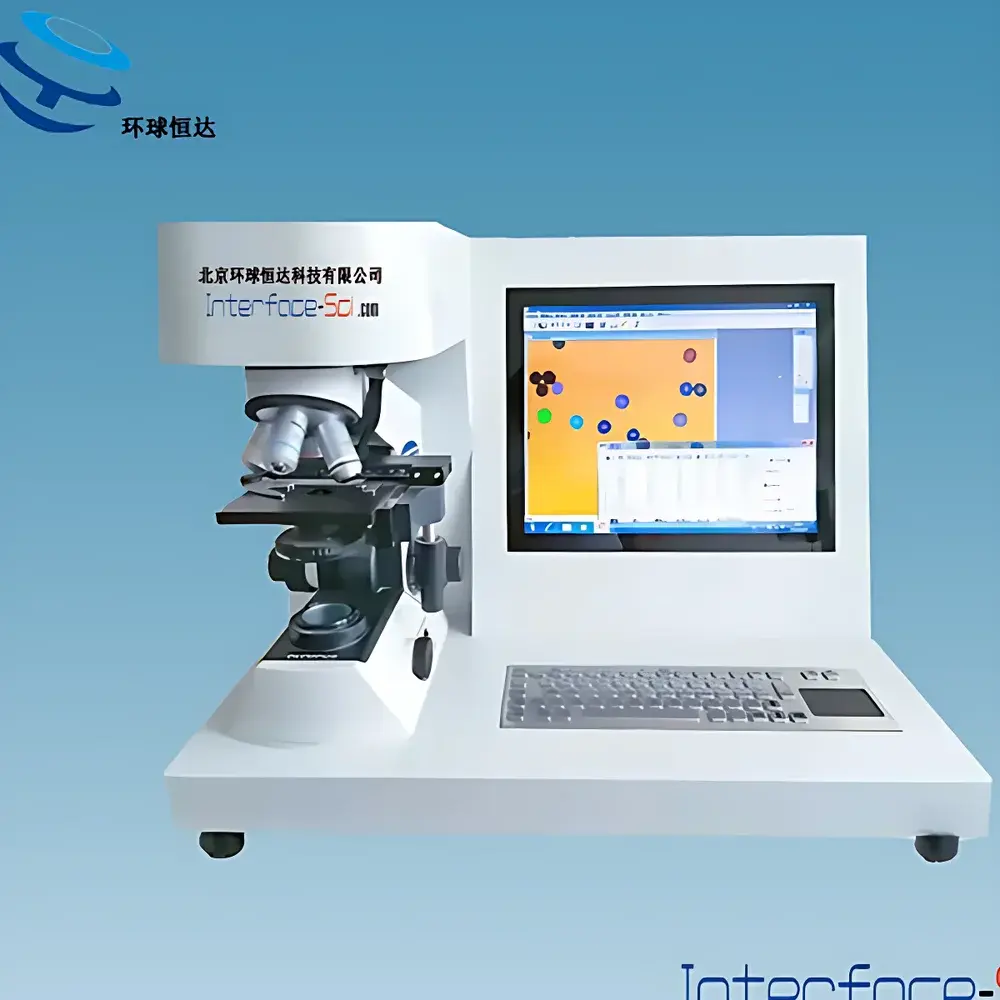
ZYKX SCI-302 Microscopic Optical Imaging System
| Brand | ZYKX |
|---|---|
| Origin | Beijing, China |
| Manufacturer Type | Authorized Distributor |
| Product Origin | Domestic (China) |
| Model | SCI-302 |
| Price | Upon Request |
| Measurement Principle | Digital Image Analysis of Particulate Morphology and Size |
| Optical Magnification Range | 40×–1600× |
| Field-of-View Resolution | 0.1 µm/pixel |
| Particle Size Range | 1–3000 µm |
| CCD Sensor | 5 MP Monochrome Scientific Grade |
| Image Segmentation Speed | ≤1 s per frame |
| Segmentation Success Rate | ≥97% |
| Accuracy & Repeatability Error | <3% |
| Compliance | ISO 13322-1:2014 (Particle Size Analysis — Image Analysis Methods — Part 1: Static Image Analysis) |
Overview
The ZYKX SCI-302 Microscopic Optical Imaging System is a high-precision static image analysis platform engineered for quantitative morphological characterization and size distribution measurement of dry or dispersed particulate samples. It operates on the fundamental principle of digital optical microscopy combined with algorithm-driven binary segmentation and geometric parameter extraction. Unlike laser diffraction or dynamic light scattering techniques, this system delivers direct visual evidence of particle shape, surface texture, agglomeration state, and spatial arrangement—critical attributes for quality control in advanced materials, pharmaceutical excipients, catalysts, and industrial powders. The system integrates a trinocular biological microscope with parfocal achromatic objectives (4×, 10×, 40×, 100× oil), widefield eyepieces (10× and 16×), and a calibrated scientific-grade monochrome CCD camera. All optical paths are optimized for Köhler illumination to ensure uniform intensity and minimal chromatic aberration across the full magnification range (40×–1600×). The resulting images are processed using ISO 13322-1:2014–compliant algorithms, enabling traceable, auditable, and reproducible measurements of over 30 morphological descriptors—including Feret diameter, convex hull area, aspect ratio, circularity, solidity, and convexity.
Key Features
- Full compliance with ISO 13322-1:2014 for static image analysis of particulates, supporting method validation under GLP and GMP frameworks
- Scientific monochrome CCD sensor (5 megapixels) with 12-bit dynamic range and hardware-level shutter synchronization for motion-free capture
- Sub-pixel resolution calibration (0.1 µm/pixel at 100× oil immersion) traceable to NIST-traceable stage micrometers
- Real-time adaptive thresholding and edge-preserving noise reduction prior to binary segmentation
- Automated particle separation for touching or overlapping objects using watershed and marker-controlled algorithms
- Segmentation success rate ≥97% across heterogeneous samples including irregular oxides, fibrous fillers, and fractured ceramics
- Measurement repeatability <3% RSD for D50 across five independent sample preparations under identical imaging conditions
Sample Compatibility & Compliance
The SCI-302 accommodates dry powders, solvent-dispersed suspensions (e.g., in ethanol or xylene), and mounted thin sections. Sample preparation follows standardized protocols defined in ASTM E2821 and ISO/IEC 17025–accredited laboratories. Compatible mounting media include Canada balsam, DPX, and water-based glycerol solutions—each selected to minimize refractive index mismatch. The system supports both brightfield and phase contrast illumination modes, enabling visualization of transparent or low-contrast particles without staining. All measurement workflows are documented with full metadata embedding (exposure time, gain, objective ID, stage coordinates), satisfying FDA 21 CFR Part 11 requirements for electronic records and signatures when paired with audit-trail-enabled software licensing.
Software & Data Management
The proprietary image analysis software provides a validated, modular interface compliant with ICH Q5E and USP <1788> guidelines for particle characterization. It features embedded calibration management, user role-based access control, and automatic generation of 21 CFR Part 11–compliant audit trails. Raw TIFF images are stored with EXIF metadata; processed results export to CSV, PDF, and XML formats compatible with LIMS integration. Statistical reporting includes cumulative distribution curves (linear and logarithmic scaling), histogram overlays, scatter plots (e.g., circularity vs. area), and batch comparison matrices. Custom report templates support client-specific SOP formatting, including header/footer branding, QA sign-off fields, and deviation flagging for out-of-spec parameters.
Applications
- Quality assurance of abrasive grits (SiC, Al₂O₃) for consistency in surface finishing performance
- Morphological screening of pharmaceutical API crystals to detect polymorphic transitions or hydration states
- Characterization of pigment dispersion stability in automotive coatings and inkjet inks
- Geometric classification of mineral fillers (talc, kaolin, calcium carbonate) for rheology prediction
- Analysis of airborne dust fractions (PM₁₀, PM₂.₅) collected on filter membranes for occupational health assessments
- Validation of milling and classification processes in battery cathode material production (e.g., NMC, LFP)
FAQ
Does the SCI-302 support automated focus stacking for particles with significant height variation?
Yes—the optional motorized Z-axis stage enables sequential acquisition across focal planes, with built-in extended depth-of-field reconstruction using gradient-based fusion algorithms.
Can the software distinguish between primary particles and agglomerates in clustered samples?
Yes—through hierarchical segmentation logic that combines intensity gradient detection, convex hull erosion, and user-definable separation thresholds based on minimum inter-particle gap distance.
Is raw image data export supported in lossless format for third-party reanalysis?
Yes—TIFF (uncompressed, 12-bit) and FITS formats are natively supported, preserving full bit-depth and embedded calibration metadata.
What regulatory documentation is provided for installation qualification (IQ) and operational qualification (OQ)?
A complete IQ/OQ protocol package—including photomicrograph verification, resolution test charts (USAF 1951), and repeatability test reports—is supplied with each system.
How is software version control and update history managed?
All software releases undergo internal verification against ISO/IEC 17025 Annex A.3 criteria; version logs, change notes, and regression test summaries are accessible within the application’s Help → Compliance section.



