
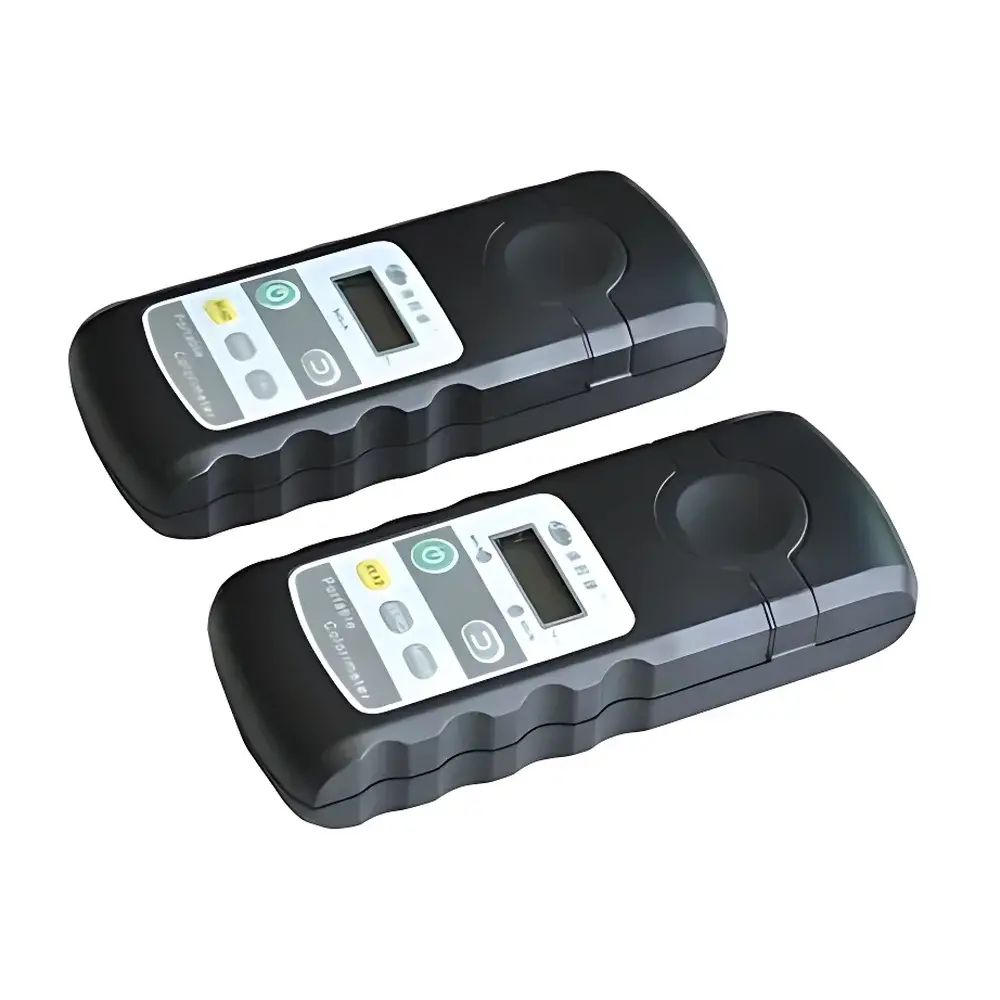
Q-AM Portable Freshwater Aquaculture-Specific Water Quality Analyzer
| Origin | Beijing, China |
|---|---|
| Manufacturer Type | Distributor |
| Origin Category | Domestic |
| Model | Q-AM |
| Price Range | USD 280 – 1,400 |
| Instrument Type | Handheld/Portable Water Quality Analyzer |
| Parameters | pH (0.0–14.0, resolution 0.1), Ammonia-N (0.02–6.00 mg/L, resolution 0.01 mg/L), Dissolved Oxygen (0.0–11.0 mg/L, resolution 0.1 mg/L), Nitrite-N (0.00–0.50 mg/L, resolution 0.01 mg/L), Sulfide (0.00–1.00 mg/L, resolution 0.01 mg/L) |
| Accuracy | ±3% full scale ±0.01 |
| Dimensions | 160 × 62 × 30 mm |
| Weight | 150 g |
| Power Supply | 2 × AA alkaline batteries |
Overview
The Q-AM Portable Freshwater Aquaculture-Specific Water Quality Analyzer is an engineered field instrument designed for rapid, on-site quantification of five critical water quality parameters in freshwater aquaculture systems: pH, dissolved oxygen (DO), ammonia-nitrogen (NH3-N), nitrite-nitrogen (NO2−-N), and sulfide (S2−). Unlike general-purpose multiparameter meters, the Q-AM employs colorimetric and electrochemical detection principles optimized for low-conductivity, biologically dynamic freshwater environments—such as ponds, raceways, hatcheries, and recirculating aquaculture systems (RAS). Its measurement architecture integrates stabilized LED optical sources, precision photodiode detection, and temperature-compensated amperometric DO sensing to deliver reproducible results under variable ambient conditions. The device operates without external power or calibration hardware, making it suitable for routine monitoring by farm technicians, extension officers, and QA personnel conducting daily health assessments.
Key Features
- Compact handheld form factor (160 × 62 × 30 mm; 150 g) with ergonomic grip and IP65-rated housing for splash resistance during pond-side use.
- Dedicated reagent kits pre-formulated for freshwater matrices—eliminating cross-contamination risk and eliminating need for volumetric glassware or pipettes.
- Two-step operational workflow: add sample + reagent → insert into analyzer → read digital display within 60 seconds.
- User-configurable calibration curves stored in non-volatile memory, supporting traceable adjustments per batch-specific reagent lot or site-specific water chemistry.
- High-stability analog front-end utilizing imported industrial-grade op-amps and low-drift reference circuits, ensuring <3% full-scale accuracy across temperature ranges of 5–40°C.
- Auto-zeroing function for pH and DO modules, minimizing drift during sequential multi-parameter measurements.
Sample Compatibility & Compliance
The Q-AM is validated for use with clarified or lightly turbid freshwater samples (TSS 50 mg/L COD). While not certified to ISO/IEC 17025, its methodology aligns with established colorimetric protocols referenced in APHA Standard Methods 2320 B (ammonia), 4500-NO2− B (nitrite), and 4500-S2− B (sulfide), as well as ASTM D888 (dissolved oxygen) and ASTM D1293 (pH). Measurement ranges meet FAO Aquaculture Technical Paper No. 530 thresholds for intensive freshwater production: DO ≥ 4.0 mg/L, pH 6.5–9.0, NH3-N ≤ 0.6 mg/L, NO2−-N ≤ 0.15 mg/L, and total sulfide ≤ 0.1 mg/L.
Software & Data Management
The Q-AM operates as a standalone instrument with no embedded Bluetooth, Wi-Fi, or USB connectivity. All data are displayed on a high-contrast LCD screen and retained only in volatile memory during active operation. For documentation compliance, users manually record readings in paper logbooks or digital spreadsheets. Though lacking FDA 21 CFR Part 11-compliant audit trails or electronic signature functionality, the device supports GLP-aligned workflows when paired with standardized SOPs—including documented reagent lot tracking, operator ID notation, and environmental condition annotation (e.g., ambient temperature, sampling depth, time). Calibration curve parameters can be archived externally via printed calibration reports generated using optional companion software (sold separately).
Applications
- Routine morning/afternoon DO and pH profiling to detect diurnal hypoxia or alkalinity shifts in earthen ponds.
- Post-feeding ammonia spike screening to guide aeration scheduling and feeding rate adjustments.
- Early warning assessment of nitrite accumulation during biofilter maturation or nitrifier inhibition events.
- Emergency sulfide testing following organic sediment disturbance or anaerobic bottom layer formation.
- Pre-stocking water quality verification prior to fingerling transfer or broodstock acclimation.
- Extension service delivery in resource-limited settings where laboratory access is unavailable or cost-prohibitive.
FAQ
Is the Q-AM suitable for marine or brackish aquaculture systems?
No. Its optical and electrochemical modules are calibrated exclusively for freshwater ionic strength and refractive index. Seawater conductivity causes significant interference in both colorimetric absorbance and DO sensor response.
What is the shelf life of the included reagent kits?
Unopened reagent vials retain stability for 18 months when stored at 2–8°C in opaque packaging. Once opened, kits must be used within 30 days under dry, room-temperature conditions.
Does the instrument require annual recalibration by an authorized service center?
No. Field recalibration is performed by the user using supplied standard solutions. However, metrological verification against NIST-traceable reference materials is recommended every six months for regulatory reporting contexts.
Can multiple operators share one unit while maintaining individual measurement records?
The Q-AM does not support user profiles or internal data logging. Each reading must be manually annotated with operator initials and timestamp at time of measurement.
How does temperature compensation work for dissolved oxygen measurements?
The integrated thermistor continuously monitors sample temperature and applies the Winkler-derived solubility correction algorithm per ISO 5814, adjusting the raw amperometric current output to report mg/L values referenced to saturation at measured temperature and local atmospheric pressure.
Related Products







