
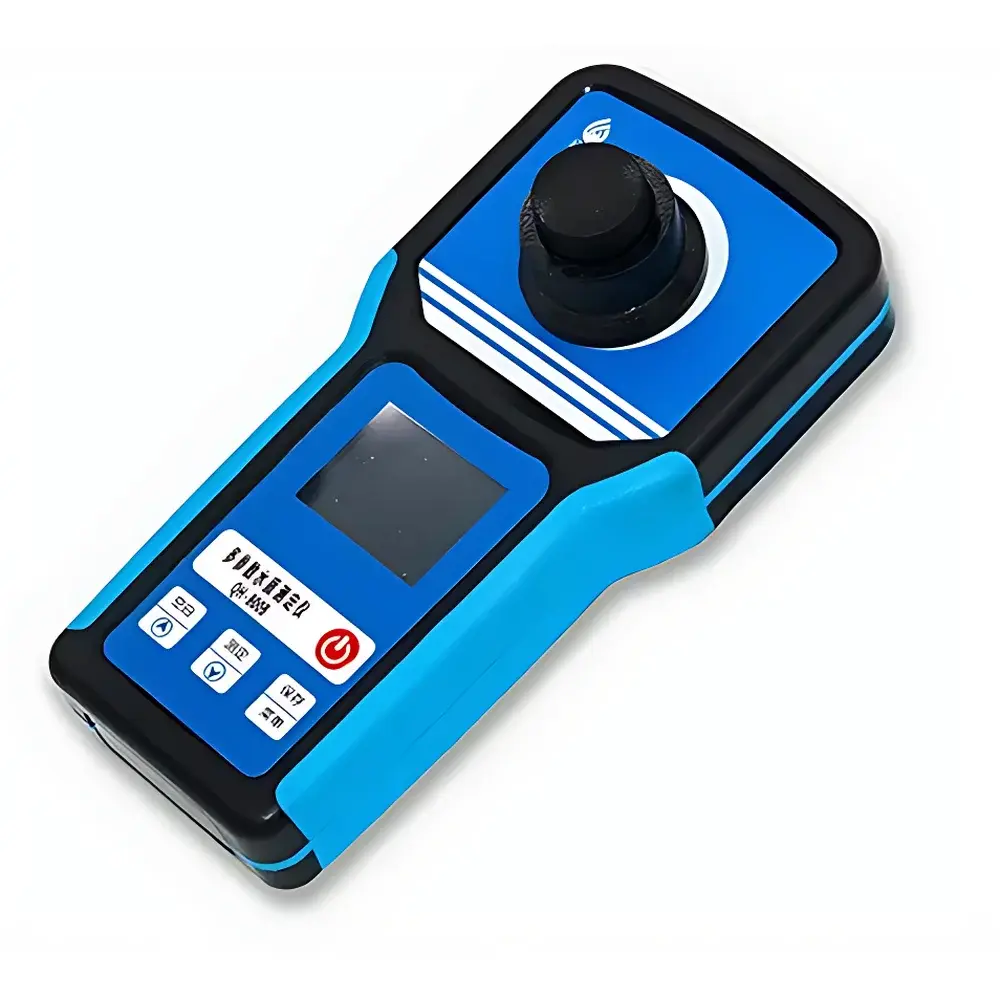
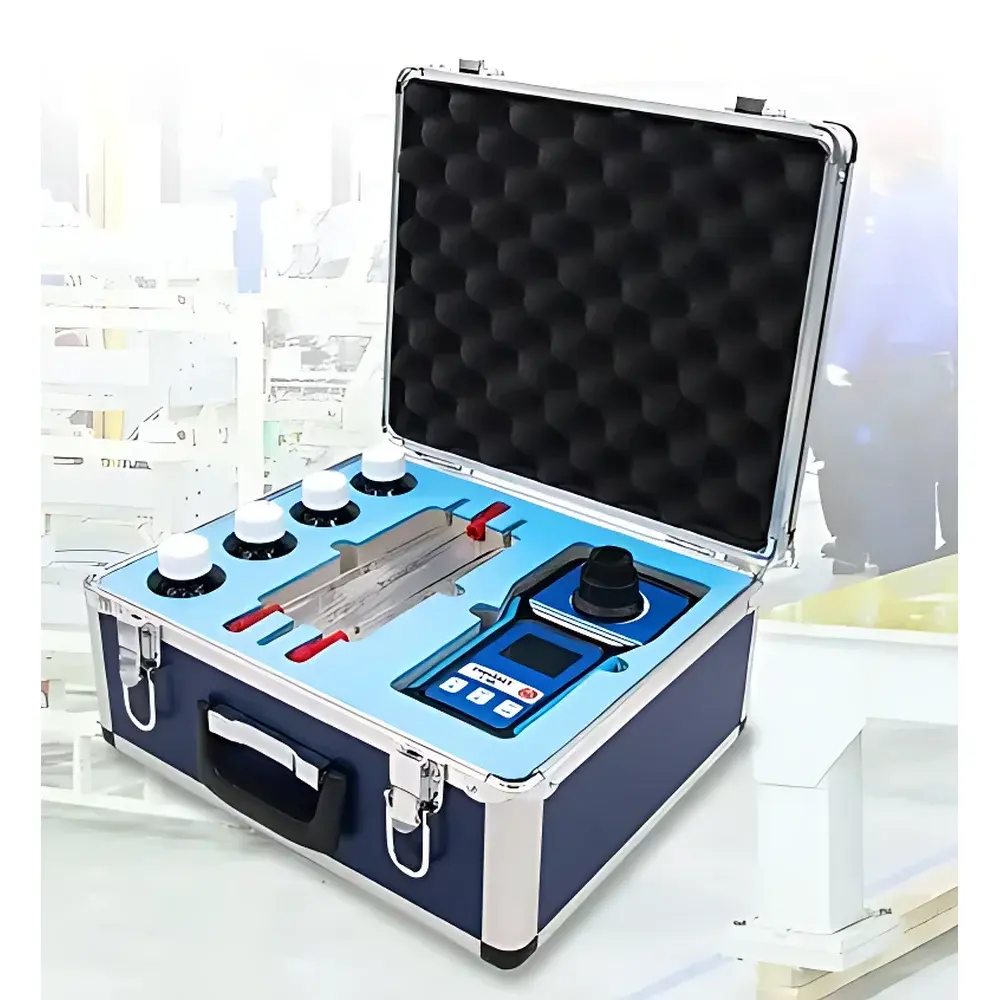
ZYKX PTB-CL20 Portable Residual Chlorine Analyzer
| Brand | ZYKX |
|---|---|
| Origin | Beijing, China |
| Model | PTB-CL20 |
| Instrument Type | Portable |
| Measurement Principle | DPD Colorimetric Method (N,N-Diethyl-p-phenylenediamine) |
| Measurand | Free Residual Chlorine |
| Measurement Range | 0.01–10 mg/L (auto-ranging with dilution support for >2 mg/L) |
| Accuracy | ±5% FS |
| Resolution | 0.01 mg/L |
| Detection Limit | 0.01 mg/L |
| Data Storage | 1000 measurements with non-volatile memory |
| Display | 3.5" color LCD with Chinese GUI |
| Power Supply | 5 × AA rechargeable or alkaline batteries (1.2 V each) |
| Operating Temperature | 5–40 °C |
| Operating Humidity | <85% RH (non-condensing) |
| Dimensions | 200 × 100 × 70 mm |
| Weight | 0.5 kg |
| Light Source | Solid-state cold LED (lifetime >50,000 h) |
| Compliance | Designed per ISO 7393-2 and EPA Method 334.0 principles |
| Battery Life | >10 hours continuous operation |
Overview
The ZYKX PTB-CL20 Portable Residual Chlorine Analyzer is a field-deployable photometric instrument engineered for rapid, on-site quantification of free residual chlorine in drinking water, wastewater effluent, swimming pools, cooling towers, and distribution system monitoring points. It implements the standardized N,N-diethyl-p-phenylenediamine (DPD) colorimetric method—recognized in ISO 7393-2, EPA Method 334.0, and APHA Standard Methods 4500-Cl G—where free chlorine oxidizes DPD to form a stable magenta-colored quinoneimine dye, measurable at 515 nm. The analyzer integrates a temperature-stabilized solid-state cold LED light source, high-transmittance optical path, and precision photodiode detection to deliver consistent absorbance readings across variable ambient conditions. Its compact handheld architecture eliminates reliance on mains power or benchtop infrastructure, enabling real-time decision-making during routine compliance checks, emergency response, or mobile laboratory operations.
Key Features
- 3.5-inch full-color LCD display with intuitive Chinese-language graphical user interface—designed for low-training operational efficiency in municipal utilities and third-party testing labs.
- Auto-ranging measurement capability (0.01–10 mg/L Cl₂) with intelligent range-switching logic; samples exceeding 2 mg/L trigger prompt-guided dilution protocols to maintain analytical integrity.
- Non-volatile internal memory stores up to 1000 test records—including date/time stamp, sample ID, calibration status, and raw absorbance values—with automatic power-fail protection ensuring zero data loss.
- Self-diagnostic firmware continuously monitors optical alignment, battery voltage, LED output stability, and cuvette recognition—flagging anomalies via on-screen alerts prior to measurement execution.
- Cold LED illumination system (515 nm peak) delivers spectral consistency and >50,000-hour operational lifetime, eliminating warm-up drift and mercury-lamp replacement cycles common in legacy spectrophotometers.
- Ruggedized portable housing (200 × 100 × 70 mm, 0.5 kg) with integrated carrying handle and shock-absorbing rubber overmolding—certified for IP65-rated dust/water resistance during field transport and outdoor deployment.
Sample Compatibility & Compliance
The PTB-CL20 is validated for use with standard 10-mm square glass or high-transmittance plastic DPD-compatible cuvettes (10 mL volume). It supports direct analysis of clarified, low-turbidity water matrices without filtration when turbidity remains below 5 NTU. For high-solids or colored samples (e.g., wastewater influent), optional pre-filtration using 0.45 µm membrane filters is recommended to minimize scattering interference. The instrument’s measurement protocol aligns with regulatory expectations under WHO Guidelines for Drinking-water Quality (4th ed.), EU Directive 98/83/EC, and China’s GB/T 5750.11–2023. While not individually certified to ISO/IEC 17025, its traceable calibration workflow—using NIST-traceable chlorine standards and documented operator verification logs—supports GLP-compliant data generation in environmental monitoring programs subject to audit.
Software & Data Management
Data export is supported via USB-C interface (no proprietary drivers required) to standard FAT32-formatted flash drives. Exported CSV files contain timestamp (RTC accuracy ±10 s/month), sample identifier, measured concentration (mg/L), method ID, calibration curve ID, and QC flag status. Firmware version 2.1+ includes optional Bluetooth 5.0 module (sold separately) for wireless transmission to ZYKX CloudLink—a secure, password-protected web portal enabling multi-user access control, automated report generation (PDF/Excel), and trend analytics across geographically dispersed sampling sites. All stored data retains immutable audit trails compliant with basic 21 CFR Part 11 principles—including electronic signature fields for analyst validation and supervisor review.
Applications
- Drinking water treatment plant effluent verification and distribution network residual mapping.
- Swimming pool and spa facility daily compliance logging per CDC Model Aquatic Health Code requirements.
- Industrial process water disinfection monitoring in pharmaceutical manufacturing (clean-in-place rinse validation).
- Emergency response teams assessing post-disaster water safety in flood-affected regions.
- Educational laboratories conducting AP Chemistry or environmental science field modules on redox titration alternatives.
- Contract environmental testing firms performing routine audits for municipal clients under national water quality surveillance frameworks.
FAQ
What chlorine species does the PTB-CL20 measure?
It quantifies free residual chlorine (hypochlorous acid and hypochlorite ion) exclusively, as defined by the DPD Method 1 procedure. Combined chlorine (chloramines) requires separate Method 3 analysis with potassium iodide addition.
Can the instrument be calibrated using liquid standards only?
Yes—calibration employs aqueous sodium hypochlorite standards traceable to NIST SRM 2675a; dry powder kits are not supported due to dissolution variability and shelf-life constraints.
Is temperature compensation applied during measurement?
No active temperature correction is performed; however, the optical system is thermally stabilized to limit drift across 5–40 °C ambient range—users must record ambient temperature manually for QA/QC cross-referencing.
How often should the optical path be cleaned?
Wipe the cuvette chamber window with lint-free lens tissue after every 20 measurements or immediately following exposure to chlorinated vapors; ethanol-moistened swabs may be used monthly for deep cleaning.
Does the device meet CE or RoHS requirements?
The PTB-CL20 complies with RoHS 2011/65/EU and meets essential requirements of the EMC Directive 2014/30/EU; CE marking is pending final notified body assessment for Class I medical device equivalence claims.
Related Products







