
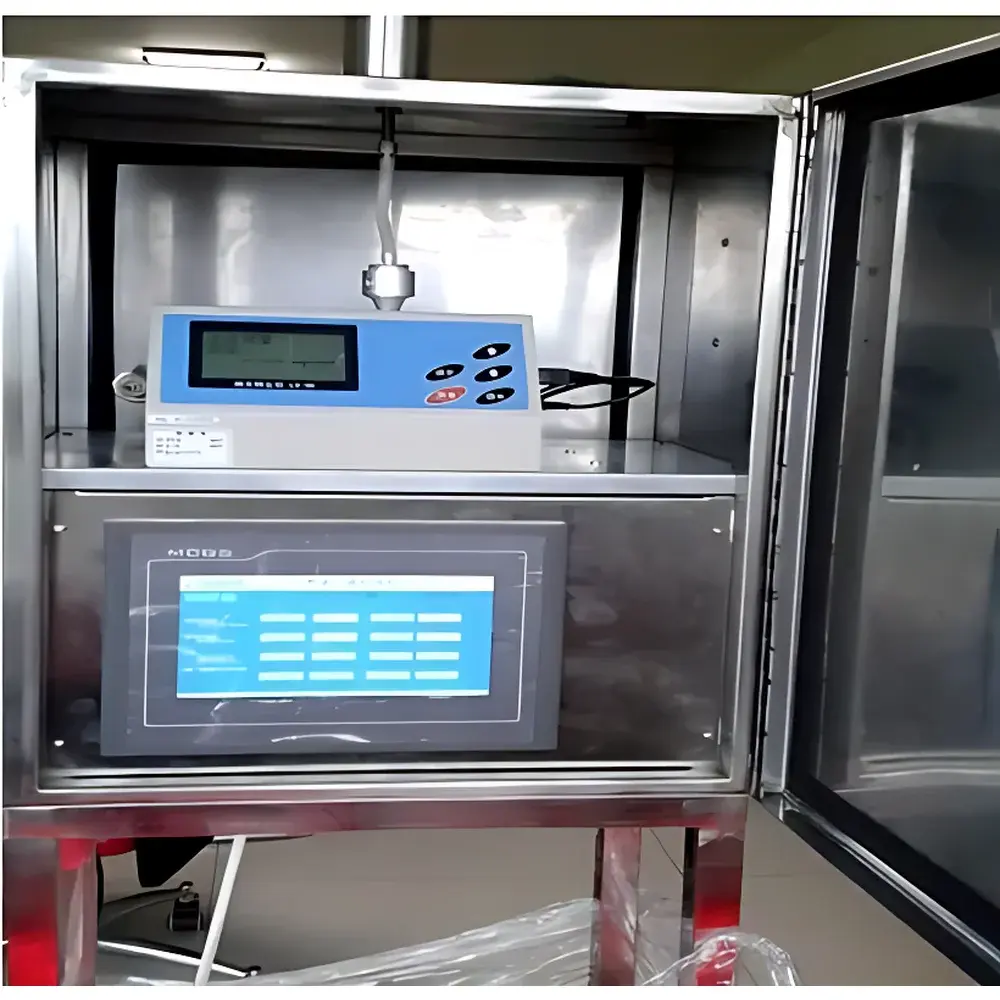
Online PM2.5 & Noise Monitoring System
| Origin | Beijing, China |
|---|---|
| Manufacturer Type | Distributor |
| Origin Category | Domestic |
| Model | PM2.5 |
| Price Range | USD 14,000–21,000 |
| Measurement Method | Laser Light Scattering |
| Measured Parameters | PM10, PM2.5 |
| Dust Measurement Range | 0.01–100 mg/m³ |
| Dust Resolution | 0.01 mg/m³ |
| Dust Accuracy | ±10% (vs. calibration aerosol) |
| Dust Repeatability | ≤1% |
| Minimum Sampling Interval | ≤60 s |
| Sound Pressure Level Range | 35–130 dB(A) |
| Frequency Weighting | A-weighting |
| Time Weighting | Fast (F), Slow (S) |
| Microphone Sensitivity | ~15 mV/Pa |
| Frequency Response | 20 Hz–12.5 kHz |
| Operating Temperature | 0–40 °C |
Overview
The Online PM2.5 & Noise Monitoring System is an integrated environmental monitoring platform engineered for continuous, real-time assessment of airborne particulate matter and ambient noise levels in urban, industrial, and regulatory compliance settings. It employs dual-sensor architecture grounded in established physical measurement principles: laser light scattering for aerosol mass concentration quantification and precision electret condenser microphone technology with digital signal processing for sound pressure level (SPL) analysis. The system conforms to core principles outlined in ISO 7196 (acoustics — instrumentation for noise measurement) and aligns with the optical detection methodology referenced in ISO 21507 (air quality — determination of PM₁₀ and PM₂.₅ — gravimetric and optical methods). Designed for unattended operation over extended periods, it delivers synchronized, time-stamped data streams suitable for air quality index (AQI) calculation, noise mapping, and long-term trend analysis in accordance with national and municipal environmental reporting frameworks.
Key Features
- Simultaneous dual-parameter acquisition: concurrent, time-aligned measurement of PM₂.₅ and PM₁₀ mass concentrations (via 650 nm laser diode scattering) and A-weighted sound pressure level (dB(A))
- High-temporal-resolution sampling: configurable measurement intervals down to 60 seconds, supporting dynamic event capture such as construction activity or traffic surges
- Optically stable dust sensor with automatic zero-point compensation and temperature/humidity drift correction algorithms
- Digital microphone module featuring built-in analog-to-digital conversion, eliminating external signal conditioning hardware and reducing calibration dependency
- Robust enclosure rated IP65 for outdoor deployment, incorporating thermal management to maintain sensor stability across 0–40 °C ambient conditions
- Embedded data logging with onboard non-volatile memory (≥30 days at 1-min interval), ensuring continuity during network outages
Sample Compatibility & Compliance
The system is validated for use in ambient outdoor air and semi-enclosed industrial perimeters. It meets the functional requirements for fixed-site monitoring under China’s HJ 653–2013 standard for particulate matter monitors and HJ 972–2018 for environmental noise monitoring equipment. While not certified to EU CE or US EPA equivalency protocols (e.g., EQPM-13-001), its optical detection method is traceable to NIST-traceable polystyrene latex (PSL) reference aerosols. All firmware and data output formats support integration into national environmental information platforms via Modbus RTU/TCP and HTTP RESTful APIs. Data integrity is preserved through timestamped records with UTC synchronization and optional NTP server alignment.
Software & Data Management
The system interfaces with a web-based monitoring portal supporting multi-node fleet management, customizable alert thresholds (e.g., PM₂.₅ > 35 µg/m³ or LAeq,1h > 65 dB(A)), and automated report generation in PDF/CSV. Raw sensor outputs are stored with metadata including sensor ID, GPS coordinates (if equipped), humidity, and temperature. Audit trails record all configuration changes and manual calibrations. For regulated environments, optional firmware supports 21 CFR Part 11–compliant electronic signatures and user-access role definitions (administrator, operator, viewer), though full GxP validation requires site-specific IQ/OQ documentation.
Applications
- Municipal air quality monitoring networks requiring synchronized particulate and noise metrics for public health advisories
- Construction site boundary monitoring to verify compliance with local noise ordinances and dust emission limits
- Industrial fence-line surveillance for cement plants, aggregate facilities, and demolition zones
- Research-grade longitudinal studies on co-exposure patterns between fine particulate loadings and community noise stress indicators
- Smart city infrastructure integration where low-bandwidth cellular telemetry (LTE-M/NB-IoT) enables cost-effective wide-area deployment
FAQ
Does this system meet U.S. EPA or EU reference method equivalency requirements?
No. It is designed and calibrated per Chinese national standards (HJ 653, HJ 972) and is not certified under U.S. EPA EQPM or EU MCERTS schemes.
Can the PM sensor be recalibrated in-field without returning to the manufacturer?
Yes — zero calibration is supported via clean-air purge; span calibration requires traceable PSL aerosol generator and is recommended annually.
Is the noise measurement compliant with IEC 61672-1:2013 Class 2 specifications?
The microphone module satisfies frequency response and linearity performance within Class 2 tolerances, though formal third-party certification is not included.
What communication protocols are supported for integration with SCADA or central EMS platforms?
Modbus RTU (RS-485), Modbus TCP, and HTTP POST/GET with JSON payloads are natively supported; MQTT is available via firmware update.
How is data security handled during wireless transmission?
All cellular and Ethernet communications use TLS 1.2 encryption; local storage is write-protected and accessible only via authenticated SSH or HTTPS session.







