
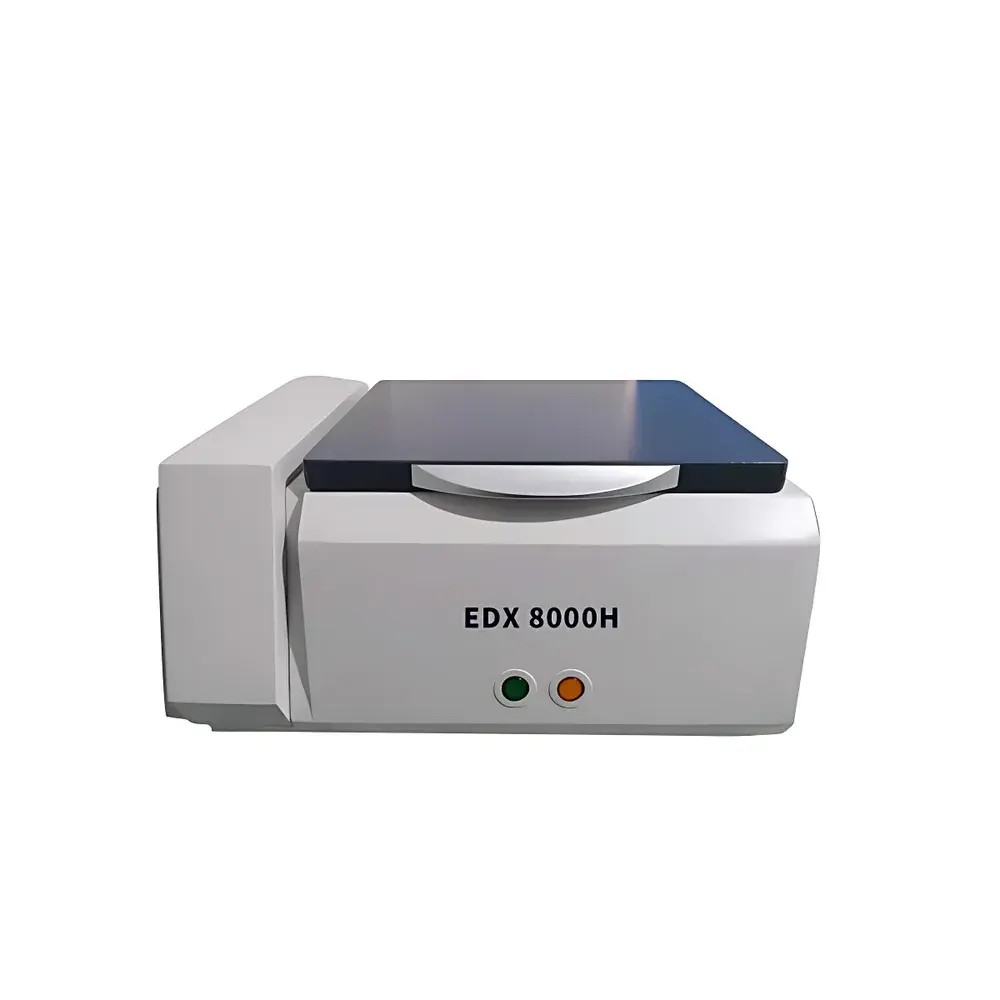
ZYKX ZY8000H Energy Dispersive X-Ray Fluorescence Spectrometer
| Brand | ZYKX |
|---|---|
| Origin | Beijing, China |
| Model | ZY8000H |
| Configuration | Benchtop/Floor-standing |
| Application Type | General-purpose |
| Elemental Range | Na (11) to U (92) |
| Detection Limit | 1 ppm for RoHS elements (Cd, Pb, Cr, Hg, Br, Cl) |
| Energy Resolution | 129 ± 5 eV (at Mn Kα) |
| Measurement Time | 100–300 s (user-adjustable) |
| Operating Temperature | 15–30 °C |
| Relative Humidity | 40–70 % RH |
| Power Supply | AC 220 V ±5 V, 50 Hz |
| Vacuum System | Integrated auto-vacuum pump (60 L/min pumping speed |
| Detector | Silicon Drift Detector (SDD), Peltier-cooled |
| Signal Processing | Digital multi-channel analyzer (4096 channels), SES proprietary algorithm |
| Collimator Options | 7 automatic sizes (2–8 mm diameter) |
| Filter Options | 5 programmable filters |
| Collimator–Filter Combinations | >30 preconfigured configurations |
| Software | Vacuum-enabled EDXRF analysis suite with auto-curve selection, real-time vacuum monitoring, spectral overlay, GLP-compliant audit trail, and dual-language UI (English/Chinese) |
Overview
The ZYKX ZY8000H Energy Dispersive X-Ray Fluorescence (EDXRF) Spectrometer is an engineered analytical platform designed for non-destructive elemental composition analysis of solid, powder, and thin-film samples. It operates on the fundamental principle of X-ray fluorescence: primary X-rays from a high-voltage tube excite inner-shell electrons in sample atoms; upon electron relaxation, characteristic secondary X-rays are emitted, with energies uniquely identifying each element and intensities quantitatively correlating with concentration. Equipped with a high-resolution silicon drift detector (SDD) and integrated vacuum chamber, the ZY8000H extends reliable detection down to sodium (Na, Z=11), overcoming atmospheric absorption limitations for light elements—critical for alloy certification, RoHS compliance verification, and geological material screening. Its robust mechanical architecture, thermally stabilized X-ray source, and low-noise digital pulse processing ensure long-term measurement stability and high reproducibility across routine QC and R&D environments.
Key Features
- Integrated high-efficiency vacuum system (60 L/min pumping speed; ultimate pressure ≤6.7×10⁻² Pa) enabling sub-ppm detection of light elements (Na–Cl) without liquid nitrogen cooling.
- Peltier-cooled SDD detector delivering 129 ± 5 eV energy resolution at Mn Kα (5.9 keV), optimized for peak-to-background ratio and count-rate linearity up to 100,000 cps.
- Proprietary SES (Signal Enhancement System) digital multi-channel analyzer with 4096-channel capability and real-time noise suppression algorithms.
- Automated optical path management: 7 motorized collimators (2–8 mm) and 5 selectable filters, supporting >30 pre-validated collimator–filter combinations for matrix-adaptive excitation.
- Intelligent calibration engine: auto-selection of quantitative working curves based on sample type recognition and spectral fingerprinting—eliminating manual curve assignment errors.
- Real-time hardware monitoring: X-ray tube temperature, vacuum chamber pressure, detector bias voltage, and cooling status continuously logged and displayed with threshold alerts.
- Dual-mode operation: seamless transition between air and vacuum measurement modes; vacuum release triggered automatically upon chamber opening per IEC 61000-4-2 safety requirements.
- USB 2.0 high-speed interface ensuring deterministic data transfer integrity and synchronization with time-stamped metadata.
Sample Compatibility & Compliance
The ZY8000H accommodates heterogeneous sample geometries via its dual-chamber design: an open large cavity (610 × 320 × 100 mm) for irregular or oversized specimens, and a sealed vacuum-compatible chamber (Φ100 × 75 mm) for controlled light-element analysis. It supports standardized reference materials—including certified Ag calibration foils—and complies with key regulatory frameworks: EU RoHS Directive 2011/65/EU, EN 14382:2021 (packaging), ASTM F2853-22 (lead in toys), and ISO 12885:2022 (XRF performance validation). Instrument firmware and software maintain traceability per GLP and ISO/IEC 17025:2017 requirements, with configurable audit trails, electronic signatures, and user-access-level controls aligned with FDA 21 CFR Part 11 principles.
Software & Data Management
The embedded EDXRF analysis software provides a unified interface for acquisition, quantification, and reporting. It features real-time spectral visualization with overlay capability, automated peak deconvolution using iterative least-squares fitting, and matrix correction via fundamental parameter (FP) algorithms. All measurement parameters—including kV/mA settings, dwell time, vacuum status, and detector live time—are timestamped and embedded in raw data files (.edf format). Reports conform to ISO 14836 and ASTM E1621 templates, exportable as PDF, CSV, or XML. The system supports secure remote diagnostics, firmware updates, and method library synchronization across networked instruments—enabling centralized lab management without compromising local data sovereignty.
Applications
- RoHS and Halogen-Free Compliance Testing: Quantitative screening of Cd, Pb, Hg, Cr⁶⁺, Br, and Cl at ≤1 ppm detection limits in plastics, PCBs, and coatings.
- Metallurgical QA/QC: Rapid grade identification and compositional verification of stainless steels, aluminum alloys (e.g., 6061, 7075), zinc die-castings, and copper-based materials—with enhanced sensitivity for Mg, Al, Si, P, and S under vacuum.
- Geological & Mining Analysis: Bulk elemental profiling of ores, slags, and exploration core samples; semi-quantitative mineralogical assessment via spectral pattern matching.
- Electroplating & Surface Coating: Simultaneous determination of coating composition (e.g., Ni–P, Sn–Bi) and thickness (via fundamental parameter modeling).
- Consumer Product Safety: Screening per CPSIA, EN71-3, and ASTM F963 for extractable heavy metals in toys, textiles, and packaging substrates.
FAQ
What elements can the ZY8000H detect?
It identifies and quantifies elements from sodium (Na, Z = 11) to uranium (U, Z = 92) in solid and powdered samples.
Is liquid nitrogen required for detector cooling?
No—the instrument uses a thermoelectrically cooled SDD detector, eliminating cryogenic handling and associated operational constraints.
Can it analyze light elements like magnesium or aluminum in air?
Light-element analysis below phosphorus (Z = 15) requires vacuum operation to minimize atmospheric attenuation of low-energy X-rays.
How is calibration maintained over time?
The system performs automatic energy calibration using internal reference peaks and supports periodic verification with certified standards; drift compensation is applied during spectral processing.
Does the software support regulatory audit requirements?
Yes—audit logs record all user actions, parameter changes, and result modifications with timestamps and operator IDs, satisfying GLP, GMP, and 21 CFR Part 11 documentation mandates.





