Eurotech XTR D20-35 Single-Screw Granulation Line
| Brand | Eurotech |
|---|---|
| Origin | Italy |
| Manufacturer Type | Authorized Distributor |
| Origin Category | Imported |
| Model | D20-35 |
| Price Range | USD 42,000 – 70,000 |
Overview
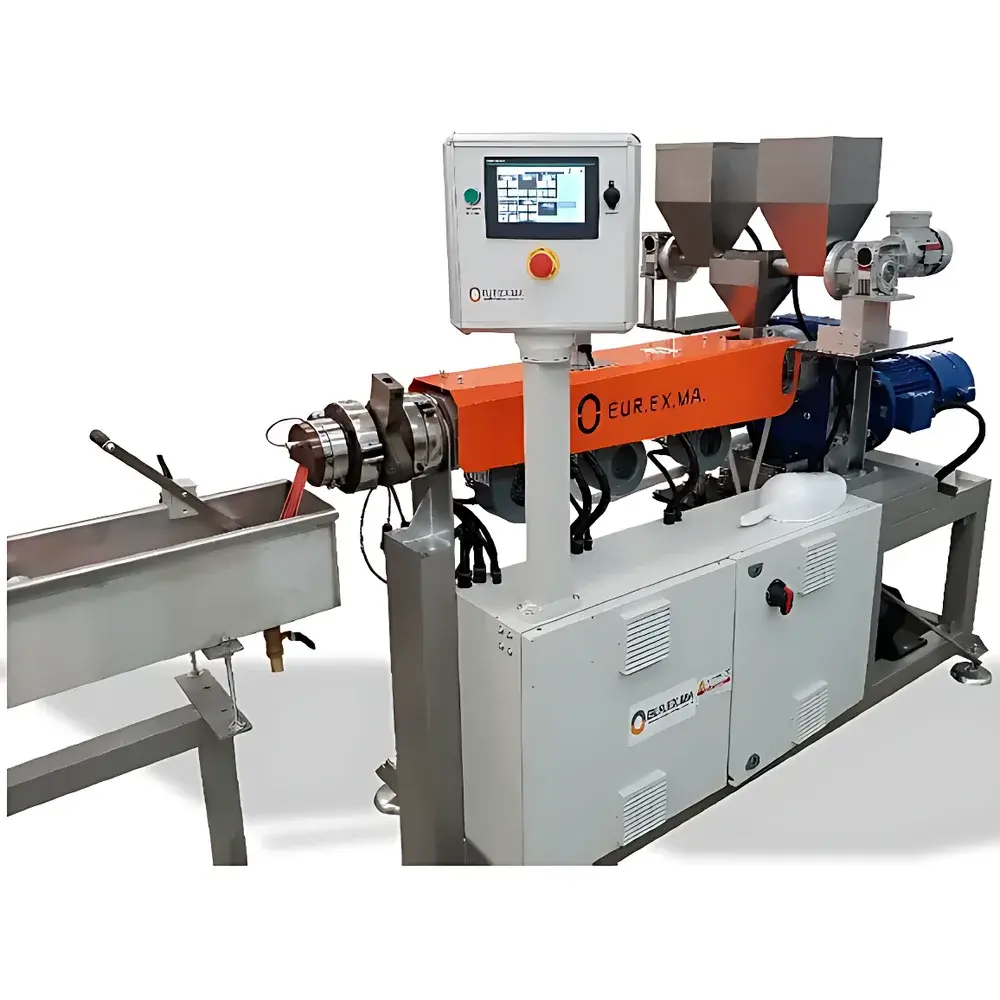
The Eurotech XTR D20-35 Single-Screw Granulation Line is an integrated extrusion-based pelletizing system engineered for precision compounding, masterbatch production, and thermoplastic recycling in industrial rubber and plastic processing environments. Unlike standalone extruders, this line incorporates a co-rotating single-screw extruder, die-face cutter module, water bath or air-cooled strand cooling section, and rotary granulator — all synchronized under centralized process control. Its core operating principle relies on controlled melt conveying, homogenization, and pressurized extrusion through a calibrated die pack, followed by immediate solidification and size-controlled cutting. Designed for continuous operation at stable throughput rates, the system supports material viscosities ranging from low-MFI polyolefins to highly filled engineering thermoplastics (e.g., glass-filled PA6, CaCO₃-loaded PP), with screw diameters of 20 mm and 35 mm enabling scalable output from laboratory-scale R&D batches (≈3–5 kg/h) to pilot-line production (up to 80 kg/h depending on formulation and cooling configuration).
Key Features
- Modular architecture with interchangeable base configurations: low-profile frame optimized for blow-film integration; high-base variant compatible with cast film chill rolls, sheet calibrators, pipe sizing sleeves, and profile dies.
- Single-screw extruder with hardened nitrided steel barrel and screw (L/D ratio: 25:1 standard), featuring segmented heating zones (3–4 zones) with ±1 °C PID temperature control and forced-air or oil-based cooling channels.
- Integrated die-face granulation unit with tungsten-carbide-coated rotating knives, adjustable cutter speed (100–1,200 rpm), and pneumatic knife pressure regulation for consistent pellet geometry.
- Stainless-steel water bath or counter-current air-cooling tunnel (optional), both equipped with level sensors, flow meters, and temperature monitoring for thermal stability during strand solidification.
- PLC-based HMI interface (Siemens S7-1200 or equivalent) supporting recipe management, real-time torque/amp monitoring, screw speed ramping profiles, and alarm logging compliant with IEC 61508 functional safety principles.
Sample Compatibility & Compliance
The XTR D20-35 accommodates a broad spectrum of thermoplastic feedstocks including LDPE, HDPE, PP, PS, ABS, PET, PC, and TPU — whether virgin, regrind, or compounded with fillers (talc, carbon black, flame retardants), pigments, or additives (antioxidants, UV stabilizers). It meets mechanical safety requirements per EN ISO 12100 and electrical compliance per CE/EMC Directive 2014/30/EU. For regulated pharmaceutical or medical-grade polymer processing, optional validation packages support IQ/OQ documentation aligned with ISO 9001:2015 and GMP Annex 15 guidelines. While not inherently FDA 21 CFR Part 11–compliant, audit-trail-capable data export modules can be added to meet GLP/GMP traceability standards.
Software & Data Management
The embedded control software provides real-time visualization of extrusion parameters — including melt pressure (via 0–100 bar transducers), barrel zone temperatures, screw RPM, main drive amperage, and cutter motor load — with automatic trend logging at user-defined intervals (1–60 sec). Historical datasets are exportable in CSV or Excel-compatible formats for post-process analysis. Optional Ethernet/IP or Modbus TCP gateways enable integration into plant-level SCADA systems (e.g., Ignition, Siemens WinCC). All parameter changes are timestamped and attributed to operator ID, satisfying basic electronic record requirements under ALCOA+ principles (Attributable, Legible, Contemporaneous, Original, Accurate).
Applications
- Production of uniform polymer pellets for injection molding and extrusion feedstock preparation.
- Recycling of post-industrial scrap (e.g., edge trim, sprues) into reusable granules with minimal thermal degradation.
- Development and scale-up of color masterbatches and additive concentrates requiring high dispersion consistency.
- Processing of heat-sensitive compounds (e.g., PVC, bio-based PLA) using low-shear screw designs and precise thermal zoning.
- On-site technical service support includes screw profile optimization, die land calibration, and granule morphology analysis via optical sieve testing (ASTM D1921).
FAQ
What is the maximum recommended throughput for the D35 configuration with glass-filled nylon?
Typical sustained output is 55–65 kg/h at <1% melt temperature deviation, assuming 25% 10-µm glass fiber loading and optimized screw design.
Can the line be retrofitted with a gravimetric feeder for liquid additives?
Yes — optional side-stuffer or twin-liquid injection ports are available with mass-flow metering (±0.5% accuracy) and PLC interlock for feed rate synchronization.
Is dry-cutting (air-cooled) supported without water contact?
Standard configuration includes air-cooling tunnel option; full dry-cutting requires die-face cutter with heated die plate and nitrogen purge to prevent oxidation.
Does Eurotech provide validation documentation for GMP environments?
Factory-issued FAT/SAT reports are included; full 3Q (IQ/OQ/PQ) documentation requires site-specific commissioning with certified third-party validation partners.
What maintenance intervals are recommended for the gearmotor and cutter assembly?
Gearmotor oil change every 4,000 operating hours; cutter blade resharpening or replacement every 200–300 hours depending on filler hardness and abrasive content.