
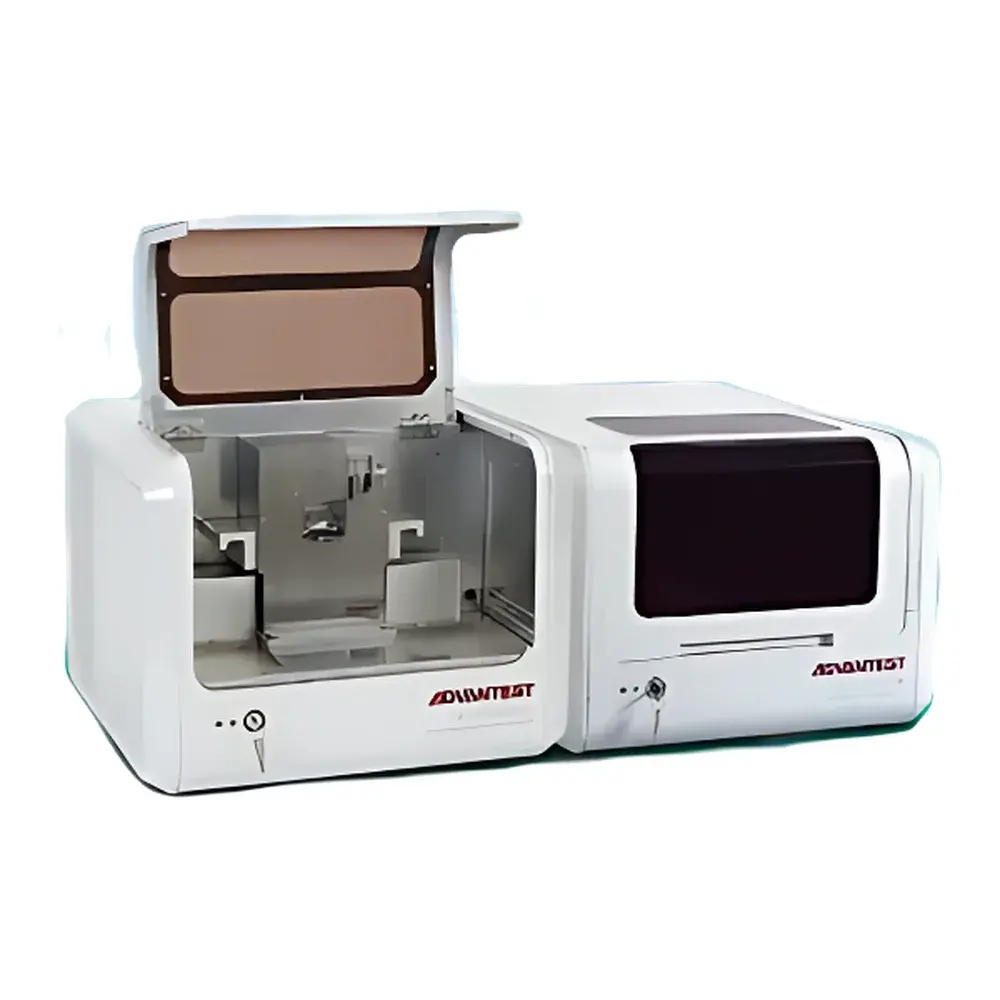
Advantest TAS7500 Series THz Time-Domain Spectroscopy and Imaging System
| Brand | Advantest |
|---|---|
| Origin | Japan |
| Model | TAS7500 Series |
| Frequency Range | 0.03–7 THz (configurable bands: 0.03–2 THz, 0.1–4 THz, 0.5–7 THz) |
| Spectral Stability | ±0.2% energy repeatability |
| Measurement Modes | Transmission, Reflection, ATR, Polarization-Resolved |
| Environmental Operation | Dry-air purged optics enclosure |
| Form Factor | Benchtop |
| Pump Source | Ultrafast Fiber Laser (1550 nm) |
| Detection | Photoconductive Antenna Array |
| Imaging Capability | 2D THz mapping (amplitude/phase), layer thickness & density profiling |
| Compliance | Designed for ISO/IEC 17025-aligned lab environments, supports GLP audit trails via software logging |
Overview
The Advantest TAS7500 Series is a benchtop terahertz time-domain spectroscopy (THz-TDS) and imaging system engineered for high-fidelity, non-destructive characterization across research and industrial quality control applications. Operating on the principle of ultrafast optical rectification and electro-optic sampling, the system generates and detects coherent THz pulses in the 0.03–7 THz range using a fiber-based 1550 nm pump laser and photoconductive antenna architecture. Unlike conventional Fourier-transform infrared (FTIR) or millimeter-wave systems, THz-TDS provides both amplitude and phase information—enabling direct extraction of complex optical constants (refractive index *n*, absorption coefficient *α*, and dielectric function *ε*) without Kramers–Kronig transformation. Its compact design integrates a dry-air purged optical path to suppress atmospheric water vapor absorption—a critical requirement for reproducible measurements below 2 THz. The TAS7500 is optimized for rapid acquisition (70 dB dynamic range), and robust mechanical stability suitable for regulated laboratory environments.
Key Features
- Three configurable frequency band options: Low-band (0.03–2 THz), Standard-band (0.1–4 THz), and Ultra-wideband (0.5–7 THz)—selected at time of order to match material absorption profiles.
- Sub-0.2% spectral energy repeatability over 8-hour continuous operation, validated per ASTM E1421-22 guidelines for spectrophotometer stability.
- Multi-modal measurement capability: transmission, reflection, attenuated total reflection (ATR), and polarization-resolved THz spectroscopy—enabling analysis of opaque, layered, or anisotropic samples without sectioning.
- Benchtop footprint (600 × 450 × 280 mm) with integrated vibration-damped optical table and motorized stage (±50 mm travel, 1 µm resolution) for automated 2D raster scanning.
- Dry-air purge enclosure (dew point < –40 °C) maintains optical path integrity during long-duration acquisitions; compatible with optional nitrogen purge upgrade for ultra-low-humidity operation.
- Real-time phase-sensitive detection with time-domain waveform averaging and lock-in amplification—supporting both broadband pulse analysis and narrowband spectral filtering.
Sample Compatibility & Compliance
The TAS7500 accommodates solid, powder, and thin-film samples up to 100 mm × 100 mm in dimension and 25 mm in thickness. It is routinely deployed for pharmaceutical tablet coating uniformity assessment (per USP ), polymer crystallinity mapping, semiconductor wafer dopant profiling, and composite material delamination detection. All hardware and firmware comply with IEC 61000-6-3 (EMC emissions) and IEC 61010-1 (safety). Software architecture supports 21 CFR Part 11-compliant user access controls, electronic signatures, and immutable audit trails when operated under validated configurations. System validation documentation—including IQ/OQ protocols aligned with ISO/IEC 17025—can be supplied upon request for GMP-regulated facilities.
Software & Data Management
Control and analysis are performed via Advantest’s proprietary TAS-Studio software (v4.2+), a Windows 10/11–based application developed in compliance with IEEE Std 12207 for scientific software lifecycle management. Core modules include: (1) Real-time waveform visualization with FFT and Hilbert transform; (2) Automated baseline correction and dispersion compensation algorithms; (3) Multi-layer optical modeling engine (transfer-matrix method) for quantitative thickness and refractive index extraction; (4) Batch processing pipeline supporting CSV, HDF5, and MAT export formats; (5) Integrated reporting module generating PDF/HTML reports with embedded metadata (instrument ID, operator, timestamp, environmental logs). Raw time-domain data is stored in vendor-neutral .tdm format, ensuring long-term archival compatibility.
Applications
- Pharmaceutical QA/QC: Non-destructive quantification of film-coating thickness (±0.5 µm), API distribution homogeneity, and polymorph identification in tablets and capsules.
- Materials Science: Carrier mobility mapping in 2D semiconductors, hydration state analysis in proton-exchange membranes, and defect density estimation in ceramic substrates.
- Security & Defense: Identification of concealed explosives and illicit substances through spectral fingerprinting in the 0.5–2.5 THz window.
- Academic Research: Ultrafast carrier dynamics studies in perovskites, low-energy phonon mode characterization in MOFs, and chiral molecular response via circularly polarized THz excitation.
- Electronics Manufacturing: Thickness metrology of low-k dielectrics (<1 µm), interconnect void detection, and thermal interface material (TIM) adhesion verification.
FAQ
What sample preparation is required for THz-TDS measurements?
Minimal preparation is needed: flat, dry, and optically accessible surfaces yield optimal results. Powders may be pelletized with polyethylene; liquids require sealed quartz cells with THz-transparent windows.
Can the TAS7500 perform depth-resolved imaging?
Yes—time-of-flight analysis of reflected THz pulses enables micrometer-scale axial resolution (~30 µm in polymers) and non-contact cross-sectional reconstruction of multilayer structures.
Is calibration traceable to national standards?
All factory calibrations reference NIST-traceable THz frequency standards and certified reference materials (e.g., silicon wafers, polyethylene films) per ISO/IEC 17025 Clause 6.6.
How does the system handle ambient humidity fluctuations?
The integrated dry-air purge maintains relative humidity <1% inside the optical path, eliminating water vapor absorption lines that compromise spectral fidelity below 2 THz.
Does the software support custom algorithm integration?
TAS-Studio provides a documented C++ SDK and Python API (via ctypes bindings), enabling integration of user-defined models, machine learning inference pipelines, or third-party spectral libraries.





