
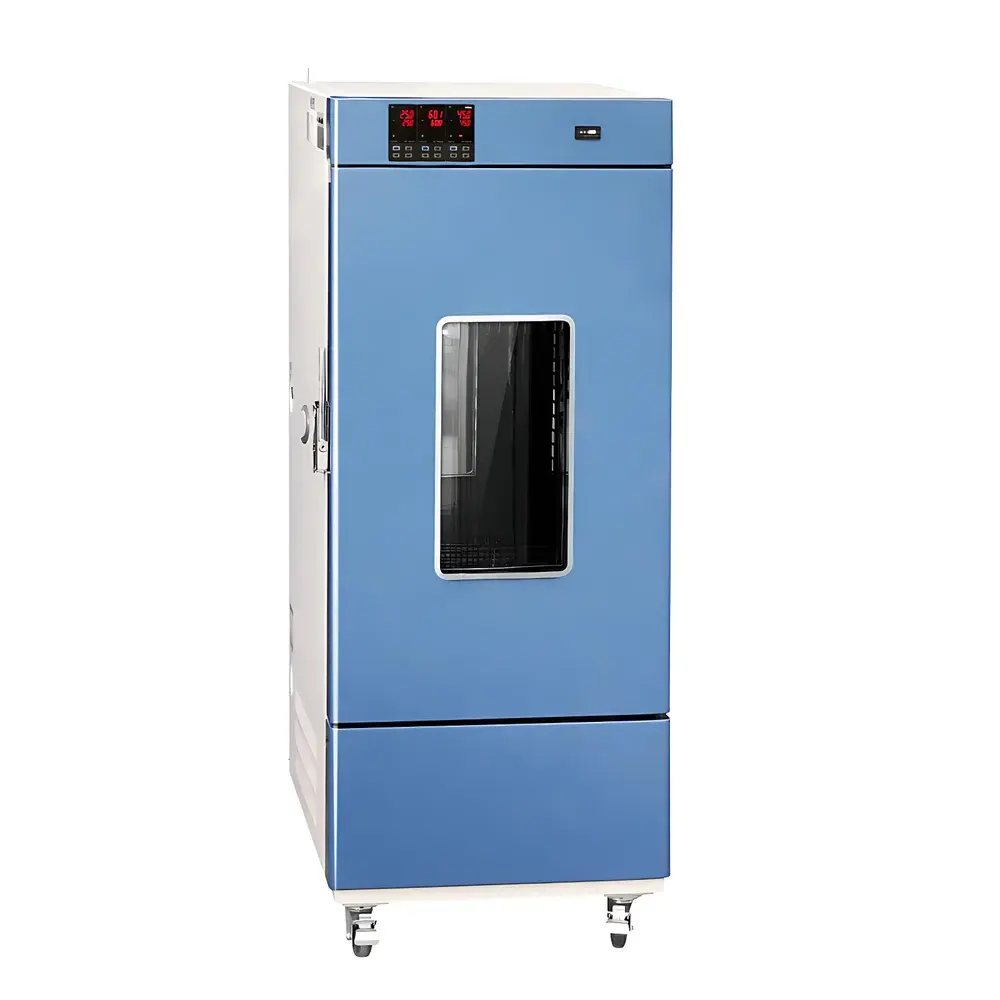
YSEI SHH-400GSD Integrated Drug Stability Testing Chamber
| Brand | YSEI |
|---|---|
| Origin | Chongqing, China |
| Manufacturer Type | Direct Manufacturer |
| Model | SHH-400GSD |
| Temperature Range | 0–60 °C |
| Humidity Range | 10–85 %RH |
| Illumination Control | 0–10,000 lux (with UV-filtered white light source) |
| Chamber Volume | 400 L |
| Power Consumption | ≤1.8 kW (at 40 °C / 75 %RH, single compressor active) |
| Ambient Operating Conditions | 5–35 °C, ≤85 %RH |
| Compliance | Meets ICH Q1A(R2), Q5C, USP <1150>, and Chinese Pharmacopoeia 2020 Edition requirements for long-term, accelerated, and intermediate stability testing |
Overview
The YSEI SHH-400GSD Integrated Drug Stability Testing Chamber is an engineered environmental simulation system designed specifically for pharmaceutical stability studies in accordance with ICH Q1 series guidelines. It provides precise, independent control of temperature, relative humidity, and photometric illumination—three critical stress variables defined in regulatory protocols for assessing drug product shelf-life, degradation pathways, and packaging integrity. Unlike modular or single-parameter chambers, the SHH-400GSD integrates all three environmental axes into a single validated chamber architecture, eliminating inter-unit variability and cross-contamination risks associated with multi-chamber test setups. Its design follows the core principles of Good Manufacturing Practice (GMP) and Good Laboratory Practice (GLP), supporting both routine quality control stability programs and formal registration batch studies required by FDA, EMA, PMDA, and NMPA.
Key Features
- Tri-variable environmental control: Simultaneous regulation of temperature (0–60 °C ±0.3 °C), humidity (10–85 %RH ±2 %RH), and illumination (0–10,000 lux, UV-filtered white light per ICH Q1B)
- Regulatory-grade data integrity: Built-in thermal printer with user-configurable print intervals (1 min to 24 h); real-time graphical traceability of temperature/humidity profiles stored internally for ≥30 days
- Dual-redundancy safety architecture: Independent overtemperature cutoff in chamber wall and air stream; dry-run protection for humidifier; compressor overload and phase-failure detection; optional GSM-based SMS alerting for power loss, sensor deviation (>±1.5 °C / >±5 %RH), and door-open events
- Energy-optimized operation: EC fan motors, high-efficiency refrigerant circuit, and adaptive PID humidity control reduce average power draw by up to 28% versus legacy constant-speed systems
- Acoustically damped enclosure: Sound pressure level ≤52 dB(A) at 1 m distance under full-load conditions—suitable for shared laboratory environments without dedicated mechanical rooms
- Modular lighting configuration: One removable photosensitive shelf included (standard); optional upgrade to three-tier illumination zones with individual lux calibration and spectral verification reports
Sample Compatibility & Compliance
The SHH-400GSD accommodates standard stability storage configurations including open trays, sealed blister packs, vials, ampoules, and IV bags on adjustable stainless-steel shelves. Its internal geometry supports ICH-defined placement rules: minimum 25 mm clearance from walls, uniform airflow distribution verified via ISO 14644-3 Class 5 airflow mapping, and photometric uniformity ≥90% across illuminated shelf surface. The chamber complies with validation requirements for IQ/OQ/PQ execution per ASTM E2500-13 and ISPE Baseline Guide Vol. 5. Documentation packages include pre-executed IQ/OQ protocols aligned with FDA 21 CFR Part 11 Annex 11 expectations—including electronic signature support, audit trail logging, and user role-based access control (RBAC) configuration templates.
Software & Data Management
While the SHH-400GSD operates as a standalone instrument with embedded controller and thermal printer, optional Ethernet/Wi-Fi connectivity enables integration with enterprise LIMS or ELN platforms via Modbus TCP or OPC UA. All logged data—including timestamped setpoint history, actual sensor readings, alarm logs, and maintenance events—are exportable in CSV format with ISO 8601-compliant timestamps. The built-in audit trail records operator ID, parameter changes, and manual overrides with immutable hash signatures. For regulated environments, optional software modules provide 21 CFR Part 11 compliance features: electronic signatures with biometric or smart-card authentication, automatic session timeout, and encrypted local database backup.
Applications
- ICH Q1A(R2) long-term stability testing (25 °C/60 %RH, 30 °C/65 %RH) and accelerated studies (40 °C/75 %RH)
- Intermediate condition assessments (30 °C/65 %RH) for products exhibiting borderline stability behavior
- Low-humidity stress testing for large-volume parenterals (e.g., 40 °C/20 %RH per Chinese Pharmacopoeia Supplemental Guidance)
- Photostability screening per ICH Q1B using controlled visible-light exposure without UV contribution
- Excipient compatibility and formulation robustness evaluation under dynamic environmental cycling
- Stability-indicating method development support through parallel sample aging under precisely documented conditions
FAQ
Does the SHH-400GSD meet FDA 21 CFR Part 11 requirements for electronic records?
Yes—when equipped with the optional compliance software package, it supports electronic signatures, audit trails, and role-based access control in alignment with Part 11 Subpart B.
Can the chamber perform ICH Q5C biopharmaceutical stability studies?
Yes—the temperature stability (±0.3 °C) and humidity repeatability (±2 %RH) meet ICH Q5C acceptance criteria for protein-based therapeutics when operated within validated ranges.
Is IQ/OQ documentation provided with the system?
Yes—a complete IQ/OQ protocol package compliant with ASTM E2500 and GAMP5 is included, along with on-site execution services upon request.
What is the maximum allowable ambient temperature for installation?
The unit must be installed in environments where ambient temperature remains between 5 °C and 35 °C, with relative humidity ≤85 %RH non-condensing.
How is photometric calibration verified during qualification?
Each unit ships with a NIST-traceable lux meter calibration certificate; users may perform in-situ verification using the included calibrated sensor probe and ICH Q1B-compliant irradiance mapping procedure.





