
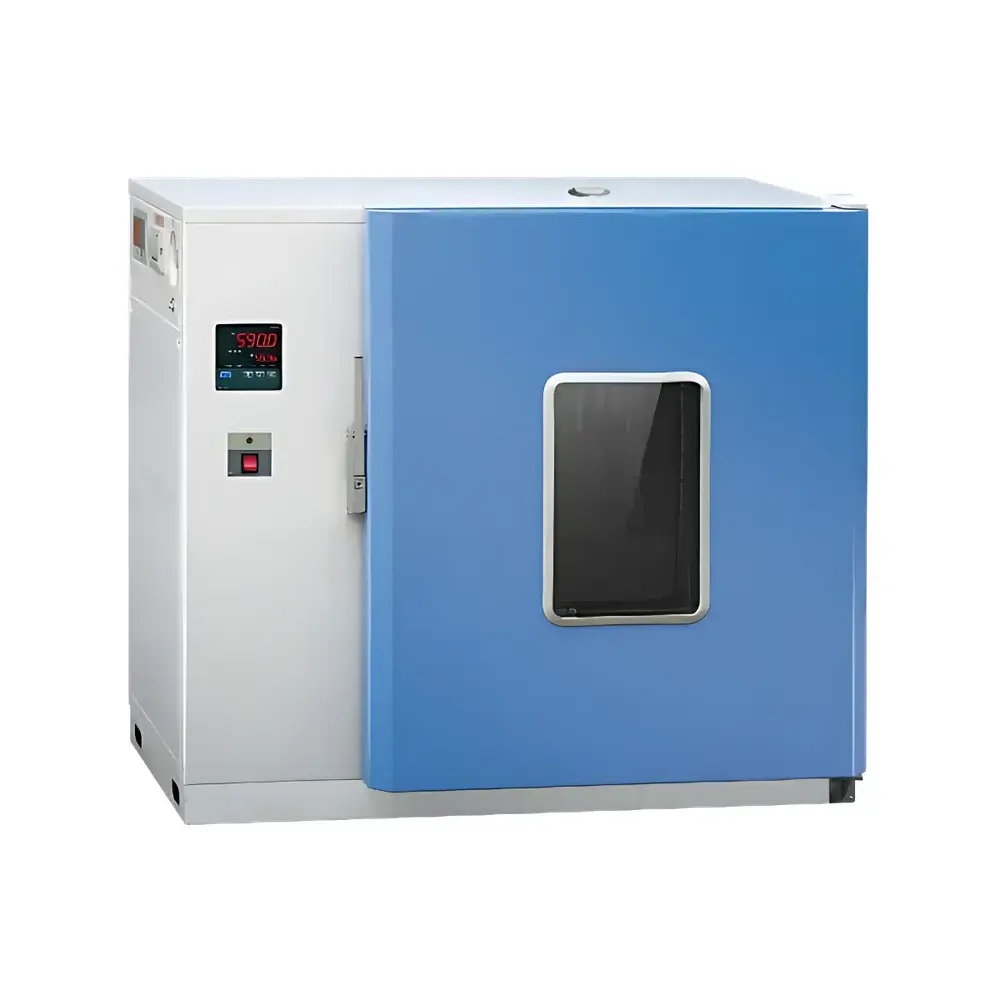
YSEI CS101-2ABN Forced-Air Constant-Temperature Drying Oven
| Brand | YSEI |
|---|---|
| Origin | Chongqing, China |
| Manufacturer Type | Direct Manufacturer |
| Product Category | Domestic Laboratory Equipment |
| Model | CS101-2ABN |
| Temperature Range | Ambient +20°C to 250°C |
| Temperature Uniformity | ±2.5°C |
| Temperature Fluctuation | ±1°C |
| Internal Chamber Dimensions (W×D×H) | 450×550×550 mm |
| External Dimensions (W×D×H) | 660×1020×790 mm |
| Chamber Material | Mirror-Finish SUS304 Stainless Steel |
| Heating Method | Electric Resistance Heating with Forced Air Circulation |
| Operating Ambient Temperature | 5–35°C |
| Relative Humidity Limit | ≤85% RH |
| Rated Power | 2000 W |
| Net Weight | 80 kg |
| Standard Shelving | 2 adjustable stainless steel shelves |
| Safety Features | Independent over-temperature cut-off protection |
Overview
The YSEI CS101-2ABN Forced-Air Constant-Temperature Drying Oven is a precision-engineered laboratory drying and thermal conditioning system designed for reproducible, stable heat treatment across scientific, industrial, and clinical environments. Built upon the principle of forced convection—where a calibrated axial fan circulates heated air uniformly throughout the insulated chamber—the oven ensures consistent thermal distribution critical for drying, baking, sterilization, moisture removal, and stability testing. Its operational temperature range spans from ambient +20°C up to 250°C, making it suitable for both low-temperature dehydration and high-temperature post-processing applications without thermal runaway risk. The unit complies with fundamental safety and performance expectations outlined in IEC 61010-1 (Safety Requirements for Electrical Equipment for Measurement, Control, and Laboratory Use) and aligns with general Good Laboratory Practice (GLP) infrastructure requirements for thermal validation.
Key Features
- Precision temperature control via microprocessor-based PID controller with digital LED display for real-time setpoint and actual chamber temperature monitoring
- Mirror-finish SUS304 stainless steel interior chamber—resistant to corrosion, easy to clean, and compliant with ISO 14644-1 Class 8 cleanroom-compatible surface standards
- Forced-air circulation system with rear-mounted centrifugal blower ensuring ≥90% airflow uniformity across the working volume
- Independent over-temperature safety cutoff circuit—mechanically isolated from the main control loop—to prevent thermal damage during controller failure or sensor drift
- Double-layer insulated door with silicone gasket seal minimizes thermal leakage and maintains external surface temperature below 45°C at maximum operating setpoint
- Two adjustable, load-rated stainless steel shelves included as standard; shelf positions are tool-free and height-adjustable in 25-mm increments
- Front-accessible air inlet and top-mounted exhaust port allow integration into local exhaust ventilation (LEV) systems where solvent vapor or particulate release is anticipated
Sample Compatibility & Compliance
The CS101-2ABN accommodates standard laboratory glassware (e.g., Petri dishes, weighing bottles, crucibles), polymer samples, pharmaceutical excipients, soil aggregates, and biological tissue specimens on inert supports. It is routinely deployed in ASTM D1654 (corrosion testing), ISO 554 (standard atmospheres for conditioning), and USP (sterilization by dry heat) workflows. While not certified for Class B autoclave equivalence, its thermal stability profile supports validation per IQ/OQ protocols under FDA 21 CFR Part 11-compliant documentation frameworks when paired with external data loggers. The unit meets CE marking requirements for electromagnetic compatibility (EMC Directive 2014/30/EU) and low-voltage safety (LVD Directive 2014/35/EU).
Software & Data Management
The CS101-2ABN operates as a standalone analog-digital hybrid instrument with no embedded network interface or proprietary software. All operational parameters—including setpoint, real-time temperature, elapsed time, and alarm status—are displayed locally. For audit-trail compliance, users may integrate third-party calibrated USB or SD-card data loggers (e.g., Omega OM-DAQPRO-5300 series) via the optional RS485 port (available upon request). Temperature profiles can be exported in CSV format for traceability in GLP/GMP environments. Firmware updates are performed manually via factory-programmed EEPROM; no remote update capability is provided, ensuring system integrity in regulated settings.
Applications
- Drying of moisture-sensitive powders, granules, and filter papers in QC/QA laboratories
- Baking of ceramic substrates and metallurgical samples prior to SEM or XRD analysis
- Thermal stabilization of reference standards before gravimetric calibration
- Residual solvent removal from coated films and thin-film photovoltaic layers
- Pre-conditioning of hygroscopic materials (e.g., Li-ion battery cathode precursors) under controlled humidity-limited ambient conditions
- Validation of thermal degradation kinetics per ICH Q1A(R2) guidelines for pharmaceutical intermediates
FAQ
What is the maximum validated temperature uniformity across the chamber volume?
At 120°C, uniformity is verified at ±2.5°C (9-point mapping per ISO 17025-accredited internal protocol); deviation increases marginally at extremes (±3.0°C at 250°C).
Can this oven be used for sterilization of surgical instruments?
It meets dry-heat sterilization time–temperature thresholds (e.g., 160°C for 120 min), but lacks built-in cycle validation, printout, or automated door interlock—thus requiring external validation per EN 554.
Is the chamber volume compliant with ASTM E145 Class II specifications?
Yes—the 0.136 m³ internal volume and forced-air design satisfy ASTM E145-22 Section 7.2.2 for “Gravity and Forced-Circulation Ovens” used in material testing.
Does the unit support ramp-soak programming?
No—this is a single-setpoint constant-temperature oven; multi-step thermal profiles require external programmable controllers.
What maintenance intervals are recommended for long-term accuracy?
Calibration of the PT100 sensor and verification of fan performance are advised annually; door gasket integrity should be inspected quarterly in high-use facilities.



