
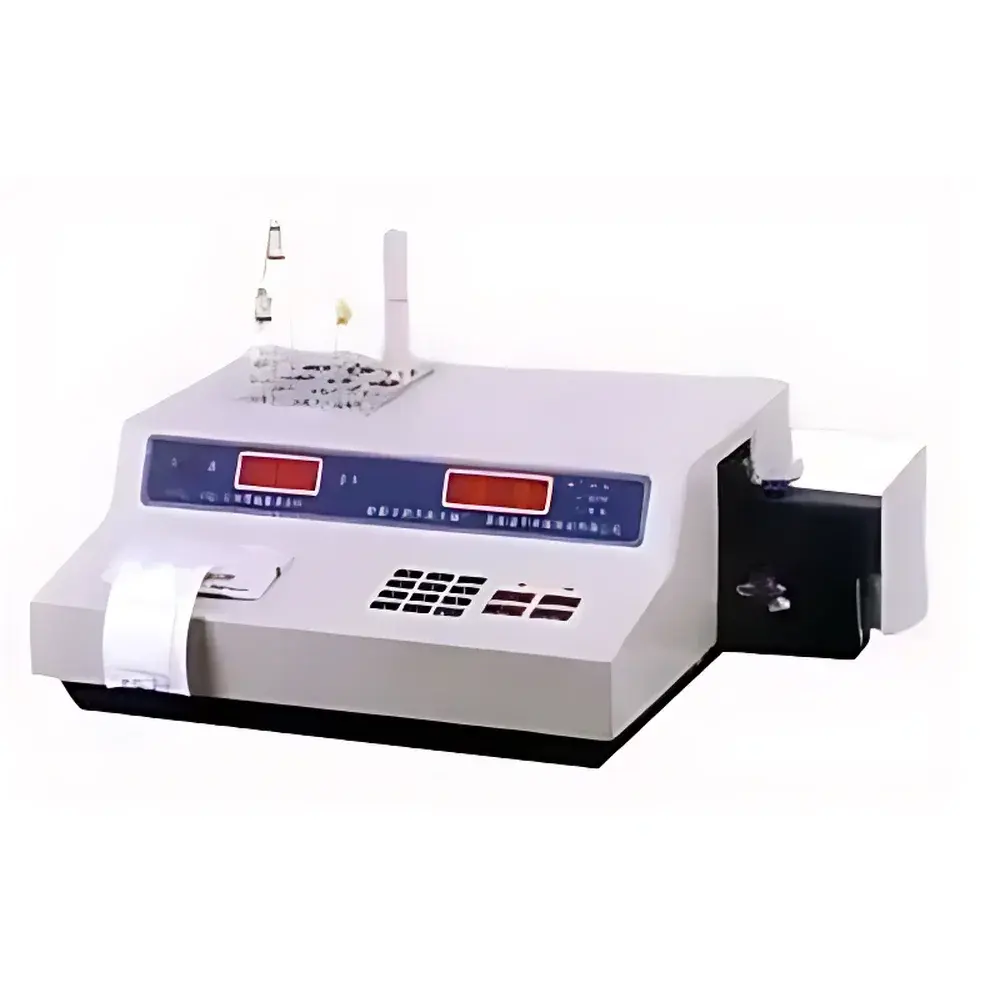
CTL-12 Chemical Oxygen Demand (COD) Analyzer
| Origin | Beijing, China |
|---|---|
| Manufacturer Type | Authorized Distributor |
| Origin Category | Domestic (China) |
| Model | CTL-12 |
| Pricing | Available Upon Request |
| Detection Limit | 5 mg/L COD |
| Measurement Range | 20–1200 mg/L COD |
| Repeatability | ≤0.87% |
| Optical Stability | 0.001 A/5 min |
| Sample Throughput | Up to 12 samples per batch |
| Digestion Time | 10 min at 165 °C |
| Measurement Wavelength | 610 nm |
| Chloride Interference Tolerance | ≤900 mg/L Cl⁻ (open-tube mode) |
| Data Storage | 9 pre-programmed calibration curves |
| Display | 5-digit LED (time, date, absorbance, concentration, slope) |
| Power Supply | 220 V, 50 Hz, 200–700 W |
Overview
The CTL-12 Chemical Oxygen Demand (COD) Analyzer is a dedicated benchtop instrument engineered for rapid, reliable quantification of chemical oxygen demand in aqueous environmental matrices—including municipal wastewater, surface water, seawater, and industrial effluents. It operates on the principle of catalyzed dichromate oxidation under strongly acidic conditions (H₂SO₄ medium), where organic and inorganic reductants are oxidized by potassium dichromate (K₂Cr₂O₇) in the presence of a proprietary composite catalyst. At 165 °C for 10 minutes, Cr(VI) is reduced to Cr(III), and the resulting Cr³⁺ concentration—measured spectrophotometrically at 610 nm—is linearly proportional to the COD value within the validated range (20–1200 mg/L), per the Lambert–Beer law. The method aligns with standardized protocols described in *Standard Methods for the Examination of Water and Wastewater*, 3rd Edition Supplement, including both open-vessel catalytic rapid digestion and sealed-tube high-chloride-resistant digestion variants.
Key Features
- Integrated digestion–colorimetry platform: Combines precise temperature-controlled heating (165 °C ± 0.5 °C), optical measurement, and digital data processing in a single compact unit.
- Cold-light LED source at 610 nm: Delivers stable photometric output with negligible thermal drift; eliminates lamp aging effects common in tungsten-halogen systems.
- Sealed digestion tube system: Enables robust interference suppression for chloride-rich samples (up to 10,000 mg/L Cl⁻), compliant with ASTM D1253-22 and ISO 6060:1989 adaptations for high-salinity matrices.
- Optical auto-zeroing and sealed cuvette chamber: Eliminates cell-matching errors and surface contamination, ensuring long-term baseline stability (optical drift < 0.001 A over 5 min).
- Onboard calibration management: Stores up to nine user-defined or factory-loaded calibration curves; supports slope-intercept validation and curve recall for multi-matrix analysis.
- Full-cycle automation: From digestion initiation to absorbance readout, concentration calculation, and result display—all executed without manual intervention between steps.
Sample Compatibility & Compliance
The CTL-12 accommodates diverse sample types: raw and treated wastewater, river and lake water, estuarine and marine samples, and high-organic-content industrial discharges. Its dual digestion modes support regulatory alignment with multiple national and international frameworks. The open-tube catalytic method conforms to China’s HJ/T 399–2007 and US EPA Method 410.4 adaptations for routine monitoring. The sealed-tube variant meets requirements for chloride tolerance outlined in ISO 15705:2002 and supports GLP-compliant workflows when paired with audit-trail-enabled data logging accessories. All digestion tubes comply with IEC 61000-4-3 EMC standards and feature pressure-relief safety design—ensuring operator protection even under extreme exothermic reaction conditions.
Software & Data Management
While the CTL-12 operates as a standalone instrument with embedded firmware, its analog output port (0–5 V DC) and RS-232 interface enable seamless integration with external LIMS or laboratory data acquisition systems. Internal memory retains measurement timestamps, absorbance values, calculated concentrations, and active curve identifiers. Printed reports—generated via optional thermal printer module—include full metadata: date/time, sample ID (user-entered), curve ID, slope/intercept, and raw absorbance. Instrument firmware supports traceable calibration verification per ISO/IEC 17025:2017 Clause 6.4.10 and satisfies documentation prerequisites for FDA 21 CFR Part 11–compatible environments when used with validated external software.
Applications
- Routine compliance monitoring for municipal wastewater treatment plants (WWTPs) subject to discharge permits (e.g., EU Urban Wastewater Treatment Directive, US Clean Water Act NPDES).
- Environmental field laboratories performing rapid turnaround analysis during pollution incident response or seasonal water quality surveys.
- Academic and governmental research labs conducting orthogonal experimental design (e.g., Taguchi methods) for optimizing oxidation kinetics or evaluating novel catalysts.
- Marine monitoring programs requiring accurate COD assessment in high-salinity coastal and offshore waters where chloride interference invalidates conventional open-reflux methods.
- Industrial pretreatment verification for food processing, pharmaceutical, and pulp/paper facilities managing variable-strength effluents.
FAQ
What digestion methods does the CTL-12 support?
It implements two standardized approaches: the open-vessel catalytic rapid method (per HJ/T 399–2007 and Standard Methods 5220D) and the sealed-tube high-chloride method (aligned with ISO 15705:2002).
Can the instrument be connected to a laboratory information management system (LIMS)?
Yes—via RS-232 serial interface or analog voltage output; third-party drivers are available for common LIMS platforms supporting ASCII-based data ingestion.
Is the 610 nm photometric channel validated against NIST-traceable standards?
The optical path is factory-calibrated using certified neutral density filters; users may perform periodic verification using CRMs such as NIST SRM 2034 (absorbance standard) or custom Cr³⁺ reference solutions.
Does the instrument meet requirements for auditable environmental reporting?
When operated with timestamped printouts and retained calibration logs, it fulfills minimum documentation criteria for ISO 14001 internal audits and EPA Region-specific QA/QC reporting templates.
What maintenance is required for long-term operational stability?
Annual verification of heater block uniformity, photometer linearity, and digestion tube integrity is recommended; no consumable optical components require replacement within the first 5 years of typical use.







