
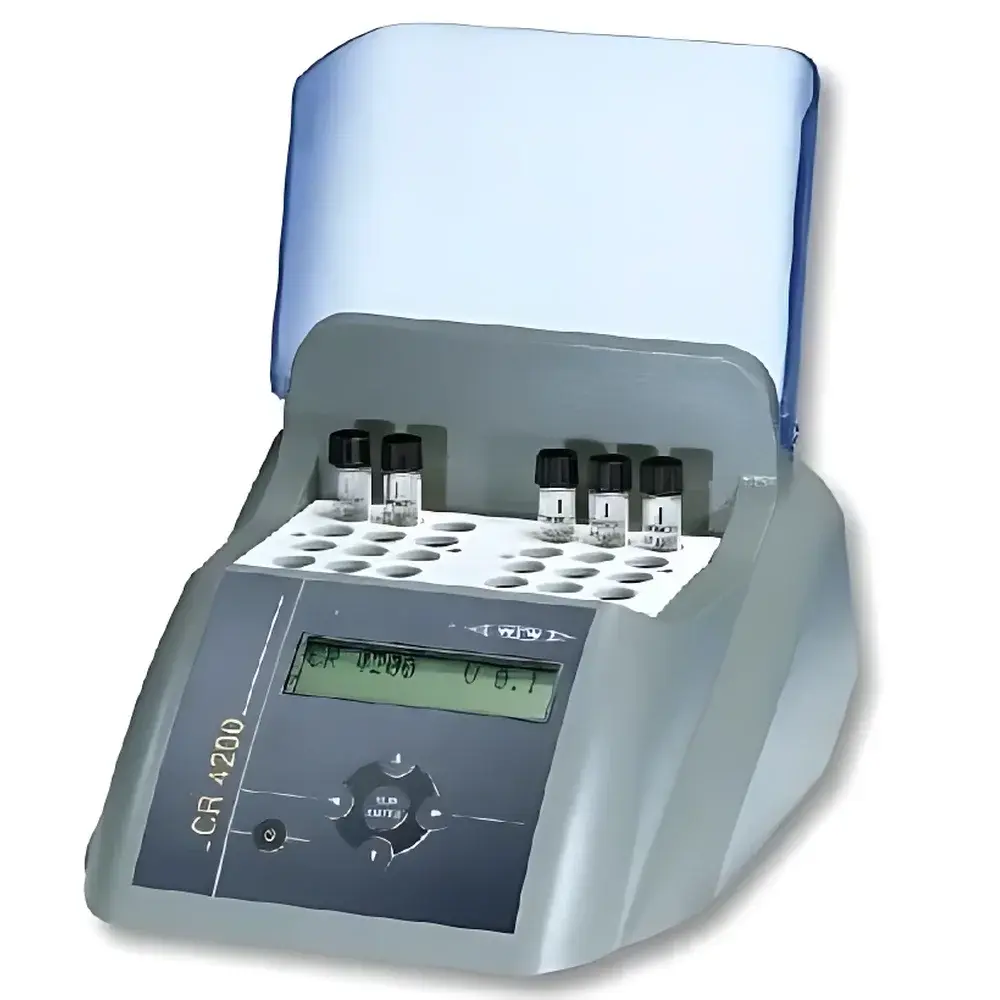
CR4200 Automated Digestion System
| Origin | Germany |
|---|---|
| Manufacturer Type | Authorized Distributor |
| Origin Category | Imported |
| Model | CR4200 |
| Pricing | Available Upon Request |
Overview
The CR4200 Automated Digestion System is a precision-engineered thermal reaction platform designed for standardized, reproducible sample digestion in environmental water quality laboratories. It operates on the principle of controlled conductive heating within calibrated metal block modules, enabling accurate thermal decomposition of organic and inorganic matrices prior to spectrophotometric or instrumental analysis (e.g., COD, total nitrogen, total phosphorus). Unlike open-flame or microwave-based systems, the CR4200 delivers uniform, stable temperature profiles across all reaction positions—critical for compliance with ASTM D1252 (COD), ISO 6060 (COD), EN 15972 (total phosphorus), and EPA Method 365.3 (phosphate). Its dual-zone architecture allows independent thermal control of two 12-position blocks, supporting parallel digestion under differing protocols without cross-contamination or thermal interference.
Key Features
- Dual independent heating zones: 2 × 12 slots for 16 mm OD digestion tubes, each zone programmable from 25 °C to 170 °C in 1 °C increments
- Precise thermal ramping: Reaches 100 °C in ~5 min, 148 °C in ~10 min, and 170 °C in ~12 min (typical ambient conditions)
- Preloaded method library: Seven validated digestion programs aligned with common regulatory standards (e.g., 148 °C/120 min for COD per ISO 6060; 120 °C/60 min for total phosphorus per EN 15972)
- Eight user-definable programs: Customizable temperature (25–170 °C) and duration (0–180 min) combinations with automatic start/stop sequencing
- Integrated safety architecture: Full-height polycarbonate safety shield, overtemperature cutoff, auto-shutdown upon program completion, and surface temperature limitation per DIN VDE 0700 Part 1 (11/90)
- Real-time thermal validation support: Optional external Pt100 probe interface (via dedicated slot) enables traceable calibration verification; temperature deviation logs exportable via RS232 to LIMS or lab notebooks
- Compliance-ready design: Certified to GS, CE, and cETLus safety standards; compatible with GLP/GMP documentation workflows through optional printer or PC data capture
Sample Compatibility & Compliance
The CR4200 accommodates standard borosilicate glass or quartz digestion tubes with 16 mm outer diameter—compatible with Hach, Lovibond, and other major reagent kits used in COD, TN, and TP assays. Tube geometry ensures optimal heat transfer and minimizes evaporation loss during extended high-temperature cycles. All thermal profiles meet repeatability requirements outlined in ISO/IEC 17025:2017 (clause 7.2.2) for equipment qualification. The system’s dual-zone capability supports method comparison studies or split-sample digestion under divergent conditions—essential for laboratory accreditation audits and inter-laboratory proficiency testing. Its electrical safety certification (GS, CE, cETLus) satisfies EU Machinery Directive 2006/42/EC and North American UL 61010-1 requirements for laboratory instrumentation.
Software & Data Management
The CR4200 operates via an integrated LED display with tactile membrane keypad—no external software required for routine operation. However, its unidirectional RS232 interface (DB9 connector) supports direct connection to laboratory PCs or printers for audit-trail generation. When paired with optional temperature validation probes, time-stamped temperature logs—including setpoint vs. actual readings at 10-second intervals—can be exported as CSV files. This functionality facilitates compliance with FDA 21 CFR Part 11 (electronic records/signatures) when integrated into validated LIMS environments. No proprietary drivers or cloud dependencies are involved; data exchange follows standard ASCII protocol for seamless integration with existing QA/QC reporting tools.
Applications
- Chemical Oxygen Demand (COD) determination per ISO 6060, ASTM D1252, and EPA 410.4
- Total nitrogen quantification using alkaline persulfate digestion (EN 15972, ISO 11908)
- Total phosphorus and orthophosphate analysis following acid persulfate or sulfuric-perchloric digestion (ISO 6878, EN ISO 15681-1)
- Heavy metal extraction from wastewater and sludge matrices prior to ICP-OES or AAS analysis
- Method development and validation studies requiring precise thermal profiling and thermal history documentation
- Quality control of digestion reagents and tube lot performance across multi-shift operations
FAQ
What safety certifications does the CR4200 hold?
The instrument carries GS (Germany Safety), CE (European Conformity), and cETLus (UL-listed for US/Canada) marks—fully compliant with DIN VDE 0700 Part 1 (11/90) for electrical safety in laboratory environments.
Can the CR4200 be used for EPA-compliant COD analysis?
Yes—it supports the 148 °C/120 min digestion protocol specified in EPA Method 410.4 and ISO 6060, provided paired with certified reagents and calibrated spectrophotometers.
Is temperature calibration traceable to national standards?
When equipped with the optional external Pt100 probe, users can perform on-site verification against NIST-traceable reference thermometers and generate printable calibration reports.
Does the system support GLP documentation requirements?
Through RS232 output and optional printer integration, it enables time-stamped thermal logs with operator ID fields—satisfying key elements of GLP Annex III (equipment use records) and ISO/IEC 17025 clause 7.7 (result reporting).
What is the maximum number of samples processed simultaneously?
24 samples (2 × 12 positions), with independent thermal control per block—enabling heterogeneous batch processing without manual intervention.
Related Products







