
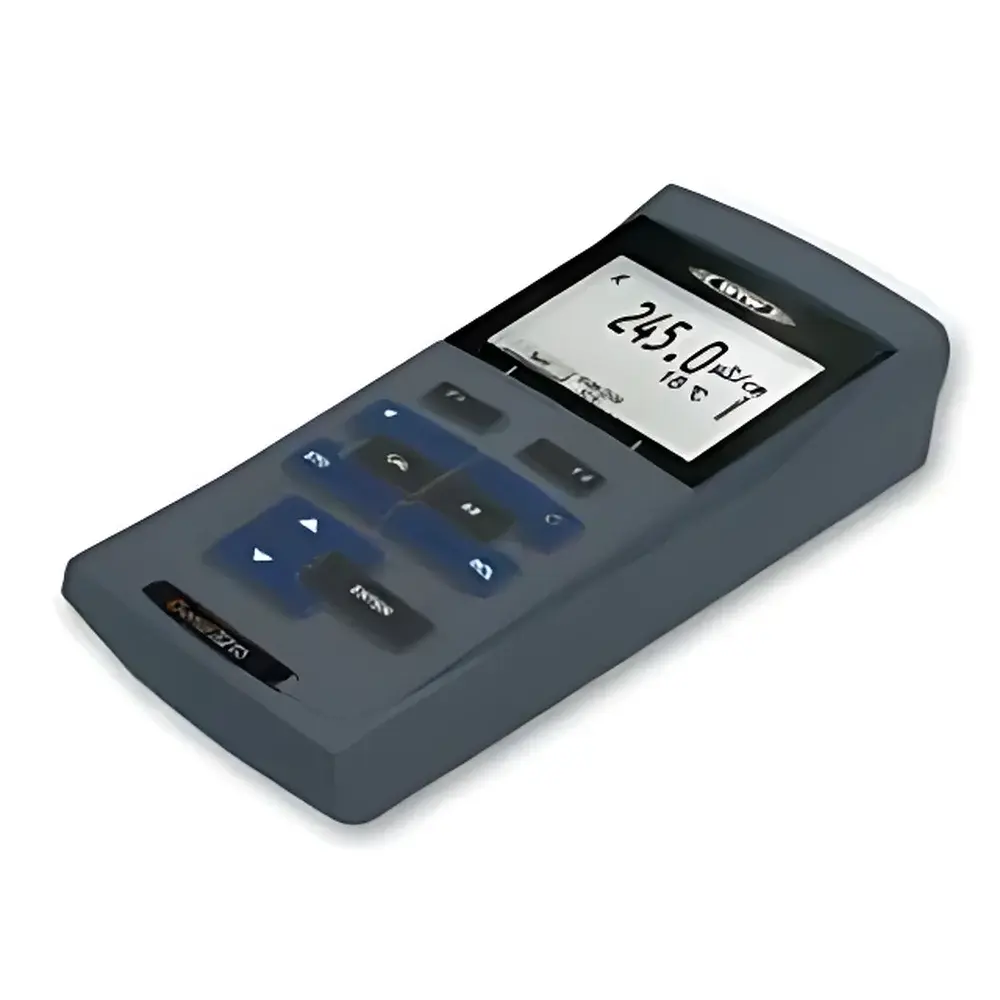
WTW Cond 3310 Portable Conductivity Meter
| Origin | Germany |
|---|---|
| Manufacturer Type | Authorized Distributor |
| Origin Category | Imported |
| Model | Cond 3310 |
| Pricing | Available Upon Request |
Overview
The WTW Cond 3310 Portable Conductivity Meter is a high-precision, field-deployable electrochemical instrument engineered for reliable, traceable conductivity, salinity, TDS, and temperature measurements in demanding environmental, industrial, and regulatory environments. Based on four-electrode (TetraCon®) conductivity measurement technology, it eliminates polarization errors and electrode surface fouling effects—critical for long-term unattended monitoring in wastewater, surface water, groundwater, aquaculture, pharmaceutical water systems, and food & beverage production. Unlike conventional two-electrode cells, the TetraCon principle separates current-carrying and voltage-sensing electrodes, ensuring linear response across an exceptionally wide dynamic range (0.0001 µS/cm to 1000 mS/cm) while maintaining stability under variable flow conditions and minimal immersion depth requirements. Its robust architecture integrates automatic temperature compensation (ATC), reference temperature selection (20 °C or 25 °C), and configurable non-linear temperature compensation (nlF) for high-fidelity data in natural waters with complex ionic composition.
Key Features
- Four-electrode TetraCon® sensor technology with built-in Pt1000 temperature probe for simultaneous, drift-free conductivity and temperature acquisition
- IP66/IP67-rated housing with fully sealed silicone keypad and 100% waterproof USB port—certified for continuous outdoor operation in rain, dust, and submersion up to 1 m for 30 min
- Backlit graphical LCD display with real-time trend plotting—enabling legible readings in low-light or nighttime field conditions
- Intelligent interval-controlled data logging: stores up to 5,000 automated records with user-defined time intervals (1 s to 24 h)
- Haptic feedback keys and context-sensitive text menu for intuitive navigation without training dependency
- Integrated calibration timer with automatic validation alerts—ensures measurement integrity between scheduled calibrations per GLP/GMP workflows
- Multi-point calibration support (1–5 points) with auto-recognition of 16 certified DIN and NIST buffer standards; calibration history retains up to 5 sessions
- Continuous Measurement Control (CMC): real-time validity flagging—visual indicator when reading falls within calibrated range; audible/visual alarm upon deviation
- Extended battery life: up to 800 hours on 4×AA alkaline batteries (100 hours with backlight enabled)
- Electrode constant adjustment range from 0.090 to 715 cm⁻¹—including fixed K=0.01, 0.1, 0.475, and 1.0 cm⁻¹ options for specialized applications
Sample Compatibility & Compliance
The Cond 3310 supports direct immersion, flow-through, and dip-style measurement configurations via interchangeable WTW TetraCon and LR series electrodes. It complies with international standard methodologies including ISO 7888 (electrical conductivity of water), ASTM D1125 (conductivity of water), and USP (water for pharmaceutical use). For regulated environments, its data integrity framework aligns with FDA 21 CFR Part 11 requirements when used with WTW’s LabX software (audit trail, electronic signature, and secure export). The instrument meets EN 61326-1 (EMC for laboratory equipment) and EN 61010-1 (safety requirements for electrical equipment). Electrode compatibility includes TetraCon 325 (K=0.475 cm⁻¹), TetraCon 397 (K=1.0 cm⁻¹), LR 325/01 (K=0.1 cm⁻¹), and LR 325/001 (K=0.01 cm⁻¹) for ultra-pure water applications down to 0.0001 µS/cm.
Software & Data Management
Data transfer occurs via isolated USB 2.0 interface—no external power required during connection. Raw datasets (including timestamps, temperature, conductivity, salinity, TDS, and electrode status) export in CSV or Excel-compatible formats. When paired with WTW LabX Light or LabX Pro software, the Cond 3310 enables full audit-trail generation, calibration certificate printing, statistical process control (SPC) charting, and automated report generation compliant with ISO/IEC 17025 and GxP documentation standards. All stored measurements include metadata such as operator ID, location tag (manually entered), calibration ID, and environmental conditions—supporting traceability in QA/QC and environmental monitoring programs.
Applications
- Environmental monitoring: long-term conductivity profiling of rivers, lakes, estuaries, and coastal seawater—integrated with salinity and TDS conversion per IOT (International Oceanographic Table)
- Wastewater treatment plants: effluent compliance testing per EPA Method 120.1 and EU Directive 2000/60/EC
- Pharmaceutical water systems: PW, WFI, and pure steam condensate verification per USP , EP 2.2.38, and JP 2.05
- Aquaculture and hydroponics: real-time salinity and ionic strength monitoring for species-specific water quality control
- Boiler feedwater and demineralized water loops: ultra-low conductivity verification using LR 325/001 electrode (0.0001–30 µS/cm)
- Food & beverage production: CIP rinse water validation, syrup concentration checks, and brine consistency control
- Swimming pool and aquarium management: automated conductivity-based dosing feedback for chlorine and pH stabilization
FAQ
What electrode types are compatible with the Cond 3310?
The instrument supports all WTW TetraCon and LR series conductivity sensors—including TetraCon 325 (K=0.475 cm⁻¹), TetraCon 397 (K=1.0 cm⁻¹), LR 325/01 (K=0.1 cm⁻¹), and LR 325/001 (K=0.01 cm⁻¹)—via standardized BNC or 6-pin mini-DIN connectors.
Does the Cond 3310 meet FDA 21 CFR Part 11 requirements?
The hardware itself does not enforce electronic signatures or audit trails; however, when connected to WTW LabX Pro software with configured user roles, digital signatures, and encrypted database logging, full Part 11 compliance is achievable for regulated laboratories.
Can the device perform automatic temperature compensation for non-aqueous samples?
ATC is optimized for aqueous solutions using Pt1000 input. For non-aqueous media, manual temperature coefficient entry (0.000–10.00 %/K) or nlF mode is recommended, though validation against reference standards is required per ISO 17025.
How is calibration verification performed between scheduled calibrations?
The integrated calibration timer triggers visual prompts at user-defined intervals. Additionally, CMC continuously compares live readings against stored calibration bounds and issues immediate alerts if values exceed ±5% of the nearest calibration point.
Is the USB interface suitable for use in wet field conditions?
Yes—the USB port features a molded, gasket-sealed cap rated IP67, allowing safe connection even during rain or high-humidity deployments without risk of ingress or short-circuiting.




