
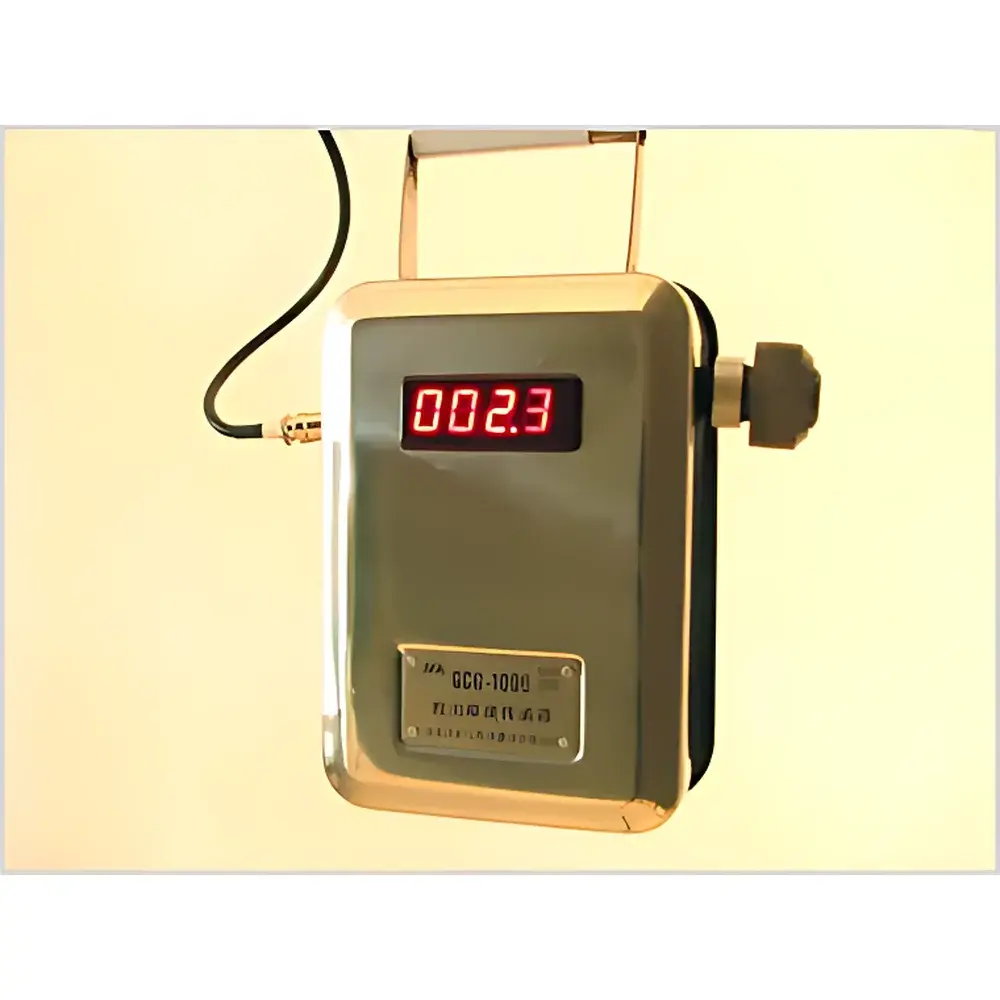
GCG1000 Online Dust Concentration Sensor
| Origin | Beijing |
|---|---|
| Manufacturer Type | Authorized Distributor |
| Origin Category | Domestic (PRC) |
| Model | GCG1000 |
| Pricing | Available Upon Request |
| Measurement Principle | Optical Scattering |
| Range | 0–1000 mg/m³ |
| Accuracy | ≤ ±10% |
| Sampling Flow Rate | 2 L/min |
| Output Options | 200–1000 Hz Frequency Signal or RS485 |
| Display | 4-digit LED |
| Alarm Output | 1-channel Optocoupler |
| Power Supply | 18 V DC (Intrinsically Safe) |
| Current Draw | ≤ 200 mA |
| Dimensions | 270 × 145 × 73 mm |
| Weight | 1.6 kg |
| Explosion Protection | Exib I |
| Operating Environment | 0–40 °C, ≤95% RH, 86–110 kPa |
Overview
The GCG1000 Online Dust Concentration Sensor is an intrinsically safe, real-time particulate mass concentration monitor engineered for continuous environmental monitoring in hazardous underground mining environments. It operates on the principle of optical scattering—specifically, laser-based light scattering—to quantify total suspended particulate (TSP) mass concentration in air. When airborne dust particles pass through the sensor’s illuminated sampling chamber, they scatter incident laser light proportionally to their size and concentration. A calibrated photodetector captures the scattered intensity, and an embedded microprocessor applies algorithmic compensation for particle refractive index, humidity effects, and flow dynamics to compute mass concentration (mg/m³) in real time. Designed to meet stringent safety and metrological requirements for coal mine applications, the GCG1000 complies with MT163-1997 (General Technical Specifications for Direct-Reading Dust Concentration Meters), Q/320581ESD001-2008 (Enterprise Standard for GCG1000), and GB3836.4-2000 for explosion-proof instrumentation (Exib I classification). Its robust architecture supports uninterrupted operation under high-humidity, high-dust, and methane-rich atmospheres typical of underground coal mines.
Key Features
- Intrinsically safe design certified to Exib I standard per GB3836.4-2000, enabling deployment in methane- and coal-dust-explosive atmospheres.
- Laser-based optical scattering detection system optimized for high sensitivity and long-term stability in harsh industrial environments.
- Integrated precision sampling pump delivering a constant 2 L/min volumetric flow rate, ensuring representative aerosol intake across variable pressure and humidity conditions.
- Dual-output interface options: configurable 200–1000 Hz frequency signal for legacy mine monitoring systems or industry-standard RS485 Modbus RTU protocol for integration into modern SCADA or DCS platforms.
- On-device 4-digit LED display provides immediate local readout of real-time dust concentration without external instrumentation.
- Single-channel optocoupler alarm output enables direct connection to supervisory safety relays or audible/visual warning devices for threshold-triggered response.
- Compact form factor (270 × 145 × 73 mm) and lightweight construction (1.6 kg) facilitate wall-mounting, boom installation, or portable deployment within confined mine entries and conveyor zones.
Sample Compatibility & Compliance
The GCG1000 is validated for continuous measurement of total dust mass concentration in ambient air containing respirable and inhalable coal dust, rock dust, and mixed mineral particulates typical of underground coal mining operations. It is not intended for aerosols containing volatile organic compounds, fibrous materials (e.g., asbestos), or highly reflective metallic particles unless empirically recalibrated. The sensor meets regulatory expectations for routine occupational exposure monitoring under China’s AQSIQ and State Administration of Work Safety guidelines. While not formally certified to ISO 7213 or EN 481, its optical scattering methodology aligns with the physical basis of those standards for total dust assessment. Its intrinsic safety rating satisfies mandatory requirements for equipment installed in Zone 0/1 explosive atmospheres per IEC 60079-0 and GB3836 series.
Software & Data Management
The GCG1000 operates as a stand-alone analog/digital transducer and does not include onboard data logging or proprietary software. However, its RS485 interface supports seamless integration with third-party industrial data acquisition systems compliant with Modbus RTU protocol (function codes 03/04). When connected to a central mine monitoring platform, it delivers timestamped concentration values at user-configurable polling intervals (default: 1–10 s). For auditability and regulatory traceability, system integrators are advised to implement full GLP-compliant data handling—including metadata tagging (sensor ID, calibration date, operator ID), secure storage, and 21 CFR Part 11–compatible electronic signatures where required for health and safety reporting.
Applications
- Real-time total dust concentration monitoring at coal face, belt conveyors, drilling stations, and loading points in underground mines.
- Integration into mine-wide environmental surveillance networks for automated ventilation control and dust suppression system triggering.
- Compliance verification against national occupational exposure limits (e.g., China’s PC-TWA for coal dust: 2.5 mg/m³).
- Preventive maintenance support by correlating dust spikes with equipment wear patterns (e.g., crusher degradation, conveyor belt slippage).
- Baseline environmental characterization during mine development and post-blast air quality assessment.
FAQ
What dust particle size range does the GCG1000 measure?
The GCG1000 reports total dust mass concentration without size-selective fractionation; it responds to airborne particles typically ranging from ~0.5 µm to >100 µm, consistent with the definition of total suspended particulate (TSP) in mining hygiene practice.
Is field calibration required, and how often?
Yes—calibration using NIST-traceable reference dust (e.g., ISO A1 test dust) is recommended before initial deployment and at least every 3 months under continuous operation, or after any mechanical impact, filter clogging, or optical window contamination.
Can the GCG1000 be used in surface applications?
While technically functional, its Exib I certification and operational specifications (e.g., humidity tolerance, temperature range) are optimized for underground coal mine environments; surface use requires validation against local explosion protection regulations and environmental durability requirements.
Does the sensor require consumables or replaceable parts?
The primary maintenance item is the inlet filter, which must be inspected and replaced periodically based on dust loading; the laser diode and photodetector are solid-state components rated for ≥20,000 hours of operation under specified conditions.







