
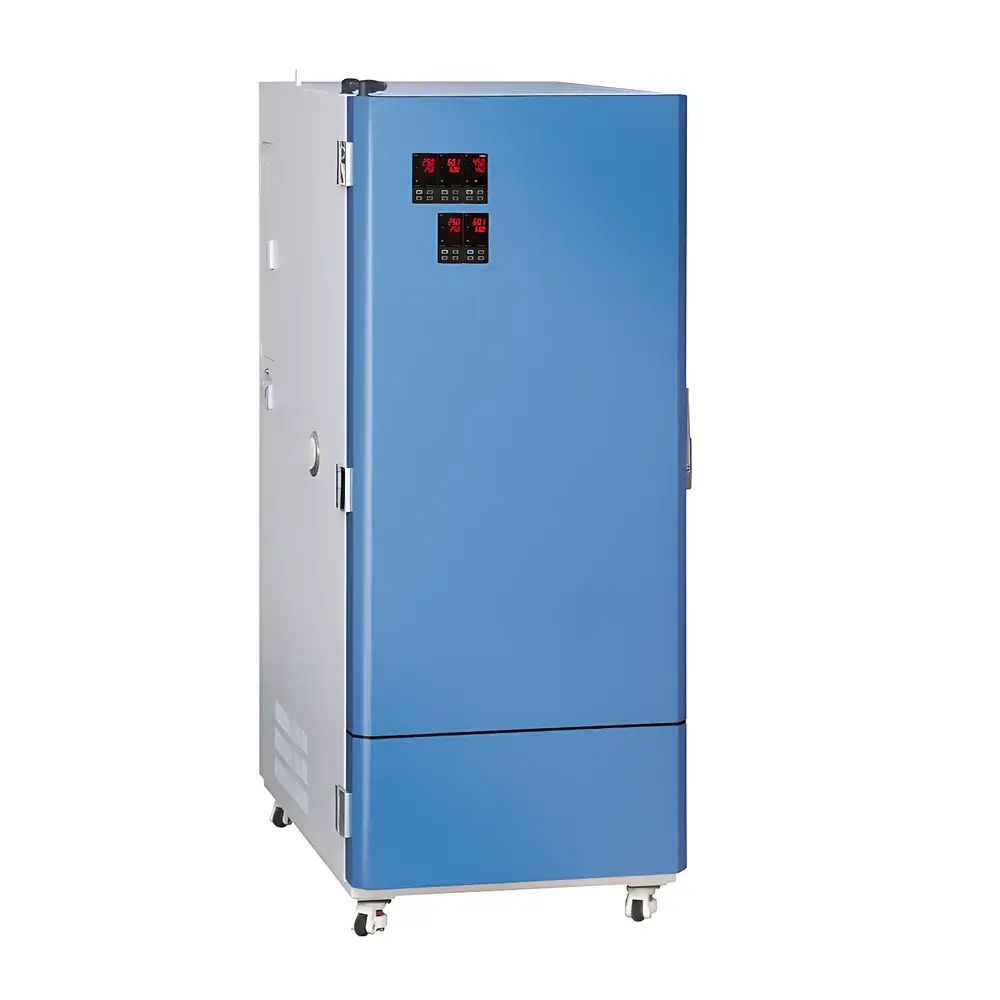
YSEI SHH-400GD-2F Drug Photostability Testing Chamber
| Brand | YSEI |
|---|---|
| Origin | Chongqing, China |
| Manufacturer Type | Direct Manufacturer |
| Country of Origin | China |
| Model | SHH-400GD-2F |
| Pricing | Available Upon Request |
| Dimensions (D×W×H) | 650 × 750 × 1850 mm |
| Illumination Uniformity | ±10% across test chamber floor |
| Light Source | UV-A + Visible LED Array (320–400 nm & 400–800 nm) |
| Total Illuminance Requirement | ≥1.2 × 10⁶ lux·hr (per ICH Q1B) |
| Near-UV Energy Dose | ≥200 W·hr/m² (320–400 nm) |
| Photometric Control Accuracy | ±500 lux (target 4500 lux per ChP 2015) |
| Operating Temperature Range | 25 ± 2 °C (ambient-controlled mode) |
| Ambient Conditions | 5–35 °C, ≤85% RH |
| Power Consumption | 2.8 kW (at 25 °C steady state) |
| Safety Protections | Independent overtemperature cutoff, compressor overload protection, door interlock |
| Data Logging | Dual-channel — real-time RS485 digital export + thermal printer (adjustable interval) |
| Remote Capability | TCP/IP-enabled |
| Compliance | ICH Q1B, USP <1191>, FDA Guidance on Photosensitivity Testing, ChP 2015 Vol. IV “Stability Testing of Chemical Drugs”, ISO/IEC 17025-aligned validation support |
Overview
The YSEI SHH-400GD-2F Drug Photostability Testing Chamber is an engineered environmental simulation system designed specifically for compliance-driven photostability assessment of pharmaceutical substances and products in accordance with ICH Q1B, FDA Guidance for Industry (Photosensitivity Testing), and the Chinese Pharmacopoeia (ChP) 2015 Edition, Volume IV. It operates on the principle of controlled, spectrally defined irradiation exposure—combining high-intensity visible light (400–800 nm) and near-ultraviolet radiation (320–400 nm)—to accelerate photochemical degradation pathways under standardized thermal and photometric conditions. The chamber maintains a stable 25 °C operating temperature while delivering uniform illumination across its internal test volume, enabling reproducible determination of light-induced changes in active pharmaceutical ingredients (APIs), excipients, and final dosage forms. Its architecture integrates dual-spectrum LED arrays calibrated to meet both total illuminance (≥1.2 × 10⁶ lux·hr) and near-UV energy dose (≥200 W·hr/m²) requirements specified in ICH Q1B, eliminating reliance on mercury-vapor or xenon arc lamps that exhibit spectral drift and thermal instability.
Key Features
- High-fidelity photometric control: Real-time feedback loop maintains ±500 lux accuracy at the target 4500 lux level (ChP 2015 requirement) and ensures spectral energy distribution conforms to ICH Q1B weighting functions.
- Dual-path data integrity: Simultaneous thermal-printed hardcopy records (user-configurable print intervals) and timestamped digital logs via isolated RS485 interface—supporting ALCOA+ principles for audit readiness.
- Scalable remote supervision: Ethernet-enabled architecture allows centralized monitoring and parameter adjustment of up to 30 SHH-GD-series units from a single host PC, facilitating multi-site stability programs and cross-laboratory protocol harmonization.
- Thermally decoupled optical system: LED-based illumination minimizes radiant heat load, enabling precise chamber temperature regulation without compensatory cooling overcapacity or localized hot spots.
- Compliance-ready safety architecture: Independent overtemperature cutoff circuitry, refrigeration compressor overload protection, and electromechanical door interlock prevent uncontrolled thermal or photic exposure during operational anomalies.
Sample Compatibility & Compliance
The SHH-400GD-2F accommodates standard pharmaceutical packaging configurations—including open petri dishes, amber vials, blister cards, and unit-dose strips—on its adjustable, non-reflective black anodized aluminum sample trays. Illumination uniformity is validated per ICH Q1B Annex 2 methodology across a 500 × 500 mm working plane, with deviation limited to ±10%. The system satisfies regulatory expectations for photostability testing as defined in ICH Q5C (Quality of Biotechnological Products), USP (Photostability Testing), and FDA’s 2022 Draft Guidance on Photosensitivity Testing of Drug Substances and Products. Full IQ/OQ documentation packages—including installation qualification protocols, operational qualification test scripts, calibration certificates traceable to NIM (National Institute of Metrology, China), and electronic signature-compliant execution reports—are available upon request to support GLP, GMP, and 21 CFR Part 11 compliance.
Software & Data Management
Data acquisition and instrument control are managed through YSEI’s proprietary StabilityLink™ software suite (v3.2+), compatible with Windows 10/11 x64 platforms. The software provides real-time graphical display of illuminance (lux), near-UV irradiance (W/m²), chamber temperature (°C), and cumulative exposure metrics (lux·hr, W·hr/m²). All logged parameters include millisecond-level timestamps, user ID tagging, and change-history tracking. Export formats include CSV, PDF summary reports, and XML-compatible structured data—enabling seamless integration with LIMS, ELN, and electronic validation systems. Audit trail functionality complies with 21 CFR Part 11 requirements, including role-based access control, electronic signatures, and immutable record retention.
Applications
- ICH Q1B-compliant forced degradation studies for new molecular entities (NMEs) and generic drug submissions.
- Comparative photostability evaluation of alternative packaging materials (e.g., HDPE vs. COP vials, opaque vs. translucent blisters).
- Excipient compatibility screening under accelerated photic stress to identify catalytic impurities or sensitizers.
- Stability protocol development for biologics and peptide therapeutics susceptible to UV-mediated oxidation or deamidation.
- Regulatory submission support for ANDA, NDA, and MAA dossiers requiring documented photostability data per regional pharmacopoeial standards.
FAQ
Does the SHH-400GD-2F meet FDA 21 CFR Part 11 requirements for electronic records and signatures?
Yes—StabilityLink™ software includes full Part 11 compliance features: audit trails with immutable timestamps, role-based user authentication, electronic signature workflows, and secure data export protocols.
Can the chamber be validated for GMP environments?
Yes—YSEI provides IQ/OQ documentation packages aligned with ISO/IEC 17025 and PIC/S TR-007 guidelines, including calibration traceability, performance verification tests, and change control templates.
What is the recommended recalibration interval for photometric sensors?
Annual recalibration against NIM-traceable reference standards is recommended; field verification using YSEI’s certified reference illuminance meter (Cat. No. YLM-2000) is supported quarterly.
Is the system compatible with third-party LIMS or ELN platforms?
Yes—via RS485 Modbus RTU or TCP/IP Modbus TCP protocols, enabling bidirectional data exchange with major laboratory informatics systems including LabVantage, Thermo Fisher SampleManager, and Dotmatics.
How is illumination uniformity verified during routine operation?
Uniformity mapping is performed during OQ using a 5 × 5 grid per ICH Q1B Annex 2; users may conduct simplified spot checks using the included handheld lux/UV meter and pre-defined grid template.




