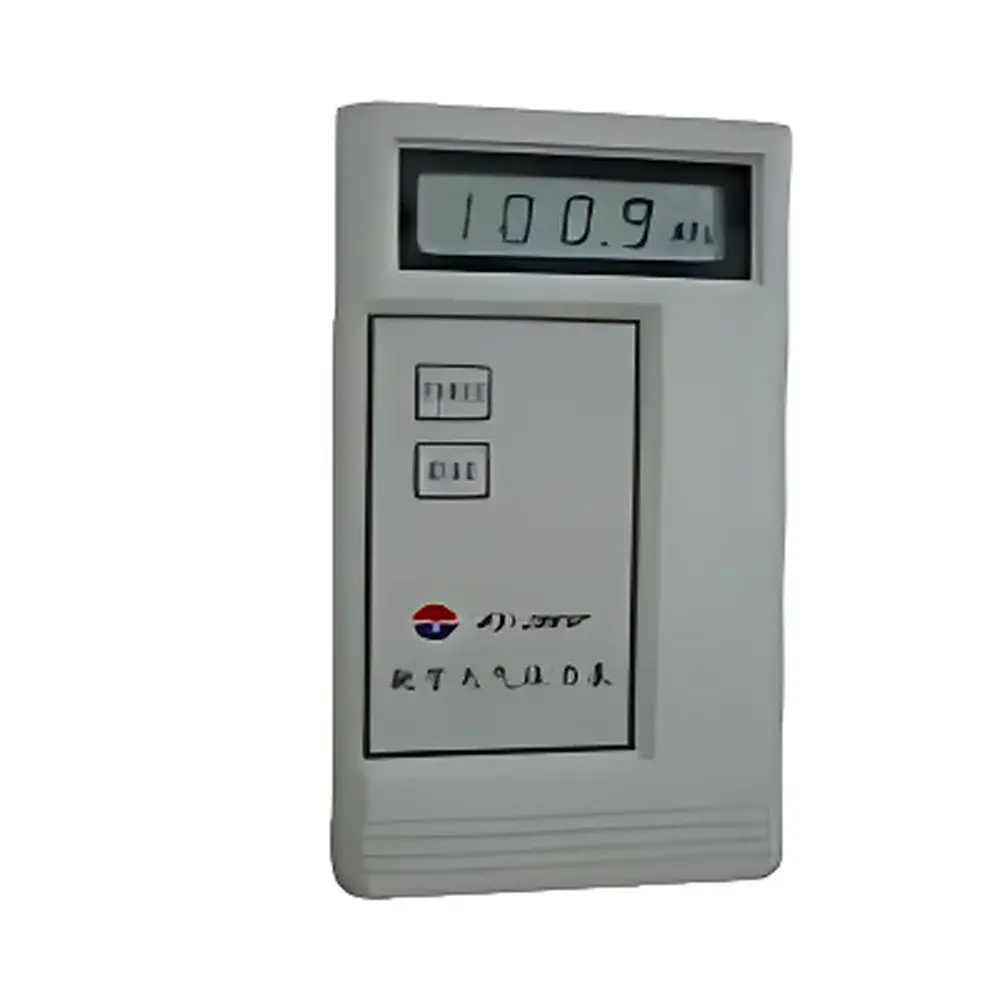
BY-2003P Handheld Digital Barometer
| Origin | Beijing |
|---|---|
| Manufacturer Type | Distributor |
| Origin Category | Domestic (China) |
| Model | BY-2003P |
| Pricing | Upon Request |
| Range | 80–110 kPa |
| Accuracy | ±0.5% FS |
| Display Resolution | 0.1 kPa |
| Operating Temperature | 5–50 °C |
| Power Supply | 9 V alkaline battery |
| Dimensions | 140 × 76 × 31 mm |
| Display | 3½-digit LCD |
| Weight | ~190 g (including battery) |
Overview
The BY-2003P Handheld Digital Barometer is a portable, field-deployable instrument engineered for precise atmospheric pressure measurement in ambient environments. It operates on the principle of piezoresistive or capacitive pressure transduction—typical of modern digital barometric sensors—converting absolute air pressure into a calibrated electrical signal, which is then processed and displayed with high repeatability. Designed for operational simplicity and environmental robustness, the device delivers traceable measurements within its specified range (80–110 kPa), covering standard sea-level to moderate high-altitude atmospheric conditions. Its compact form factor and low-power architecture make it suitable for mobile deployment where fixed-installation instrumentation is impractical—particularly in outdoor calibration verification, field meteorological surveys, and laboratory reference checks.
Key Features
- High-stability sensor core with ±0.5% full-scale accuracy—validated against NIST-traceable reference standards during production calibration.
- 3½-digit LCD display providing real-time resolution of 0.1 kPa, enabling discrimination of subtle barometric trends critical for weather forecasting and altitude estimation.
- Ruggedized handheld enclosure (140 × 76 × 31 mm) constructed from impact-resistant ABS housing, rated for operation across 5–50 °C ambient temperatures and typical indoor/outdoor humidity levels (non-condensing).
- Low-power design powered by a single 9 V alkaline battery, supporting continuous operation exceeding 100 hours under normal usage; integrated auto-shutdown minimizes standby drain.
- Dedicated HOLD function allows users to freeze the current reading for recording or comparison—essential for synchronized multi-point monitoring or documentation under GLP-compliant workflows.
- EMI-hardened circuitry ensures reliable performance in electromagnetically noisy industrial zones, military field deployments, or near RF-emitting equipment without signal corruption.
Sample Compatibility & Compliance
The BY-2003P measures ambient atmospheric pressure only—it does not interface with process lines, sealed vessels, or fluid media. As a direct-reading absolute pressure instrument, it requires unobstructed exposure of its vented sensing port to ambient air. No sample preparation, conditioning, or auxiliary gas supply is required. The device complies with general electromagnetic compatibility requirements per IEC 61326-1 (industrial environment), and its mechanical construction meets IP20 ingress protection specifications. While not certified to ISO/IEC 17025 as a standalone calibration standard, it is routinely employed as a secondary reference in laboratories maintaining ISO 9001 quality systems. For regulatory applications involving environmental monitoring or aviation support, users are advised to perform periodic verification against a primary barometric standard accredited to ISO/IEC 17025.
Software & Data Management
The BY-2003P is a self-contained, standalone instrument with no embedded data logging, Bluetooth, or USB connectivity. All measurements are displayed locally and retained only while power remains active or until manually held via the HOLD function. This architecture intentionally eliminates firmware dependencies, cybersecurity vulnerabilities, or software validation overhead—making it ideal for regulated environments where auditability and operational transparency are prioritized over digital integration. Users requiring archival capability may pair the device with external manual logbooks or validated electronic lab notebooks (ELNs) compliant with FDA 21 CFR Part 11 when used in GxP contexts. Calibration records—including date, technician ID, reference standard ID, and deviation values—should be maintained per organizational SOPs aligned with GLP/GMP principles.
Applications
- Meteorological fieldwork: Real-time barometric trend tracking for short-term weather prediction, storm front detection, and station intercomparison.
- Altitude profiling: Supporting drone calibration, parachute deployment modeling, and UAV flight envelope validation where local QNH/QFE determination is required.
- Environmental chamber monitoring: Verifying atmospheric baseline stability during accelerated aging tests or climate simulation studies.
- Sports science: Assessing barometric influence on physiological metrics (e.g., VO₂ max corrections) at varying elevations during athletic training or competition.
- Defense & civil emergency response: Rapid atmospheric assessment prior to chemical/biological agent dispersion modeling or CBRN reconnaissance operations.
- Academic research: Undergraduate physics labs studying gas laws, thermodynamic cycles, or fluid statics—where affordability, portability, and pedagogical clarity are essential.
FAQ
Is the BY-2003P suitable for measuring pressure inside sealed containers or pipelines?
No. It is an absolute atmospheric pressure meter with a vented sensor; it must be exposed directly to ambient air.
Does the device require annual recalibration?
While not mandatory, we recommend verification against a traceable reference standard at least once per year—or before critical measurement campaigns—to ensure continued conformance with ±0.5% FS specification.
Can it operate in sub-zero temperatures?
The specified operating range is 5–50 °C; extended cold exposure may affect battery performance and LCD response time, and is outside validated performance limits.
Is the 9 V battery user-replaceable?
Yes. Standard PP3-type 9 V alkaline batteries are used; replacement requires no tools and does not void calibration.
What does “FS” mean in the accuracy specification?
“FS” denotes Full Scale—here, 110 kPa—so ±0.5% FS equals ±0.55 kPa maximum error across the entire 80–110 kPa range.