
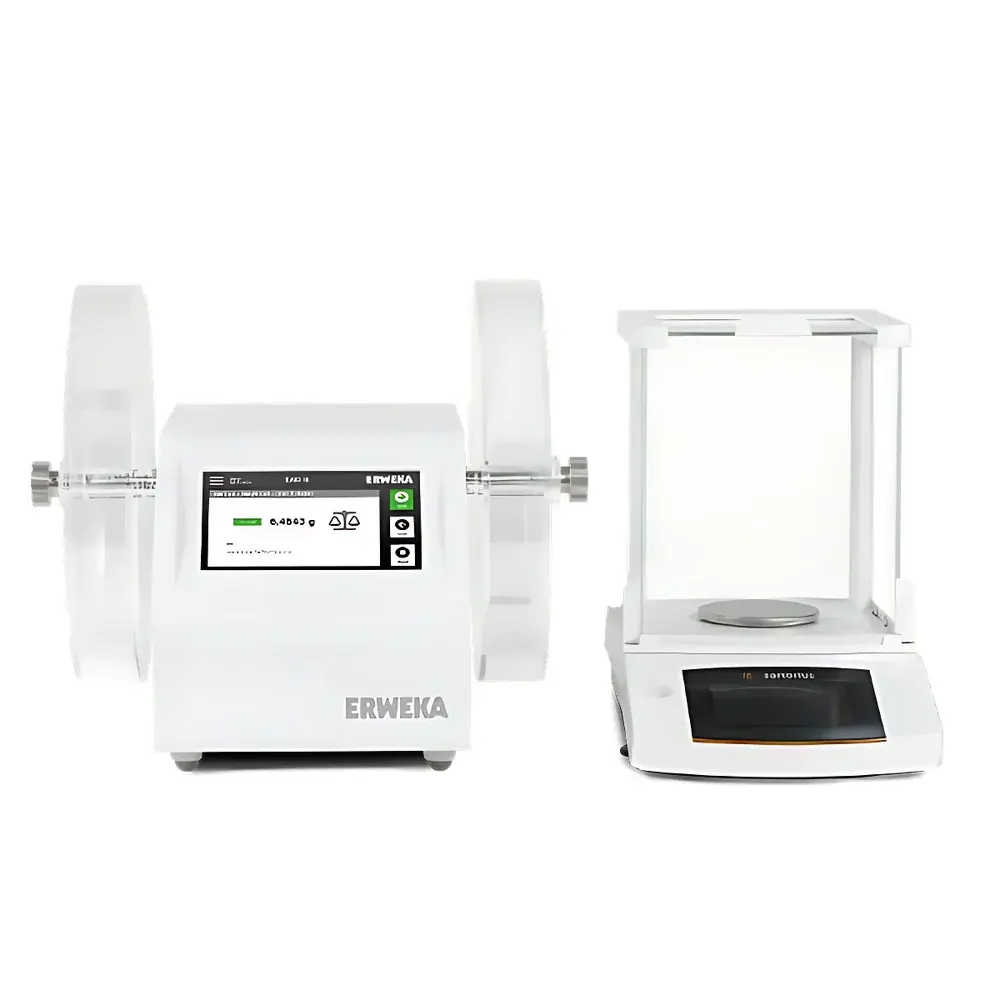
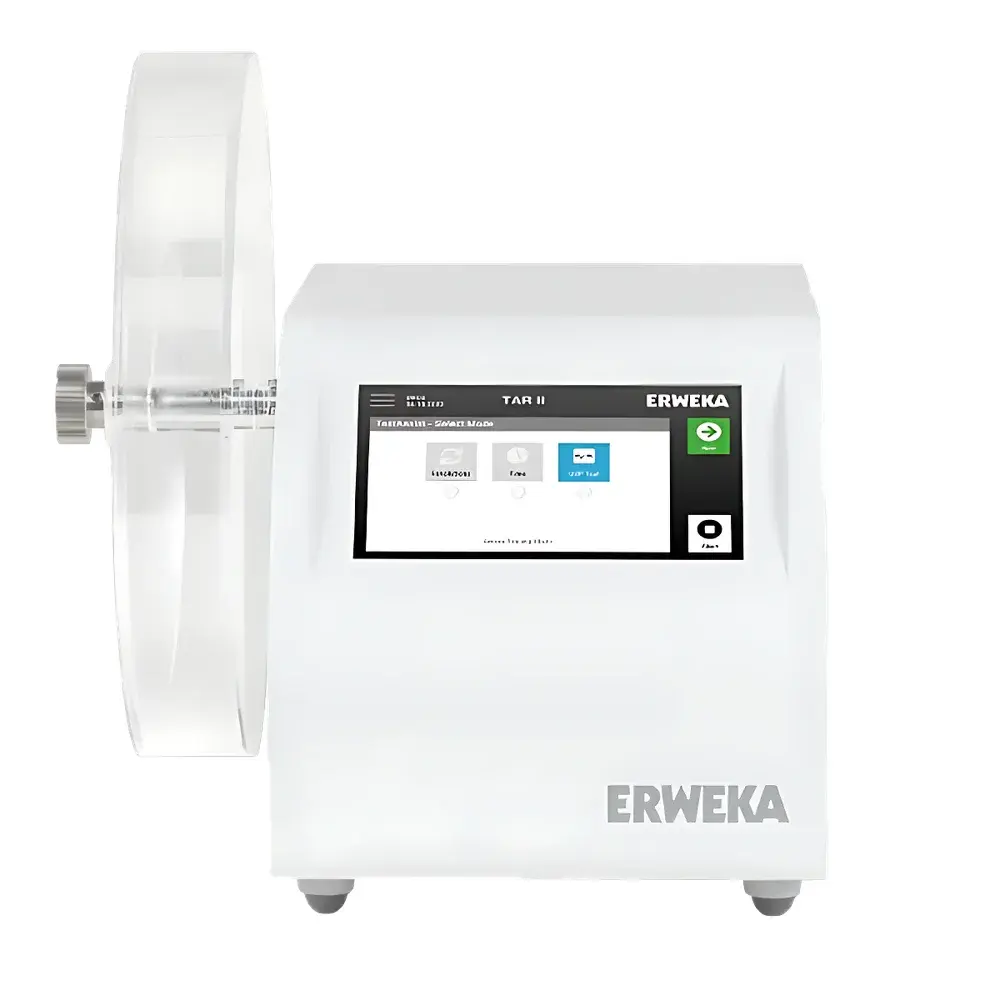
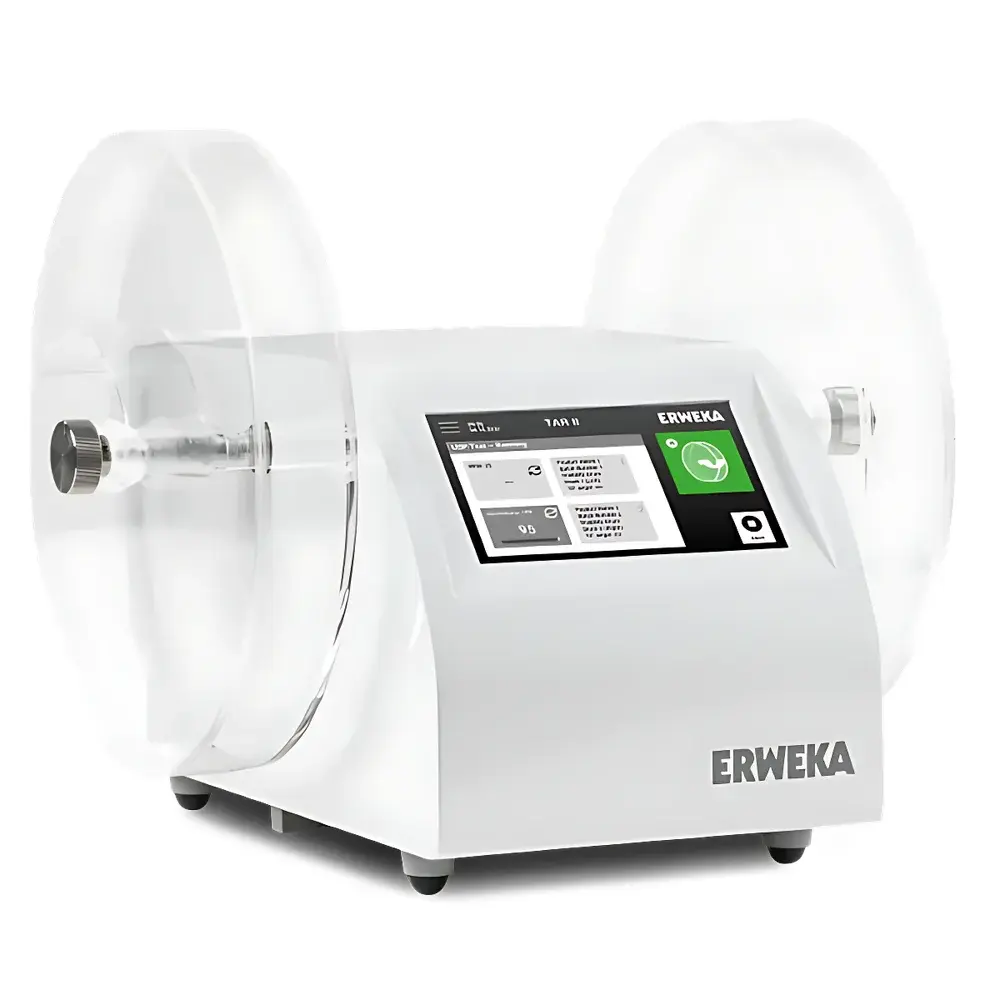
ERWEKA TAR II Friability Tester
| Brand | ERWEKA |
|---|---|
| Origin | Germany |
| Model | TAR II |
| Compliance | USP <1216>, EP 2.9.7, JP 6.05 |
| Display | 7-inch high-resolution touchscreen |
| Test Stations | Configurable for 1 or 2 stations (field-upgradable) |
| Test Modes | Rotation count, time-based, and fully automated USP-compliant mode |
| Data Integration | Direct balance interface with real-time weight acquisition |
| Software | TestAssist™ embedded control & reporting suite |
| Qualification Support | Built-in IQ/OQ verification routines |
| Reporting | Auto-generated, printable test reports (last 10 stored) |
| User Assistance | Context-sensitive on-screen help & service diagnostics |
Overview
The ERWEKA TAR II Friability Tester is an ISO 17025-aligned, regulatory-grade instrument engineered for precise mechanical durability assessment of uncoated and film-coated tablets in compliance with United States Pharmacopeia (USP) , European Pharmacopoeia (EP) 2.9.7, and Japanese Pharmacopoeia (JP) 6.05. Based on the standardized drum rotation principle—where tablets are subjected to controlled tumbling motion within a cylindrical, baffle-equipped drum—the TAR II quantifies mass loss due to surface abrasion and edge chipping after a defined number of revolutions. Its core architecture integrates gravimetric measurement directly into the test workflow via certified analytical balance interfacing, eliminating manual transcription errors and ensuring full traceability of pre- and post-test weights. Designed for GLP/GMP environments, the TAR II meets critical data integrity requirements under FDA 21 CFR Part 11 when paired with validated TestAssist™ software and audit-trail-enabled balances.
Key Features
- Modular dual-station configuration: Supports independent or synchronized testing across one or two drums—upgradable in-field without hardware replacement.
- TestAssist™ intelligent software: Embedded firmware with three deterministic test modes—rotation-count, time-based, and USP-compliant auto-execution—including automatic pass/fail evaluation and built-in retest logic per USP criteria.
- Direct balance integration: Bi-directional RS232/USB communication with METTLER TOLEDO, SARTORIUS, or other GLP-compliant balances; weight data acquired automatically at t0 and tfinal, timestamped and logged with device ID and operator credentials.
- 7-inch capacitive touchscreen HMI: Intuitive, icon-driven interface compliant with IEC 62366-1 usability engineering standards; all critical parameters (rpm, duration, drum angle, sample mass) validated before test initiation.
- Regulatory-ready qualification tools: Integrated IQ/OQ checklists with digital signature capture, calibration log export (CSV/PDF), and firmware version traceability accessible via Service Menu.
- Context-aware assistance: One-tap contextual help overlays displaying operational guidance, error resolution steps, and standard operating procedure references—localized per user language setting.
Sample Compatibility & Compliance
The TAR II accommodates standard USP-specified drum dimensions (28.5 cm diameter × 39 cm length) with adjustable 10° inclination—pre-installed and verified per USP . It supports tablet diameters from 4 mm to 25 mm and masses up to 6 g per unit, with maximum load capacity of 6.5 g per drum. All mechanical components—including drum material (anodized aluminum), baffle geometry, and rotational drive system—conform to EP 2.9.7 dimensional tolerances and surface finish specifications. The instrument undergoes factory verification against NIST-traceable torque and angular displacement standards. Documentation packages include Design Qualification (DQ) summary, Factory Acceptance Test (FAT) report, and Certificate of Conformance to ISO 9001:2015 and Machinery Directive 2006/42/EC.
Software & Data Management
TestAssist™ operates as a deterministic, embedded real-time OS—not a PC-dependent application—ensuring deterministic timing and uninterrupted execution during validation. Each test generates a structured XML-based audit trail containing operator ID, timestamped weight values, drum RPM stability logs, environmental temperature/humidity metadata (when external sensors are connected), and final friability percentage calculation per Equation 1 in USP . Reports comply with ALCOA+ principles: Attributable, Legible, Contemporaneous, Original, Accurate, Complete, Consistent, Enduring, and Available. Export formats include PDF/A-1b (archival), CSV (LIMS ingestion), and encrypted SQLite databases for e-signature workflows. System access controls support role-based permissions (Operator, Supervisor, Administrator) aligned with Annex 11 and EU GMP Annex 11 requirements.
Applications
Primary use cases include QC release testing of immediate-release and modified-release tablets during formulation development, stability studies (ICH Q1–Q5), batch record review, and supplier qualification. Secondary applications extend to excipient compatibility screening (e.g., evaluating lubricant impact on tablet cohesion), coating process optimization (film thickness vs. abrasion resistance), and regulatory submission dossier preparation (e.g., CTD Module 3.2.P.5.3). The TAR II is routinely deployed in contract manufacturing organizations (CMOs), pharmaceutical R&D labs, and global regulatory agencies conducting method verification per ICH Q2(R2).
FAQ
Does the TAR II require external PC software for operation?
No—TestAssist™ is fully embedded; no PC, license server, or third-party runtime dependencies are required.
Can historical test data be exported to LIMS without manual intervention?
Yes—via configurable FTP/SFTP push or network share mapping; CSV exports include unique test IDs, instrument serial numbers, and digital signatures.
Is the 10° drum inclination adjustable or fixed?
Fixed at 10° per USP ; mechanical verification occurs during IQ and is documented in the FAT report.
What balance models are validated for direct integration?
METTLER TOLEDO XSR/XSE series, SARTORIUS Entris/Secura, and A&D FX-i series—with firmware v3.2+ and RS232/USB HID profile enabled.
How is electronic signature compliance achieved?
Through TestAssist™’s dual-password authentication, biometric-ready API hooks, and 21 CFR Part 11–compliant audit trail generation—validated as part of the software’s computer system validation (CSV) package.





