
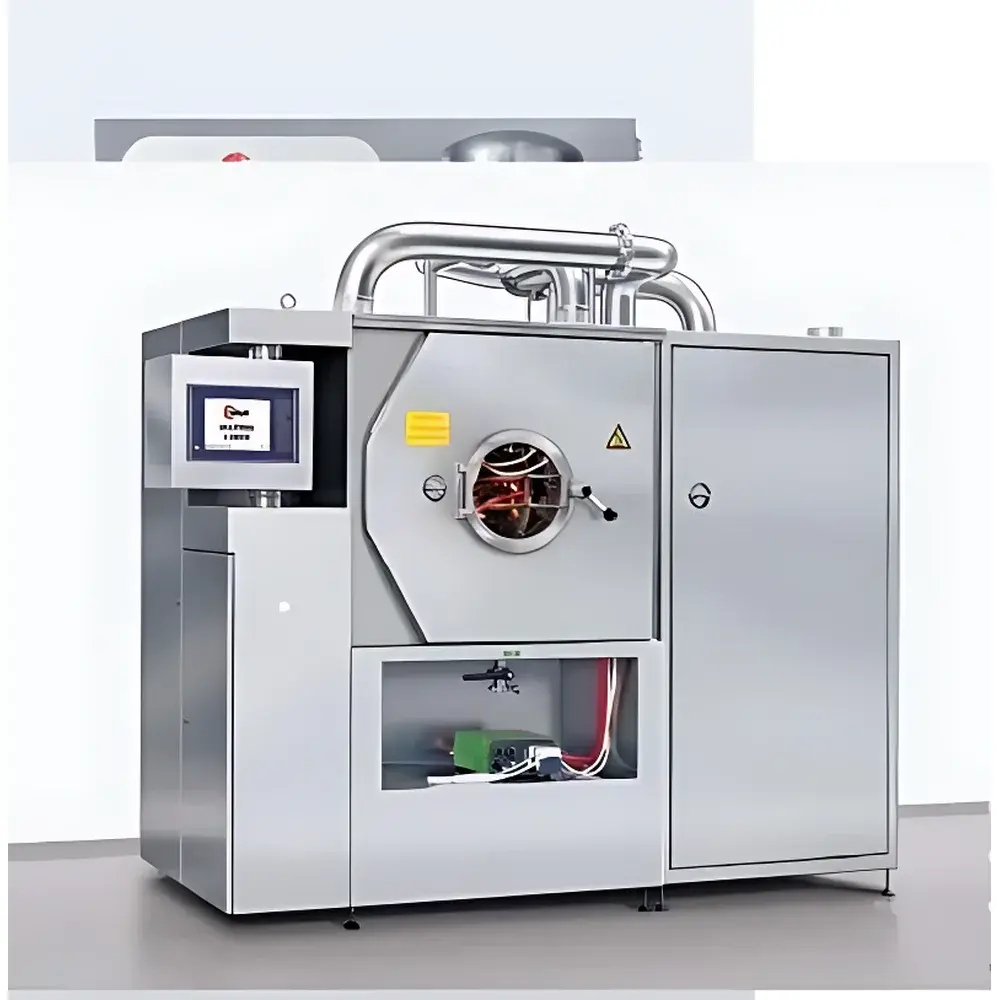
Glatt GMPC II Laboratory Pan Coater
| Brand | Glatt |
|---|---|
| Origin | Germany |
| Model | GMPC II |
| Batch Volume Range | 2–56 L |
| Drum Diameters | 440 mm (16″), 540 mm (20″), 640 mm (24″), 750 mm (30″) |
| Rotation Speed | 2–18 rpm |
| Inlet Air Flow | 550–1000 Nm³/h |
| Max. Inlet Air Temperature | 80 °C |
| Heating Capacity | 30 kW |
| Compressed Air Consumption | ≤60 Nm³/h |
| Nozzle System | Binary spray nozzles (1 or 2 nozzles, configurable per drum size) |
| Air Filtration | EN 779 F7 (pre-filter) + EN 1822 H13 (HEPA) on inlet |
| Electrical Power | Inlet fan motor 3.0 kW, Outlet fan motor 4.0 kW, Drive motor 0.75 kW, Spray pump motor 0.135 kW |
| Overall Height | 2400 mm |
| Approx. Weight (coater) | 600 kg |
| Compliance | Designed for GLP/GMP-aligned pharmaceutical development environments |
Overview
The Glatt GMPC II is a modular, high-precision laboratory-scale pan coater engineered for the reproducible film coating of solid oral dosage forms—including tablets, pellets, and granules—under controlled, scalable process conditions. Based on the proven principles of tangential airflow and uniform drum rotation, the GMPC II employs a multi-drum architecture to support systematic process development across batch sizes ranging from 2 L to 56 L (equivalent to ~1.6–45.0 kg at 0.8 kg/L bulk density). Its design integrates fluidized-bed-compatible air handling with traditional pan-coating mechanics, enabling both aqueous and organic solvent-based film coating, as well as optional sugar coating protocols when configured with dedicated nozzle manifolds and thermal management upgrades. The system complies with fundamental engineering requirements for pharmaceutical R&D equipment, including structural integrity under cyclic thermal and mechanical loads, traceable airflow calibration, and containment-ready interface points for integration into isolator or glovebox environments.
Key Features
- Modular interchangeable drums: Four standardized drum options (440 mm, 540 mm, 640 mm, and 750 mm diameter) allow seamless scale-up studies without requalification of core process parameters.
- Precision-controlled drum rotation: Variable-speed drive (2–18 rpm) with torque monitoring ensures consistent tablet motion and minimizes attrition during extended coating cycles.
- Dual-stage air filtration: Inlet air passes through an EN 779 F7 coarse filter followed by an EN 1822 H13 HEPA filter, ensuring particulate removal down to 0.3 µm at ≥99.95% efficiency—critical for low-bioburden coating operations.
- Binary spray system: Configurable with one or two high-precision binary nozzles per drum size, supporting atomization optimization via independent control of atomizing air and liquid feed pressure.
- Thermally robust air handling: Capable of delivering inlet air up to 80 °C with a maximum electrical heating capacity of 30 kW; inlet and outlet air units feature separately rated motors (3.0 kW and 4.0 kW, respectively) for stable pressure differential control.
- GMP-aware mechanical layout: All contact surfaces are constructed from electropolished AISI 316L stainless steel; piping and ductwork conform to ASME BPE surface finish standards (Ra ≤ 0.8 µm).
Sample Compatibility & Compliance
The GMPC II accommodates a broad spectrum of solid dosage forms—from high-density immediate-release tablets to low-density multiparticulates—with minimal risk of segregation or edge wear due to its optimized drum geometry and adjustable baffle configuration. It supports formulation development aligned with ICH Q5A, Q5C, and Q8(R2) guidelines, and its operational envelope meets prerequisite conditions for subsequent tech transfer to production-scale Glatt GPCG or Vector systems. While not certified as 21 CFR Part 11-compliant out-of-the-box, the platform is architected for integration with validated SCADA or MES systems that provide electronic record audit trails, user access controls, and change management logging—key elements for FDA and EMA inspection readiness.
Software & Data Management
The GMPC II operates via a dedicated PLC-based control panel with analog and digital I/O modules for real-time monitoring of critical process parameters: drum speed, inlet/outlet air temperature and humidity, static pressure differential, spray rate, and chamber dew point. Data acquisition is timestamped and exportable in CSV format for offline analysis in JMP, SIMCA, or Python-based process analytical technology (PAT) workflows. Optional Ethernet/IP or Modbus TCP interfaces enable connectivity to centralized data historians. All setpoints, alarms, and operator actions are logged with ISO 8601 timestamps, satisfying ALCOA+ data integrity principles when paired with appropriate procedural controls.
Applications
- Formulation screening of polymer-based film coatings (e.g., Eudragit®, Opadry®, Kollicoat®) under varying relative humidity and thermal profiles.
- Process parameter mapping for enteric, sustained-release, and taste-masking coatings using Design of Experiments (DoE) methodology.
- Stability-indicating coating trials where residual solvent content, film thickness uniformity, and dissolution profile consistency must be correlated with process variables.
- Sugar coating feasibility assessment for pediatric or niche-market dosage forms requiring high-gloss, moisture-barrier finishes.
- Training and SOP development for manufacturing personnel prior to commissioning full-scale coating lines.
FAQ
What drum sizes are included with the standard GMPC II configuration?
The system ships with one drum; additional drums (440 mm, 540 mm, 640 mm, or 750 mm) are ordered separately based on intended batch scale and product characteristics.
Is compressed air required for the binary spray system?
Yes—compressed air (≤60 Nm³/h at 6–7 bar) is essential for nozzle atomization; dew-point-controlled supply is recommended to prevent nozzle clogging.
Can the GMPC II be installed inside a Class C cleanroom?
Yes, provided HVAC integration accounts for its total heat load (up to 30 kW) and exhaust air volume (≥1000 Nm³/h); structural mounting must accommodate vibration isolation per ISO 14644-1.
Does Glatt provide IQ/OQ documentation for the GMPC II?
Factory-verified IQ/OQ protocols are available as optional deliverables; site-specific PQ execution remains the responsibility of the end user’s qualified validation team.
What maintenance intervals are recommended for the air filtration system?
EN 779 F7 pre-filters should be replaced every 3–6 months depending on ambient particulate load; EN 1822 H13 HEPA filters require annual integrity testing (DOP/PAO scan) and replacement per manufacturer specifications or after 18–24 months of continuous operation.





