
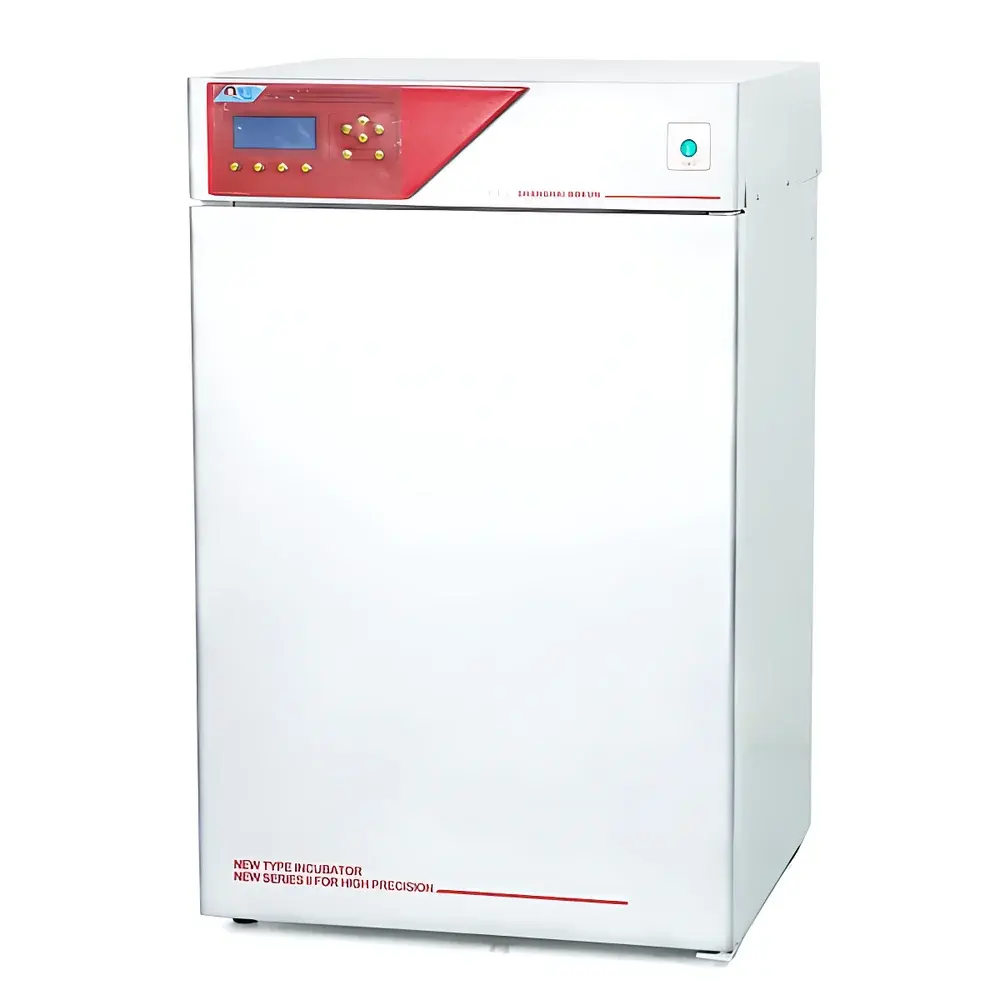
BOXUN BC-J160 Gas-Jacketed CO₂ Incubator with IR CO₂ Sensing
| Brand | BOXUN |
|---|---|
| Origin | Shanghai, China |
| Manufacturer Type | Direct Manufacturer |
| Instrument Type | Gas-Jacketed CO₂ Incubator |
| CO₂ Detection | Infrared (IR) Sensor |
| Temperature Control Range & Accuracy | Ambient +5°C to 60°C |
| Temperature Uniformity | ≤ ±0.5°C |
| CO₂ Concentration Control Range & Accuracy | 0–20% |
| Capacity | 160 L |
| External Dimensions (W×D×H) | 700 × 650 × 1030 mm |
| Internal Chamber Dimensions (W×D×H) | 540 × 490 × 680 mm |
| Temperature Stability (Fluctuation) | ≤ ±0.2°C |
| Temperature Resolution | 0.1°C |
| CO₂ Recovery Time | ≤ (Setpoint %) × 1.2 min |
| Humidification Method | Natural Evaporation |
| Power Supply | AC 220 V ±10%, 50 Hz ±2% |
| Rated Power | 800 W |
| Standard Shelving | 3 Adjustable Stainless Steel Shelves |
| Filtration Efficiency | ≥99.998% for particles ≥0.3 µm (Dual HEPA-grade Filters) |
| Interface | RS-485 for PC/Logger Connectivity |
| Data Protection | Power-Failure Parameter Memory & Auto-Restore Function |
Overview
The BOXUN BC-J160 is a gas-jacketed, microprocessor-controlled CO₂ incubator engineered for precision cell culture applications in academic research laboratories, biopharmaceutical development facilities, and quality control environments. It operates on the principle of independent gas-jacket temperature regulation—where heated air circulates within an outer chamber surrounding the inner culturing compartment—to ensure rapid thermal recovery and exceptional spatial uniformity across the 160 L working volume. CO₂ concentration is continuously monitored and regulated via a calibrated infrared (IR) sensor, offering high specificity, long-term stability, and immunity to humidity or condensation interference—critical for maintaining physiological pH in bicarbonate-buffered media. The unit complies with core design expectations for ISO 13485-aligned manufacturing environments and supports GLP-compliant documentation workflows through its embedded data logging and parameter retention architecture.
Key Features
- Gas-jacket heating system with dual temperature sensors (chamber + jacket) and chip-based suppression logic to minimize thermal disturbance during door opening
- Infrared CO₂ sensing technology with factory calibration traceability; response time optimized for dynamic setpoint adjustments
- Dual-stage HEPA filtration (≥99.998% efficiency at 0.3 µm) integrated into both intake and recirculation pathways to maintain ISO Class 5-equivalent internal air purity
- UV germicidal lamp (254 nm) with programmable activation cycles for routine decontamination of chamber surfaces and air stream
- Electropolished stainless-steel interior chamber with seamless welds and rounded corners to eliminate microbial harborage zones
- Intelligent door-heating system preventing inner-glass condensation—ensuring unobstructed optical access during microscopy or real-time imaging
- High-brightness LCD interface displaying simultaneous real-time values for temperature, CO₂ concentration, relative humidity, and system status
- Redundant control architecture: primary microcontroller with independent backup monitoring circuitry for critical parameters (temperature, CO₂)
- RS-485 serial interface compliant with Modbus RTU protocol for integration into centralized lab monitoring systems or SCADA platforms
- Non-volatile memory preserving all operational parameters—including alarm history, setpoints, and calibration offsets—in the event of power interruption or controller reset
Sample Compatibility & Compliance
The BC-J160 accommodates standard tissue-culture vessels including T-flasks (up to T225), multiwell plates (6–96-well), Petri dishes, roller bottles, and custom bioreactor modules mounted on its three adjustable stainless-steel shelves. Its chamber geometry and airflow design meet ANSI/ASHRAE Guideline 180-2021 recommendations for laminarized recirculation in enclosed biological containment systems. While not certified as a medical device under FDA 21 CFR Part 820, the incubator’s construction materials, sensor validation protocols, and software architecture align with foundational requirements for GMP Annex 1 (EU) and USP environmental control systems. All firmware revisions are version-controlled and support audit-trail generation per ALCOA+ principles when paired with validated third-party data acquisition software.
Software & Data Management
The BC-J160 does not include proprietary cloud software but provides deterministic serial communication via RS-485 for interoperability with industry-standard platforms such as LabVIEW, MATLAB Data Acquisition Toolbox, or enterprise LIMS solutions (e.g., Thermo Fisher SampleManager, LabVantage). Logged parameters—including timestamped temperature, CO₂, and humidity readings—are stored locally in circular buffer memory (retaining ≥30 days of 1-minute interval data). Optional accessories include a thermal printer module (supporting trend curve output), GPRS-based SMS alerting for out-of-specification events, and Ethernet-to-RS485 gateways enabling remote supervision without modifying native firmware. All data export formats adhere to CSV and IEEE 11073-10201 standards for biomedical device interoperability.
Applications
This incubator serves as a foundational platform for mammalian cell line maintenance (e.g., CHO, HEK293, HeLa), primary neuronal and stem cell expansion, hybridoma production, microbiological assays requiring controlled CO₂ atmospheres (e.g., Campylobacter jejuni cultivation), and regenerative medicine workflows involving scaffold-based 3D culture. Its stable thermal profile and low particulate emission make it suitable for pre-analytical sample conditioning prior to flow cytometry, ELISA, or qPCR preparation. In industrial settings, the BC-J160 supports process validation studies for media optimization, passage number effects, and bioburden assessment under ICH Q5D and Q5A regulatory frameworks.
FAQ
What CO₂ sensor technology does the BC-J160 use, and why is IR preferred over thermal conductivity?
It employs a solid-state infrared (IR) sensor with dual-wavelength compensation. Unlike thermal conductivity detectors, IR sensors are unaffected by ambient humidity, nitrogen composition shifts, or background gas interference—ensuring accuracy across variable atmospheric conditions.
Is the humidity level actively controlled or passively maintained?
Humidity is maintained via natural evaporation from a stainless-steel water pan; no active humidification system is installed. Relative humidity typically stabilizes between 90–95% RH at 37°C/5% CO₂, consistent with ISO 13408-1 requirements for cell culture environments.
Can the BC-J160 be validated for IQ/OQ/PQ protocols?
Yes—its modular sensor layout, accessible calibration ports, and deterministic control logic support full qualification per ASTM E2500 and EU GMP Annex 15. Calibration certificates for IR CO₂ and PT100 temperature sensors are provided with each unit.
Does the unit comply with electromagnetic compatibility (EMC) directives for laboratory deployment?
It meets EN 61326-1:2013 (industrial environment emissions and immunity) and carries CE marking for intra-EU placement, subject to proper grounding and installation per manufacturer-supplied instructions.
What is the recommended maintenance schedule for filters and UV lamps?
HEPA filters should be replaced every 12 months under continuous operation; UV lamps require replacement after 1,000 hours of cumulative use or annually—whichever occurs first—to maintain >90% nominal irradiance output.




