
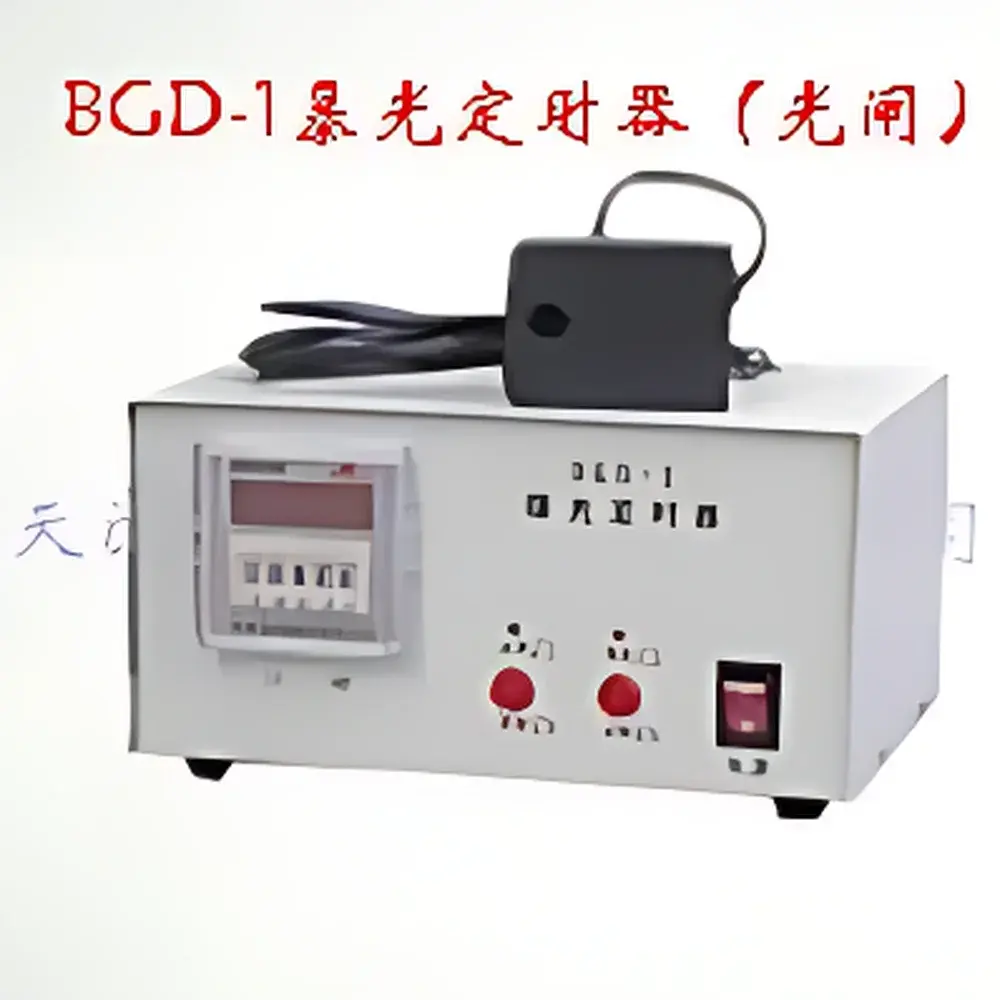
BGD-1 Top Optical Shutter Timer
| Brand | Top |
|---|---|
| Origin | Tianjin, China |
| Manufacturer Type | Manufacturer |
| Country of Origin | Domestic (China) |
| Model | BGD-1 |
| Pricing | Upon Request |
| Timing Accuracy | ±0.1 s |
Overview
The BGD-1 Top Optical Shutter Timer is a precision electronic timing controller engineered for synchronized light-gating applications in optical and holographic experimentation. It functions as a programmable pulse generator that triggers and terminates illumination events with high temporal fidelity—specifically designed to interface with mechanical or electro-optic shutters, laser drivers, or flash units in controlled optical setups. Its core operational principle relies on digital quartz-based timekeeping, delivering stable, repeatable gate durations from 0.1 seconds up to 999.9 seconds in 0.1 s increments. Unlike general-purpose timers, the BGD-1 integrates direct TTL-compatible trigger I/O, enabling seamless integration into interferometric, holographic recording, and time-resolved photometry systems where precise exposure synchronization is critical to fringe stability and signal-to-noise ratio.
Key Features
- Digital timing resolution of 0.1 s across full range (0.1–999.9 s), calibrated against traceable quartz oscillator reference
- TTL-level input/output ports for external trigger initiation and shutter status feedback
- Front-panel push-button interface with LED display for real-time parameter verification and manual operation
- Robust industrial-grade enclosure with EMI-suppressed power supply, suitable for laboratory environments with sensitive optical benches
- No internal battery dependency—operates continuously via regulated DC power input (12 V ±10 %)
- Designed for long-term stability: drift < ±0.05 s per 24 h under constant ambient temperature (23 ±2 °C)
Sample Compatibility & Compliance
The BGD-1 is not a sample-measuring instrument but a timing control subsystem. As such, it imposes no intrinsic constraints on optical media or specimen types; compatibility is determined solely by the connected shutter mechanism (e.g., Uniblitz VS series, Thorlabs SH1, or custom vacuum-compatible iris shutters). It complies with IEC 61000-6-3 (EMI emission limits) and IEC 61000-6-2 (immunity to electrostatic discharge and radiated RF fields). While not certified to ISO/IEC 17025, its timing accuracy specification (±0.1 s) is verifiable using NIST-traceable time-interval analyzers and aligns with common practice in academic holography labs adhering to ISO 10111 (optical testing standards) and ANSI Z136.1 (laser safety protocols requiring controlled exposure duration).
Software & Data Management
The BGD-1 operates as a standalone hardware timer without embedded firmware or USB/RS-232 connectivity. It does not generate, store, or export timestamped data logs. However, its TTL output signal can be captured by external data acquisition systems (e.g., National Instruments DAQmx, LabVIEW, or MATLAB Data Acquisition Toolbox) for audit trails, experiment synchronization logging, or GLP-compliant record retention. When integrated into validated workflows—such as those governed by FDA 21 CFR Part 11—the timer’s role is documented as a fixed-function ancillary device; its calibration status must be maintained per institutional SOPs, with periodic verification using certified time-interval measurement equipment.
Applications
- Holographic interferometry: Precise control of reference and object beam exposure windows during in-line or off-axis hologram recording
- Pulsed laser alignment: Synchronizing Q-switched Nd:YAG or diode-pumped solid-state laser firing with camera gating or detector activation
- Optical pump-probe experiments: Defining fixed delay intervals between excitation and probe pulses in ultrafast spectroscopy setups
- Education laboratories: Teaching temporal coherence, interference visibility, and exposure reciprocity law in undergraduate optics curricula
- Photolithography process development: Managing UV lamp exposure cycles in maskless lithography test rigs
FAQ
Is the BGD-1 compatible with vacuum or cleanroom environments?
The unit is rated for ambient laboratory use only (IP20 enclosure); it is not sealed or outgassing-certified for vacuum integration. Mounting outside the chamber with feedthrough-trigger cabling is recommended.
Can timing parameters be programmed remotely?
No—programming is exclusively local via front-panel controls. For automated sequencing, external microcontroller or DAQ-generated TTL triggers must be used.
What is the maximum load capacity of the output relay or TTL driver?
The output is a 5 V TTL logic signal (≤8 mA sink/source), intended for control input to shutter controllers—not direct actuation of high-power devices.
Does Top provide calibration certificates?
Calibration documentation is available upon request and includes measurement uncertainty analysis per ISO/IEC 17025 guidelines when performed by an accredited third-party lab.
How often should timing accuracy be verified?
We recommend verification at installation, after any physical shock or temperature excursion beyond 20–25 °C, and at least annually in GLP/GMP-aligned facilities.





