
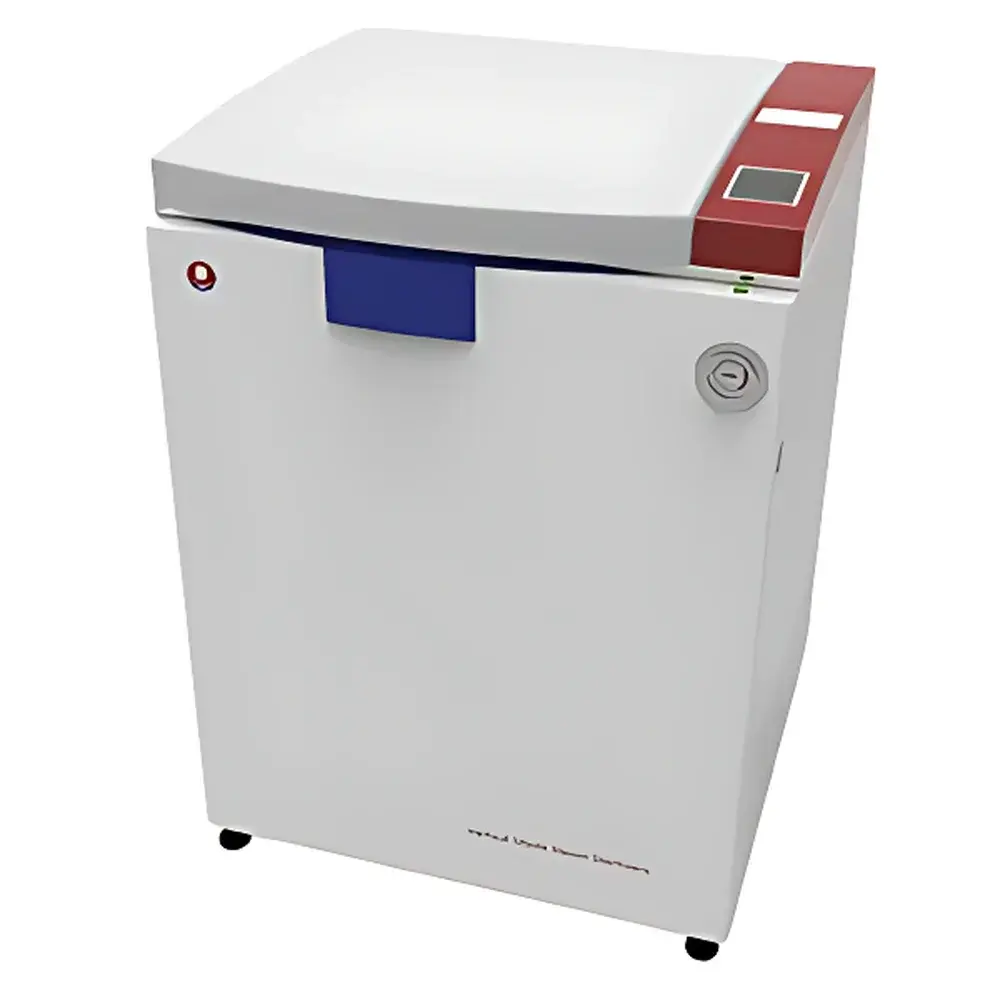
Boxun BXM-75M Vertical Steam Sterilizer
| Brand | Boxun |
|---|---|
| Origin | Shanghai, China |
| Manufacturer Type | Direct Manufacturer |
| Product Category | Domestic |
| Model | BXM-75M |
| Instrument Type | Vertical |
| Max Temperature | 135 °C |
| Max Working Pressure | 0.22 MPa |
| Chamber Dimensions | Ø400 × 700 mm |
| External Dimensions | 750 × 800 × 1080 mm |
| Chamber Volume | 75 L |
| Temperature Range (Sterilization) | 105–135 °C |
| Temperature Range (Drying) | 102 °C |
| Temperature Range (Melting) | 40–100 °C |
| Temperature Range (Heating/Insulation) | 25–85 °C |
| Time Range (Sterilization) | 4–120 min |
| Time Range (Drying/Melting/Insulation) | 0–999 min |
| Pre-set Delay | Up to 99 h 60 min |
| Design Pressure | 0.25 MPa |
| Drying Residual Moisture | <1% |
| Heating Power | 5.9 kW |
| Power Supply | AC 220 V ± 22 V, 50 Hz ± 1 Hz |
| Ambient Operating Conditions | 5–40 °C, 20–80% RH |
| Chamber & Basket Material | SUS304 Stainless Steel |
| Cooling Method | Forced-air rapid cooling |
| Air Intake Filtration | Built-in HEPA-grade filter |
| Water Supply | Dual-channel automatic fill (deionized water & tap water) |
| Standard Probe | Single-channel sterilization load temperature sensor |
| CWS System | Condensate Water Reuse System |
| WPS System | Waste Water & Vapor Purification System |
Overview
The Boxun BXM-75M Vertical Steam Sterilizer is a CE-compliant, microprocessor-controlled Class B vacuum-assisted steam sterilization system engineered for laboratories, clinical research units, and small-scale pharmaceutical production environments requiring reproducible, traceable, and validated terminal sterilization of heat-stable instruments, glassware, culture media, and porous loads. It operates on the fundamental principle of saturated steam under pressure—leveraging the thermodynamic relationship between steam temperature and absolute pressure—to achieve microbial inactivation through protein denaturation and nucleic acid hydrolysis. With a maximum operating temperature of 135 °C at 0.22 MPa (2.2 bar gauge), the unit meets ISO 17665-1:2017 requirements for moist heat sterilization process validation and supports cycle development aligned with EN 285:2015 for large sterilizers and EN 13060:2014 for small steam sterilizers.
Key Features
- Robust SUS304 stainless steel chamber and triple-layered sterilization baskets ensure long-term resistance to acidic, alkaline, and saline corrosion during repeated sterilization cycles.
- Integrated dual-channel automatic water replenishment system allows selection between deionized and municipal water sources, with real-time level monitoring and fail-safe dry-run prevention.
- Intelligent one-touch door actuation mechanism combines mechanical self-locking with electronic interlock verification—preventing accidental opening during pressurized or high-temperature phases per ISO 15883-1 safety mandates.
- High-resolution capacitive touch LCD interface enables intuitive navigation through 16 user-definable cycle templates, including sterilization, drying, melting, and insulation modes—with independent time/temperature parameter control for each phase.
- Onboard condensate water reuse (CWS) system captures, cools, and recirculates sterilization-generated condensate, reducing total water consumption by up to 40% versus conventional drain-to-waste configurations.
- Waste purification system (WPS) incorporates multi-stage filtration—particulate removal, activated carbon adsorption, and hydrophobic membrane separation—to treat exhaust vapor and condensate before atmospheric release, minimizing environmental impact and compliance risk.
- Forced-air rapid cooling module reduces post-cycle cooldown time by >50%, enabling faster throughput without compromising thermal uniformity or material integrity.
- Standard single-point load temperature probe provides real-time monitoring of item core temperature during sterilization, supporting critical process documentation for GLP/GMP audits.
Sample Compatibility & Compliance
The BXM-75M accommodates a wide range of load types—including wrapped/unwrapped instruments, textile packs, porous polymer components, liquid media in sealed containers (with vented caps), and microbiological agar plates—provided they conform to EN 13060-defined load classifications. Its pulse vacuum capability (0–99 cycles programmable) ensures efficient air removal from lumened devices and porous materials, achieving ≥99.9999% SAL (Sterility Assurance Level) at 121 °C/15 min or 134 °C/3 min per ISO 11134 and ISO 11140 standards. All safety-critical functions—including overtemperature cutoff, overpressure relief, door interlock verification, and dry-run detection—are independently hardwired and certified to IEC 61010-1:2010 and GB 4793.1–2007. The sterilizer is designed for integration into FDA 21 CFR Part 11–compliant workflows when paired with optional wireless temperature sensors and audit-trail-enabled data export modules.
Software & Data Management
The embedded control firmware logs all operational parameters—including chamber pressure, jacket temperature, load temperature, cycle phase timestamps, alarm events, and door status—at 1-second intervals. Data is stored internally for ≥10,000 cycles and exportable via USB 2.0 to CSV or XML format for third-party analysis. Optional wireless temperature sensors (validated at 0 °C, 60 °C, and 121 °C per ISO/IEC 17025-accredited calibration certificate) enable full thermal mapping and IQ/OQ/PQ protocol execution. When connected to Boxun’s optional thermal printer (Epson or domestic thermal models), the system generates real-time printouts of cycle curves and summary reports—each bearing unique cycle ID, operator ID, and timestamp—supporting ALCOA+ data integrity principles.
Applications
- Terminal sterilization of surgical instruments, pipette tips, and labware in academic and diagnostic laboratories.
- Preparation and sterilization of bacteriological growth media (e.g., nutrient agar, tryptic soy broth) in microbiology and cell culture facilities.
- Decontamination of biohazardous waste prior to autoclave-compatible disposal pathways.
- Validation support for cleanroom gowning equipment, filters, and packaging materials in early-phase biomanufacturing.
- Research-grade sterilization of ceramic, glass, and metal substrates used in biomaterials and tissue engineering studies.
FAQ
What regulatory standards does the BXM-75M comply with?
It conforms to ISO 17665-1, EN 285, EN 13060, IEC 61010-1, and GB 4793.1, with design and testing documentation available upon request for audit preparation.
Can the sterilizer be validated for GMP use?
Yes—when equipped with calibrated wireless temperature sensors, data loggers, and optional printer modules, it supports full IQ/OQ/PQ execution and 21 CFR Part 11-compliant record retention.
Is remote monitoring supported?
The base unit does not include Ethernet or Wi-Fi; however, USB-exported data can be ingested into centralized LIMS or MES platforms. Remote door operation is enabled via optional IR remote controller.
What maintenance is required for long-term reliability?
Routine tasks include weekly chamber seal inspection, monthly drain filter cleaning, quarterly safety valve functional testing, and annual calibration of temperature/pressure transducers by authorized service personnel.
How is condensate managed during extended drying cycles?
The integrated WPS system separates and purifies condensate vapor; residual liquid is collected in an optional external wastewater tank—ideal for installations lacking floor drains.



