
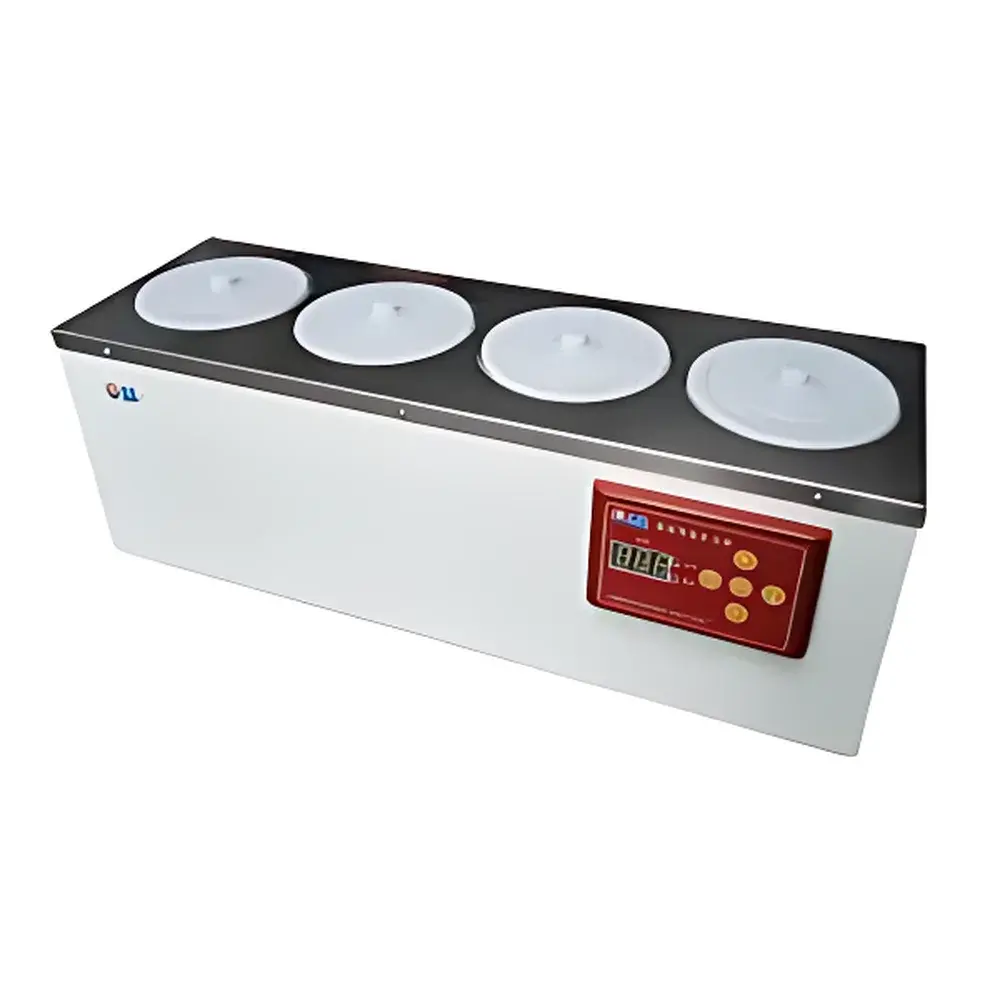
BOXUN HH.S11-4 Single-Row Four-Hole Electric Constant-Temperature Water Bath
| Brand | BOXUN |
|---|---|
| Origin | Shanghai, China |
| Manufacturer Type | Direct Manufacturer |
| Country of Origin | China |
| Model | HH.S11-4 |
| Price Range | USD 140–700 |
| Construction | Powder-Coated Steel Exterior & 304 Stainless Steel Interior Chamber |
| Dimensions (W×D×H) | 635×205×225 mm |
| Chamber Dimensions (W×D×H) | 600×170×120 mm |
| Heating Power | 1 kW |
| Temperature Range | RT + 5 °C to 100 °C |
| Temperature Uniformity | ±1 °C at setpoint |
| Control System | Digital PID with High-Accuracy NTC Sensor |
| Diagnostic Function | Built-in Electronic Component Self-Check |
Overview
The BOXUN HH.S11-4 is a precision-engineered single-row four-hole electric constant-temperature water bath designed for reliable thermal stabilization of samples in routine laboratory workflows. Operating on the principle of convective heat transfer via immersion in temperature-controlled water, this unit delivers stable, uniform thermal environments essential for enzymatic assays, serological testing, sample thawing, reagent warming, and incubation of temperature-sensitive biological materials. Its robust architecture—featuring a powder-coated carbon steel housing and a corrosion-resistant 304 stainless steel inner chamber—ensures long-term durability in high-use clinical, academic, and industrial QC settings. The system is calibrated to maintain setpoint accuracy within ±1 °C across its full operating range (RT + 5 °C to 100 °C), meeting baseline thermal performance expectations for ISO/IEC 17025-compliant laboratories performing non-critical but repeatable heating tasks.
Key Features
- Digital PID temperature controller with NTC thermistor sensor for high repeatability and minimal overshoot
- Self-diagnostic circuitry that monitors critical electronic components—including relay status, sensor continuity, and power supply integrity—reducing unplanned downtime
- Four independent circular wells (Ø approx. 85 mm each) arranged in a single linear row, optimized for standard test tubes (13–18 mm OD), culture bottles, and small-volume flasks
- 1 kW resistive heating element with overheat protection cutoff (mechanical safety thermostat) compliant with IEC 61010-1 Class II requirements
- Front-panel LED display with intuitive push-button interface; no external software or PC required for basic operation
- Low evaporation design with recessed chamber geometry and minimized surface-area-to-volume ratio
Sample Compatibility & Compliance
The HH.S11-4 accommodates common laboratory vessels up to 250 mL capacity per well, including borosilicate glass test tubes, polypropylene centrifuge tubes, and low-form beakers. It supports applications requiring CLSI-recommended pre-warming of blood collection tubes prior to centrifugation and USP –aligned temperature conditioning of sterile preparations. While not certified for GLP/GMP production environments, the unit meets general-purpose laboratory equipment requirements under GB/T 28001 (China Occupational Health and Safety Standard) and conforms to electromagnetic compatibility (EMC) limits per GB/T 18268.21. Its ±1 °C temperature stability satisfies method validation criteria for ASTM D1557 (soil compaction), ISO 3696 (water for analytical use), and routine QC checks in pharmaceutical stability studies where precise, non-refrigerated thermal conditioning is required.
Software & Data Management
The HH.S11-4 operates as a standalone analog-digital hybrid instrument without embedded data logging or network connectivity. All control logic resides in hardware-based firmware, eliminating cybersecurity concerns associated with IoT-enabled devices. Temperature setpoints and real-time chamber readings are displayed locally only; no audit trail, user access control, or FDA 21 CFR Part 11 compliance is provided. For labs requiring traceability, integration with external data acquisition systems (e.g., via RS-232 or 4–20 mA analog output modules—available as optional accessories from BOXUN upon request) enables time-stamped temperature recording in LIMS or ELN platforms. Routine calibration verification can be performed using NIST-traceable liquid-in-glass thermometers or portable digital probes (e.g., Fluke 1523).
Applications
- Pre-incubation of serum, plasma, and CSF specimens prior to immunoassay or coagulation testing
- Controlled thawing of cryopreserved cell suspensions and enzyme stocks to minimize thermal shock
- Standardization of viscosity measurements for Newtonian fluids in teaching laboratories
- Accelerated aging studies of polymer films and adhesives under elevated humidity-free conditions
- Supporting ASTM E2912 (standard practice for calibration of water baths) through periodic verification using reference standards
- Heating of buffer solutions and staining reagents in histopathology and microbiology workflows
FAQ
Is the HH.S11-4 suitable for use with flammable solvents?
No. This unit is rated for aqueous media only. Do not operate with organic solvents, oils, or low-flashpoint liquids due to lack of explosion-proof construction.
Can the temperature be calibrated by the end user?
Yes. A manual offset adjustment function is accessible via service mode (detailed in the operator manual); however, full calibration requires external reference instrumentation and should be documented per internal QA procedures.
What is the typical warm-up time to reach 37 °C from ambient?
Approximately 18–22 minutes under standard load (four wells filled with 150 mL deionized water each), verified per ISO 8573-1 methodology.
Does BOXUN provide installation qualification (IQ) or operational qualification (OQ) documentation?
Standard delivery includes a factory calibration certificate and CE-marked conformity statement. IQ/OQ protocols are available as paid consulting services through authorized BOXUN technical support channels.
Is the stainless steel chamber electropolished?
No. The interior uses standard mill-finish 304 stainless steel, sufficient for routine cleaning with mild detergents and 70% ethanol; electropolishing is not specified in the design baseline.
Related Products



