
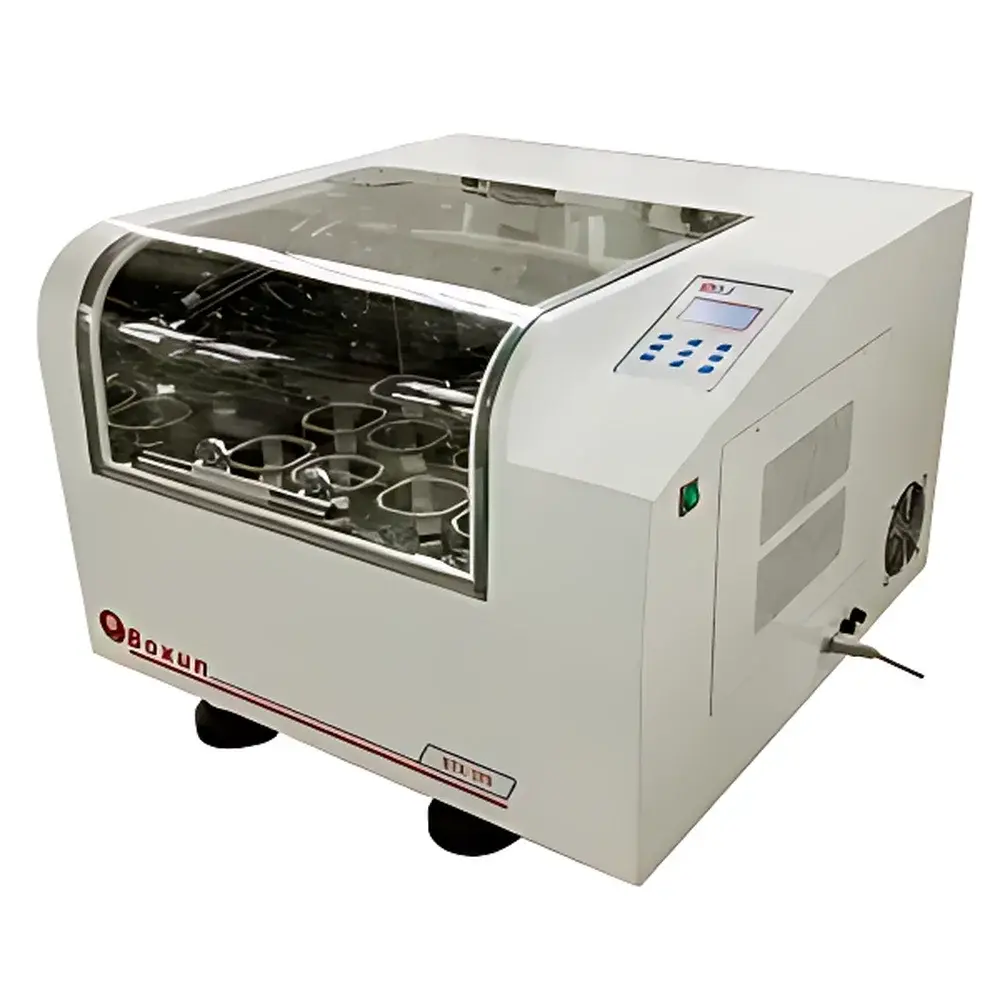
BOXUN BSD-TX270 Benchtop Incubated Orbital Shaker
| Brand | BOXUN |
|---|---|
| Origin | Shanghai, China |
| Manufacturer Type | Direct Manufacturer |
| Product Category | Domestic (China-Made) |
| Model | BSD-TX270 |
| Price Range | USD 1,400–2,800 |
| Instrument Type | Temperature-Controlled Orbital Shaker |
| Timer Range | 0–999 h |
| Oscillation Frequency | 30–250 rpm (up to 600 rpm at amplitude <5 mm) |
| Orbit Diameter | 0–40 mm (infinitely adjustable) |
| Temperature Range | 5–60 °C |
| Temperature Accuracy | ±0.1 °C |
| Temperature Uniformity | ±1 °C (at 37 °C) |
| Platform Quantity | 1 |
| Platform Size | 440 × 390 mm |
| Chamber Volume | 70 L |
| Power Consumption | 800 W |
| Input Voltage | AC 220 V, 50/60 Hz |
Overview
The BOXUN BSD-TX270 Benchtop Incubated Orbital Shaker is an engineered solution for precise, reproducible cell culture, microbial growth, solubility studies, and biochemical incubation under controlled temperature and orbital agitation. Utilizing a single-axis orbital drive mechanism with continuously variable amplitude adjustment (0–40 mm orbit diameter), the system delivers stable, low-shear motion optimized for oxygen transfer efficiency in suspension cultures. Its integrated P.I.D. microprocessor controller—paired with environmental scanning logic—maintains thermal stability within ±0.1 °C and ensures uniform chamber conditions (±1 °C at 37 °C). Designed for continuous operation in regulated laboratory environments, the BSD-TX270 complies with core mechanical safety and electromagnetic compatibility requirements per IEC 61010-1 and meets structural robustness benchmarks for Class II laboratory equipment.
Key Features
- Single-axis orbital drive architecture with infinitely adjustable orbit diameter (Φ0–40 mm), enabling fine-tuned optimization of mixing intensity and dissolved oxygen (DO) transfer across diverse biological systems.
- Wide-frequency oscillation range: 30–250 rpm standard; extended capability up to 600 rpm when operating at low-amplitude settings (<5 mm), supporting both gentle suspension and high-aeration protocols.
- P.I.D.-based temperature control with real-time environmental feedback loop, ensuring rapid stabilization and minimal overshoot during setpoint transitions.
- LCD backlit display showing simultaneous readouts of set values and real-time measurements for temperature, speed, amplitude, and remaining timer duration.
- Brushless DC motor drive delivering constant torque and speed across voltage fluctuations (AC 220 V ±10%, 50/60 Hz), eliminating carbon brush wear and scheduled maintenance.
- Comprehensive safety suite: overtemperature audiovisual alarm with independent cutoff circuitry, power-failure recovery mode with auto-resume functionality, and parameter lockout to prevent unauthorized changes.
- Soft-start acceleration profile minimizes mechanical shock to samples—critical for fragile cell lines, enzymatic assays, or low-volume reagent preparations.
Sample Compatibility & Compliance
The BSD-TX270 accommodates standard microbiological and cell culture vessels including Erlenmeyer flasks (250 mL × 10 standard configuration), test tubes, deep-well plates, and custom-sized containers up to 1000 mL capacity (6 units max). Its 440 × 390 mm platform supports universal clamping accessories (sold separately) for secure mounting of flask holders, tube racks, or multi-well adapter plates. The unit operates within ambient room temperature ranges of 10–30 °C and relative humidity ≤80% non-condensing. While not certified to ISO/IEC 17025 or GLP-specific validation protocols out-of-the-box, its parameter logging capability, password-protected settings, and deterministic thermal/mechanical response support user-led IQ/OQ documentation per FDA 21 CFR Part 11 guidelines when integrated into validated workflows.
Software & Data Management
The embedded microcontroller records operational parameters—including start time, elapsed duration, temperature history, and speed profiles—for up to 999 hours. Though standalone data export is not supported via USB or Ethernet, all displayed values are traceable via manual log entry or optional external data acquisition systems interfaced through analog output ports (0–5 V DC, configurable per parameter). The system supports audit-ready operation through encrypted parameter locking and session-based access control, facilitating compliance with internal SOPs requiring change control and operator accountability.
Applications
- Mammalian and insect cell line expansion in serum-containing or serum-free media under tightly regulated DO and shear conditions.
- Microbial fermentation studies (e.g., E. coli, S. cerevisiae) requiring scalable agitation profiles across temperature gradients.
- Enzyme kinetics assays where consistent mixing and thermal homogeneity directly impact reaction rate reproducibility.
- Dissolution testing of pharmaceutical formulations per USP , particularly for modified-release dosage forms sensitive to agitation consistency.
- Hybridization and washing steps in molecular biology protocols (e.g., Southern/Northern blotting, antigen-antibody incubations).
- Environmental microbiology applications involving soil slurry enrichment or waterborne pathogen cultivation.
FAQ
What is the maximum load capacity of the platform?
The platform supports up to 15 × 250 mL flasks or 6 × 1000 mL flasks, with total payload limited to 15 kg for optimal mechanical longevity and thermal uniformity.
Does the shaker support remote monitoring or network connectivity?
No native Ethernet, Wi-Fi, or RS-232 interface is included; however, analog output signals allow integration with third-party SCADA or LabVIEW-based supervisory systems.
Can the unit maintain 5 °C ambient cooling without external refrigeration?
Yes—the compressor-assisted cooling system enables stable operation down to 5 °C without auxiliary chillers, though ambient room temperature must remain below 25 °C for rated performance.
Is calibration documentation provided with the instrument?
Factory calibration certificates for temperature and speed sensors are available upon request at time of order; users are responsible for periodic verification per internal quality standards.
How does the power-failure recovery function operate?
Upon restoration of AC power, the unit automatically resumes the previously active program—including temperature setpoint, speed, amplitude, and remaining timer—without manual reconfiguration.




