
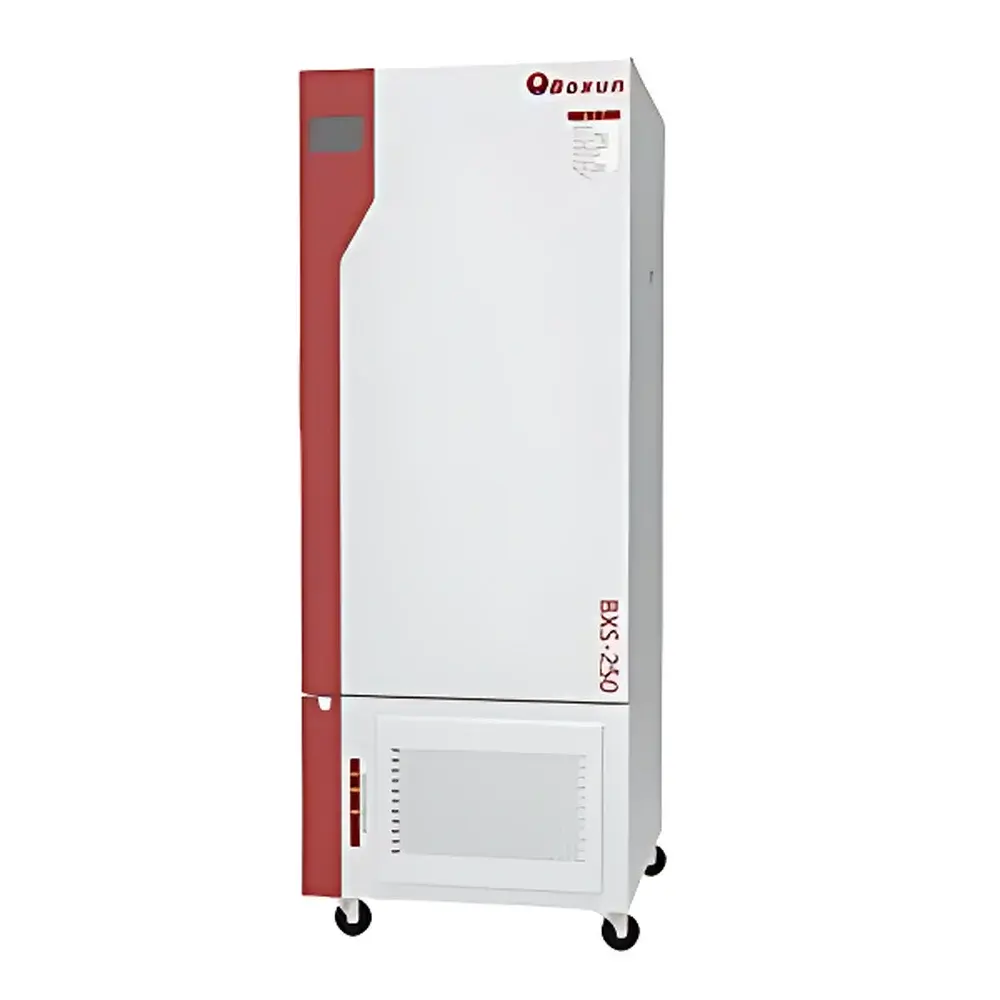
Boxun BXS-250 Expandable Drug Stability Testing Chamber
| Brand | Boxun |
|---|---|
| Origin | Shanghai, China |
| Manufacturer Type | Direct Manufacturer |
| Model | BXS-250 |
| Temperature Range | 0–70 °C (10–70 °C with illumination active) |
| Temperature Resolution | 0.1 °C |
| Temperature Uniformity (at 25 °C) | ±1 °C |
| Temperature Fluctuation (at 25 °C) | ±0.5 °C |
| Humidity Range (optional) | 25–95 %RH |
| Humidity Fluctuation | ±3 %RH |
| Illuminance Range (optional) | 0–10,000 Lux (adjustable) |
| Illuminance Deviation | ±500 Lux |
| UV Irradiance Range (optional) | 0–2 W/m² |
| UV Spectral Range | 320–400 nm |
| Input Power (base) | 1150 W |
| Input Power (humidity + light/UV config) | up to 1850 W |
| Chamber Volume | 250 L |
| Interior Dimensions (W×D×H) | 510 × 450 × 1090 mm |
| Exterior Dimensions (W×D×H) | 650 × 740 × 1726 mm |
| Standard Shelves | 4 (max 7) |
| Data Storage Capacity | 250,000 records |
| Real-time Log Access | latest 1600 entries |
| Interface Options | USB, RS232, RS485 |
| Compliance Support | FDA 21 CFR Part 11 (with optional software), GMP/GLP audit trail, ICH Q1A–Q1E, USP <1151>, WHO TRS 953 Annex 2 |
Overview
The Boxun BXS-250 Expandable Drug Stability Testing Chamber is an engineered environmental simulation system designed specifically for pharmaceutical stability studies in accordance with ICH Q1 series guidelines (Q1A–Q1E), USP , and WHO Technical Report Series No. 953 Annex 2. It provides precise, long-term control of temperature, relative humidity, visible light, and near-ultraviolet radiation—three critical stress factors mandated in forced degradation and shelf-life determination protocols. Unlike general-purpose incubators or climate chambers, the BXS-250 integrates modular subsystems that operate under coordinated microprocessor regulation, enabling concurrent or independent execution of accelerated testing (e.g., 40 °C/75 %RH), long-term storage (25 °C/60 %RH), photostability assessment (≥1.2 × 10⁶ Lux·hr), and UV exposure (≥200 W·hr/m²). Its chamber architecture features a double-wall insulated stainless-steel interior, C.H. (Cyclic Heat) thermal recovery system, and variable-frequency refrigeration—ensuring rapid stabilization after door opening and minimal thermal overshoot during multi-segment programmable cycles.
Key Features
- Programmable 30-segment, 99-cycle control logic with user-defined ramp/soak profiles, compliant with ICH Q1B photostability step requirements.
- Fuzzy PID temperature and humidity regulation with real-time adaptive compensation for load variation and ambient drift.
- Integrated TFT 4.3-inch 16-bit color touchscreen running Windows CE OS, supporting password-protected screen lock, event logging, and on-device data review (last 1600 entries).
- Dual-channel high-accuracy sensors: platinum RTD (Pt100) for temperature, capacitive polymer sensor for humidity, silicon photodiode for illuminance, and UV-A broadband radiometer (320–400 nm) for near-UV irradiance.
- Modular expansion architecture: field-upgradable humidity control module, single/dual shelf-mounted illumination units, and independently controllable UV modules—all calibrated traceably to NIST-traceable references.
- Comprehensive data integrity safeguards: time-stamped audit trail (power on/off, parameter changes, alarms), USB export of raw logs (CSV), and optional FDA 21 CFR Part 11–compliant software with electronic signatures and role-based access control.
- Robust mechanical design including reinforced glass observation door, dual-stage mechanical door lock, embedded thermal printer (standard), and redundant safety interlocks (over-temperature cutoff, door-open alarm, sensor fault detection, low-water shutoff).
Sample Compatibility & Compliance
The BXS-250 accommodates standard pharmaceutical packaging formats—including blister packs, HDPE bottles, vials, and sachets—across up to seven adjustable stainless-steel shelves (4 standard, 3 optional). Its uniform airflow distribution (achieved via high-efficiency EC fans and rear-wall ducting) ensures spatial homogeneity within ±1 °C and ±3 %RH across all shelf levels, validated per ISO 14644-1 Class 8 and ASTM E2805–21 test methods. All configurations support full 3Q validation (IQ/OQ/PQ) documentation packages aligned with EU Annex 15 and FDA Guidance for Industry: Process Validation. Optional wireless temperature/humidity dataloggers (NIST-calibrated at three points: 0 °C, 60 °C, 121 °C; and three RH combinations: 15 °C/40 %RH, 20 °C/60 %RH, 30 °C/80 %RH) facilitate periodic chamber mapping and requalification per GMP Annex 15 Section 4.3.
Software & Data Management
The embedded controller stores 250,000 timestamped measurements (temperature, humidity, illuminance, UV dose) with millisecond-level resolution. Data export via USB yields CSV files compatible with JMP, Minitab, and Phoenix WinNonlin for statistical trend analysis and Arrhenius modeling. The optional FDA Edition monitoring software provides full 21 CFR Part 11 compliance: electronic signatures, automated backup, immutable audit trails, and configurable alert thresholds with SMS notification via integrated GPRS module. GMP Edition software adds batch-specific metadata tagging, deviation management workflows, and automatic report generation aligned with ALCOA+ principles (Attributable, Legible, Contemporaneous, Original, Accurate, Complete, Consistent, Enduring, Available).
Applications
- ICH Q1A(R2) accelerated stability testing (40 °C/75 %RH, 30 °C/65 %RH)
- ICH Q1B photostability testing under D65 daylight simulators and UV-A sources
- ICH Q5C biopharmaceutical storage condition evaluation (2–8 °C, 25 °C/60 %RH)
- USP drug product storage condition qualification
- Forced degradation studies per ICH Q5C and Q1D
- Excipient compatibility screening under controlled humidity gradients
- Long-term stability monitoring for ANDA submissions and post-approval changes
FAQ
Does the BXS-250 meet ICH Q1B photostability requirements for total exposure dose?
Yes. The illumination module delivers ≥1.2 × 10⁶ Lux·hr cumulative exposure, and the UV module achieves ≥200 W·hr/m² in the 320–400 nm band, both verified using calibrated reference sensors traceable to PTB (Physikalisch-Technische Bundesanstalt).
Can humidity and UV be operated simultaneously without compromising temperature stability?
Yes. The system’s decoupled control architecture maintains temperature uniformity within ±1 °C even during concurrent 95 %RH and full-intensity UV operation, as confirmed by thermocouple mapping per ASTM E2805–21.
Is 3Q validation documentation included with purchase?
A complete IQ/OQ/PQ protocol package compliant with EU Annex 15 and FDA guidance is available as an optional deliverable, including pre-executed test scripts, acceptance criteria, and blank execution records.
What data security measures are implemented for regulatory audits?
All logged events include cryptographic timestamps, operator ID, and parameter change history. With FDA Edition software, data files are digitally signed, encrypted at rest, and stored with write-once-read-many (WORM) retention policies to satisfy ALCOA+ and 21 CFR Part 11 §11.10(d).
How is calibration traceability ensured across optional modules?
Each sensor module (humidity, illuminance, UV) ships with individual calibration certificates issued by CNAS-accredited labs, referencing NIST SRM 1930 (illuminance), NIST SRM 2366 (UV), and EURAMET cg-12 (humidity), with stated measurement uncertainties and recalibration intervals.





