
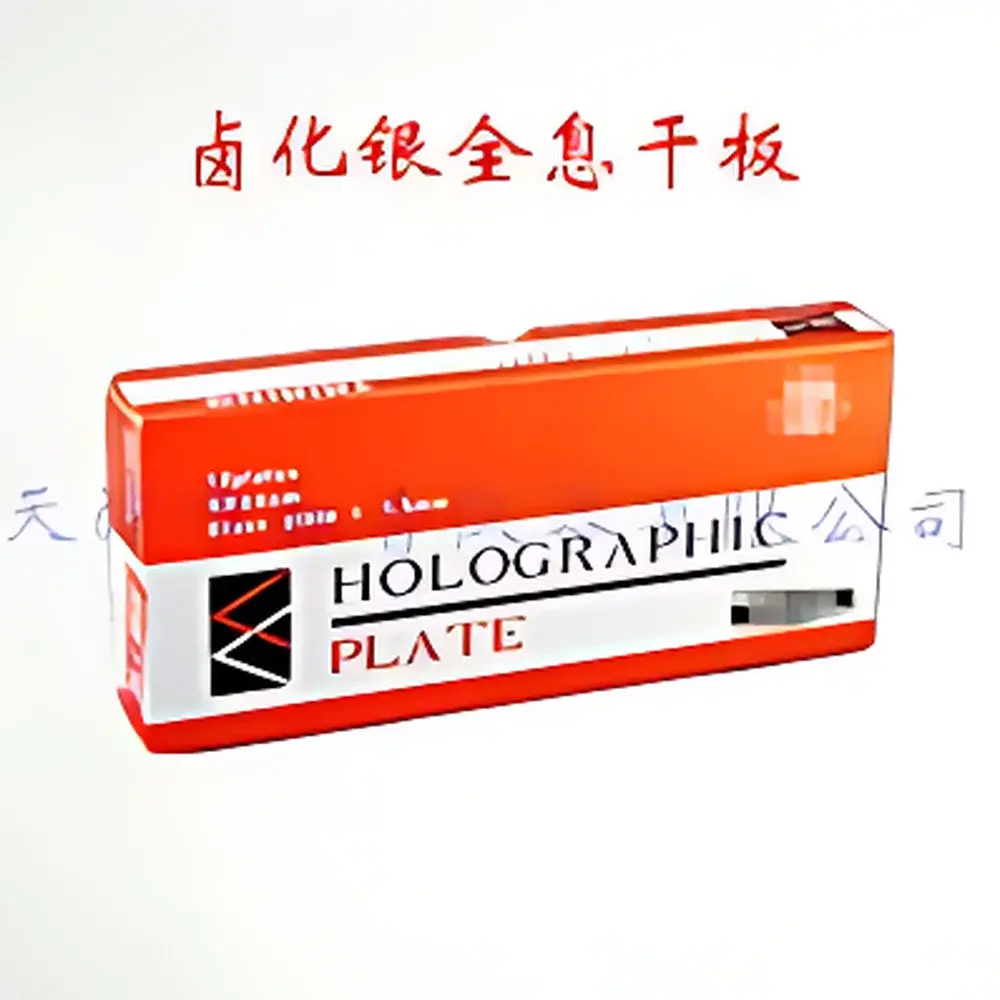
Topo TP Silver Halide Holographic Plate
| Brand | Topo |
|---|---|
| Model | TP Silver Halide Holographic Plate |
| Type | High-Resolution Photographic Emulsion Plate for Laser Holography |
| Sensitivity Wavelength | 632.8 nm (He–Ne laser) |
| Gamma (Contrast Coefficient) | ≥4 |
| Sensitivity | ≥30 μC/cm² |
| Emulsion Thickness | 7 μm |
| Resolution | ≥3000 line pairs/mm |
| Origin | Tianjin, China |
| Manufacturer | Topo Optics Co., Ltd. |
| Compliance | ISO 9001-certified production facility |
| Packaging | Light-tight aluminum foil wrap with desiccant in sealed black box |
Overview
The Topo TP Silver Halide Holographic Plate is a high-performance, panchromatic-free silver halide photographic emulsion plate engineered specifically for analog laser holography applications. Based on classical Couder-type gelatin-silver halide technology, it employs ultra-fine-grain AgBr/AgI crystallites suspended in a uniform gelatin matrix to achieve exceptional spatial frequency response and high diffraction efficiency under coherent red-light illumination (λ = 632.8 nm). Unlike modern photopolymer or dichromated gelatin media, this plate operates via photochemical reduction of silver halide crystals upon photon absorption—followed by chemical development—to form a stable, high-contrast latent image that functions as a phase or amplitude transmission hologram. Its design prioritizes reproducibility, archival stability, and compatibility with standard darkroom processing protocols used in academic, metrological, and industrial holographic interferometry laboratories.
Key Features
- Ultra-fine grain silver halide emulsion (mean crystal size < 0.05 μm) enabling resolution exceeding 3000 line pairs/mm—critical for recording high-spatial-frequency interference fringes in off-axis and Fourier-transform holography.
- Optimized spectral sensitivity centered at 632.8 nm (He–Ne laser), with narrowband response ensuring minimal noise from ambient light leakage during exposure.
- Gamma coefficient ≥4 provides steep characteristic curve slope, supporting high-contrast reconstruction essential for low-noise, high-fidelity wavefront reconstruction in both amplitude and phase holograms.
- Uniform 7 μm emulsion layer thickness—controlled within ±0.3 μm tolerance—ensures consistent modulation transfer function (MTF) across the active area and minimizes thickness-related phase distortion.
- Chemically stabilized gelatin binder system resists thermal drift and humidity-induced swelling, maintaining dimensional stability during long exposures (up to 120 s) and post-processing.
- Pre-sensitized and pre-hardened in ISO Class 7 cleanroom environment; supplied in light-tight, nitrogen-flushed packaging with integrated desiccant for shelf life up to 18 months at 4°C.
Sample Compatibility & Compliance
This plate is compatible with standard holographic setups including Denisyuk reflection geometry, transmission Gabor holography, and pulsed ruby laser systems (with appropriate neutral density filtering). It supports both wet-chemical development (using PQ-type developers such as Kodak D-19 or custom alkaline hydroquinone formulations) and rapid microfilm-style processing in roller-transport processors. The manufacturing process complies with ISO 9001:2015 quality management standards. While not certified to ISO 10934 (holographic materials specification) or ASTM E2042 (standard guide for holographic interferometry), its performance parameters align with benchmark values cited in ISO/TR 11146-3 and the NIST Holography Metrology Handbook. All batches undergo batch-level sensitivity calibration traceable to NIST-traceable He–Ne laser power meters and calibrated densitometers.
Software & Data Management
As an analog optical recording medium, the TP Silver Halide Plate does not interface with digital software or require firmware updates. However, it integrates seamlessly into digitally controlled holographic workflows: exposure timing is synchronized via TTL-triggered shutters driven by LabVIEW, MATLAB, or Python-based acquisition scripts; interferogram contrast analysis is performed using ImageJ/Fiji with FFT-based fringe evaluation plugins compliant with ISO 10110-5. Full audit trails—including exposure time, laser power, environmental temperature/humidity logs, and developer bath temperature—are maintained per GLP principles for qualification studies. Archival storage follows ANSI IT9.2–2019 guidelines for silver-gelatin media, recommending cold (–18°C), low-humidity (<30% RH) conditions for long-term fidelity preservation.
Applications
- Research-grade volume holographic gratings for wavelength-selective filters and optical multiplexers.
- Dynamic holographic interferometry in mechanical stress/strain analysis (e.g., tensile testing, vibration mode mapping).
- Master hologram fabrication for embossed hologram mass production (e.g., security foils, ID documents).
- Education and training platforms for undergraduate optics labs requiring hands-on experience with classical holographic recording physics.
- Reference standards in metrology labs performing MTF validation of imaging systems and wavefront sensors.
- Art conservation documentation via holographic surface topography mapping of fragile cultural artifacts.
FAQ
What is the recommended development process for optimal diffraction efficiency?
Use Kodak D-19 diluted 1:1 with distilled water at 20°C for 3.5 minutes, followed by 30-second stop bath (1% acetic acid), 4-minute fixer (Kodak Fixer, 24°C), and 20-minute wash (running tap water, 15–20°C) with hypo-clearing agent.
Can this plate be used with green (532 nm) or blue (473 nm) lasers?
No—it exhibits negligible sensitivity outside the 600–650 nm band. For shorter wavelengths, consider dichromated gelatin or photopolymer alternatives.
Is the emulsion side marked on the plate?
Yes—each plate bears a faint, non-diffractive edge mark applied during coating; orientation is confirmed via contact-angle test with developer droplet.
What is the maximum usable energy fluence before saturation?
At 632.8 nm, linear response extends up to 30 mJ/cm²; beyond this, reciprocity failure and granularity noise increase significantly.
Does Topo provide batch-specific sensitivity certificates?
Yes—each shipment includes a Certificate of Conformance listing measured gamma, fog level (Dmin ≤ 0.15), and resolution verification per ISO 10110-5 Annex B.






