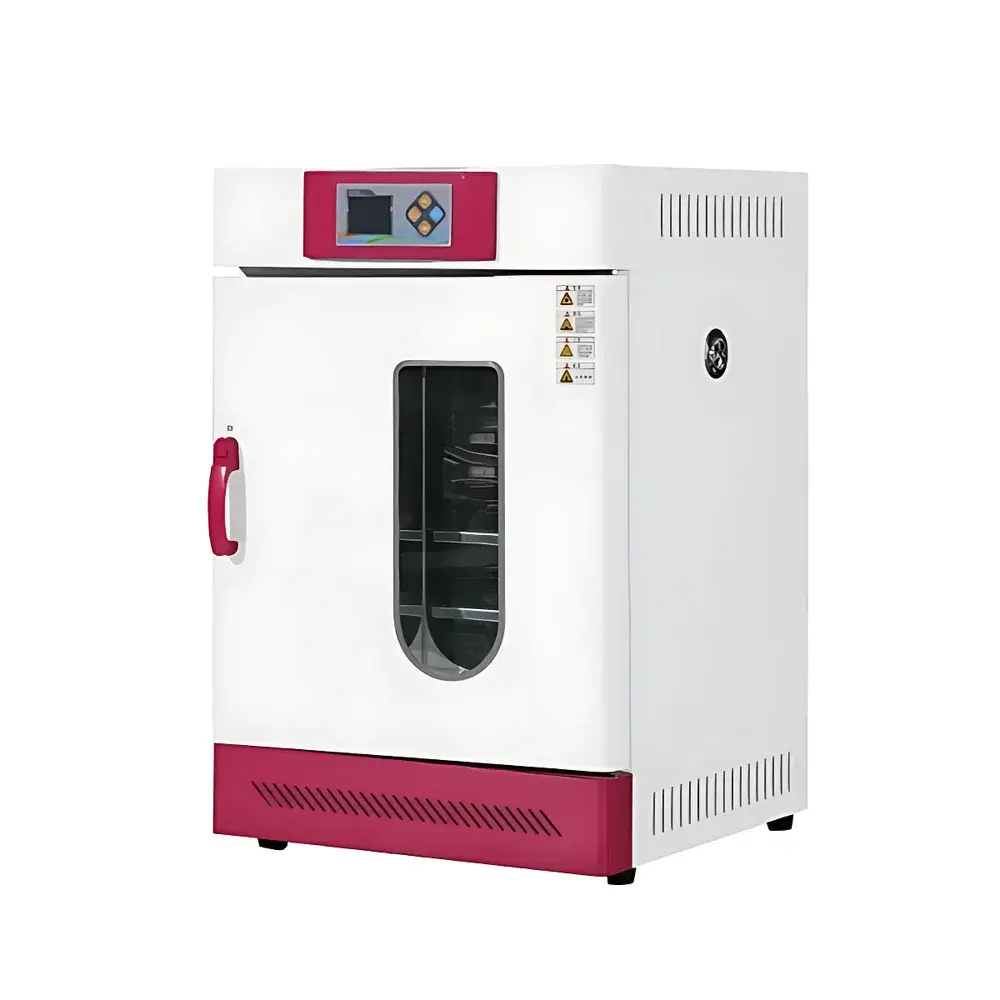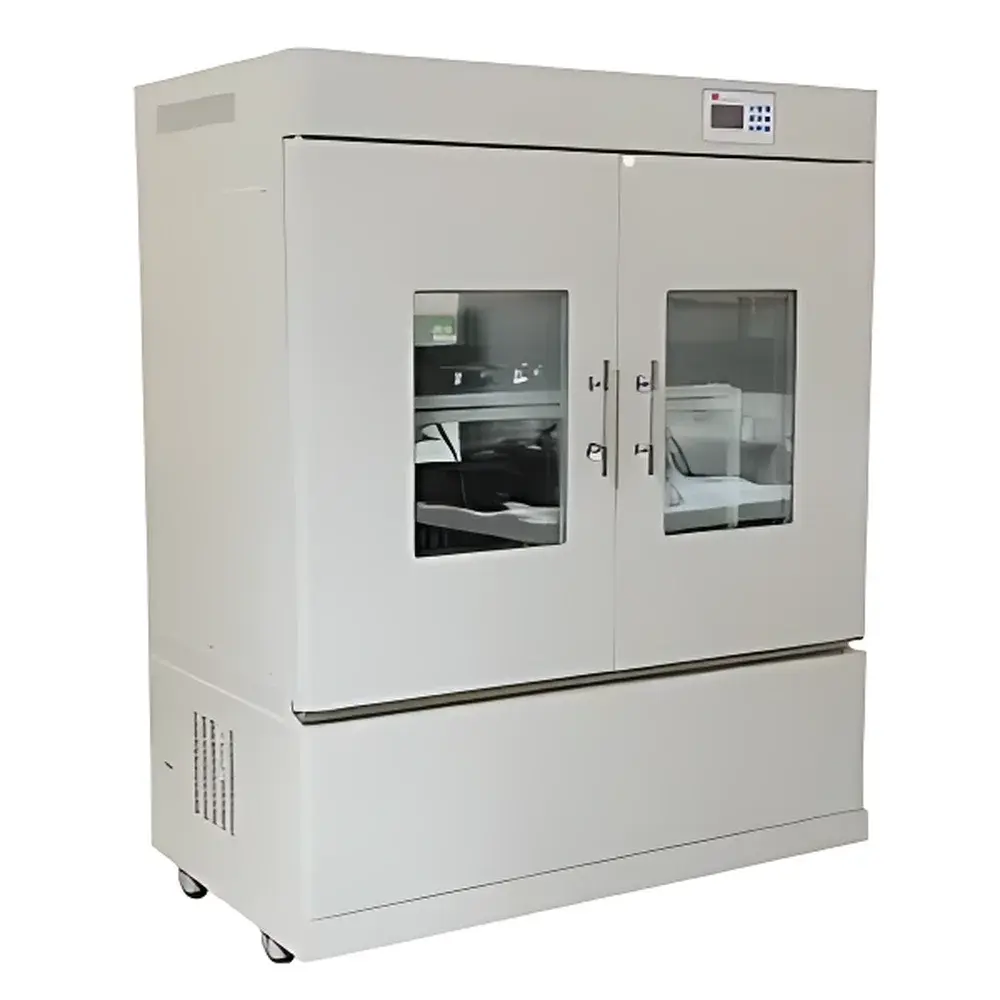
Boxun BSD-YX(F)2600 Large-Capacity Vertical Orbital/Reciprocating Incubator Shaker
| Brand | Boxun |
|---|---|
| Origin | Shanghai, China |
| Manufacturer Type | Direct Manufacturer |
| Product Category | Domestic |
| Model | BSD-YX(F)2600 |
| Price Range | USD 2,800–7,000 (FOB Shanghai) |
| Instrument Type | Temperature-Controlled Orbital & Reciprocating Shaker |
| Timer Range | 0–999 h |
| Oscillation Frequency | Orbital 30–300 rpm, Reciprocating 30–250 rpm |
| Oscillation Amplitude | Orbital Ø35 mm, Reciprocating 0–50 mm |
| Temperature Range | 4–60 °C |
| Shelf Quantity | 2 adjustable platforms |
Overview
The Boxun BSD-YX(F)2600 is a dual-mode, large-capacity vertical incubator shaker engineered for high-throughput life science laboratories requiring precise, stable, and programmable environmental control during dynamic culture processes. It integrates orbital and reciprocating motion modes within a single compact vertical architecture—optimized for space-constrained cleanrooms, bioprocessing labs, and GMP-compliant QC facilities. Its core operation relies on PID-controlled forced-air convection heating/cooling coupled with brushless DC motor-driven oscillation, ensuring uniform thermal distribution (±1 °C at 25 °C, empty chamber) and mechanical reproducibility (±1 rpm frequency stability). Designed to support aerobic microbial growth, protein expression, cell suspension culture, hybridization kinetics, and enzymatic assays, the system meets fundamental operational requirements outlined in ISO 13485 Annex A (for medical device R&D), USP (cell culture apparatus qualification), and GLP-relevant environmental monitoring protocols.
Key Features
- Dual-mode oscillation: Selectable orbital (30–300 rpm, Ø35 mm amplitude) or reciprocating (30–250 rpm, 0–50 mm stroke) motion via intuitive front-panel interface—enabling method-specific optimization for bacterial fermentation vs. tissue homogenization.
- Vertical double-shelf configuration: Two independently accessible stainless-steel shelves (970 × 560 mm and 950 × 590 mm) maximize volumetric loading while minimizing floor footprint (1430 × 820 × 1590 mm overall).
- PID microprocessor controller with backlit LCD: Displays real-time temperature, speed, amplitude, timer, and programmed segment status; supports 10-segment programmable curves with ramp/soak logic for complex kinetic studies.
- Brushless DC motor drive: Eliminates carbon wear, delivers constant torque across full speed range, ensures low-speed stability (<50 rpm) without drift—critical for sensitive suspension cultures and fragile primary cells.
- Enhanced safety architecture: Dual independent overtemperature cutoffs (main PID + mechanical backup limiter), door interlock switch, motor overheat protection, power-fail recovery with auto-resume, and encrypted parameter lockout to prevent unauthorized changes during GLP audits.
- Optimized airflow design: Adjustable fresh-air inlet and asymmetric deflector plates minimize thermal gradients and condensation; intelligent defrost cycle maintains chamber setpoint stability (±0.5 °C deviation during defrost).
Sample Compatibility & Compliance
The BSD-YX(F)2600 accommodates standard laboratory vessels—including Erlenmeyer flasks (50–1000 mL), culture bottles, multi-well plates, and custom bioreactor bags—via interchangeable clamping systems (not included). Its stainless-steel mirror-finish interior (AISI 304), rounded chamber corners, and seamless welds comply with ISO 14644-1 Class 7 cleanroom maintenance standards. The unit operates within FDA 21 CFR Part 11–compatible environments when paired with optional data logging accessories (e.g., external USB recorder or GPRS alarm module). All electrical components meet IEC 61010-1 safety certification requirements for laboratory equipment.
Software & Data Management
While the onboard controller provides standalone operation, optional integration modules enable traceable data governance: a built-in RS-485 port supports Modbus RTU communication for SCADA linkage; the optional thermal printer outputs time-stamped temperature/speed logs compliant with ALCOA+ principles (Attributable, Legible, Contemporaneous, Original, Accurate, Complete, Consistent, Enduring, Available). For remote oversight, the GPRS-enabled alarm module transmits SMS alerts on threshold breaches (e.g., >60.5 °C, speed deviation >±3 rpm, door open >30 s)—supporting 21 CFR Part 11 audit trails when combined with timestamped server logs.
Applications
- High-density bacterial culture (E. coli, Bacillus spp.) under controlled O2 transfer conditions using orbital mode at 200–250 rpm and 37 °C.
- Yeast fermentation and recombinant protein expression requiring gentle agitation (reciprocating mode, 60–100 rpm, 30 °C) to reduce shear stress.
- Hybridization and antigen-antibody binding kinetics where temperature ramping (e.g., 45 °C → 65 °C over 2 h) and simultaneous shaking are essential.
- Environmental microbiology testing per ISO 6222 (coliform enumeration) and EPA Method 1603—leveraging its 4 °C refrigeration capability for cold-adapted strain propagation.
- Stability studies for biologics under ICH Q5C guidelines, utilizing long-duration (up to 999 h) uninterrupted runs with automatic endpoint notification.
FAQ
What is the maximum flask capacity per shelf?
Each shelf supports up to 35 × 500 mL Erlenmeyer flasks (orbital mode) or 40 × 1000 mL bottles (reciprocating mode), verified under ISO 20417-compliant load distribution testing.
Does the unit support CO₂-enriched environments?
Yes—an optional inert gas inlet (standard 6 mm BSP thread) allows connection to N₂ or CO₂ supply lines for anaerobic or controlled-atmosphere applications.
Is calibration documentation provided?
Factory calibration certificates for temperature (NIST-traceable probe) and speed (laser tachometer-verified) are included; user-accessible calibration offsets are available via service menu.
Can the shaker be validated per IQ/OQ protocols?
Yes—the mechanical and thermal performance specifications align with ASTM E2500-13 guidance; validation templates and URS-compatible test scripts are available upon request.
What maintenance is required for long-term reliability?
No routine motor servicing is needed due to brushless design; annual verification of door seal integrity, fan filter cleaning, and bearing lubrication (per OEM schedule) ensures >10-year service life under continuous operation.