
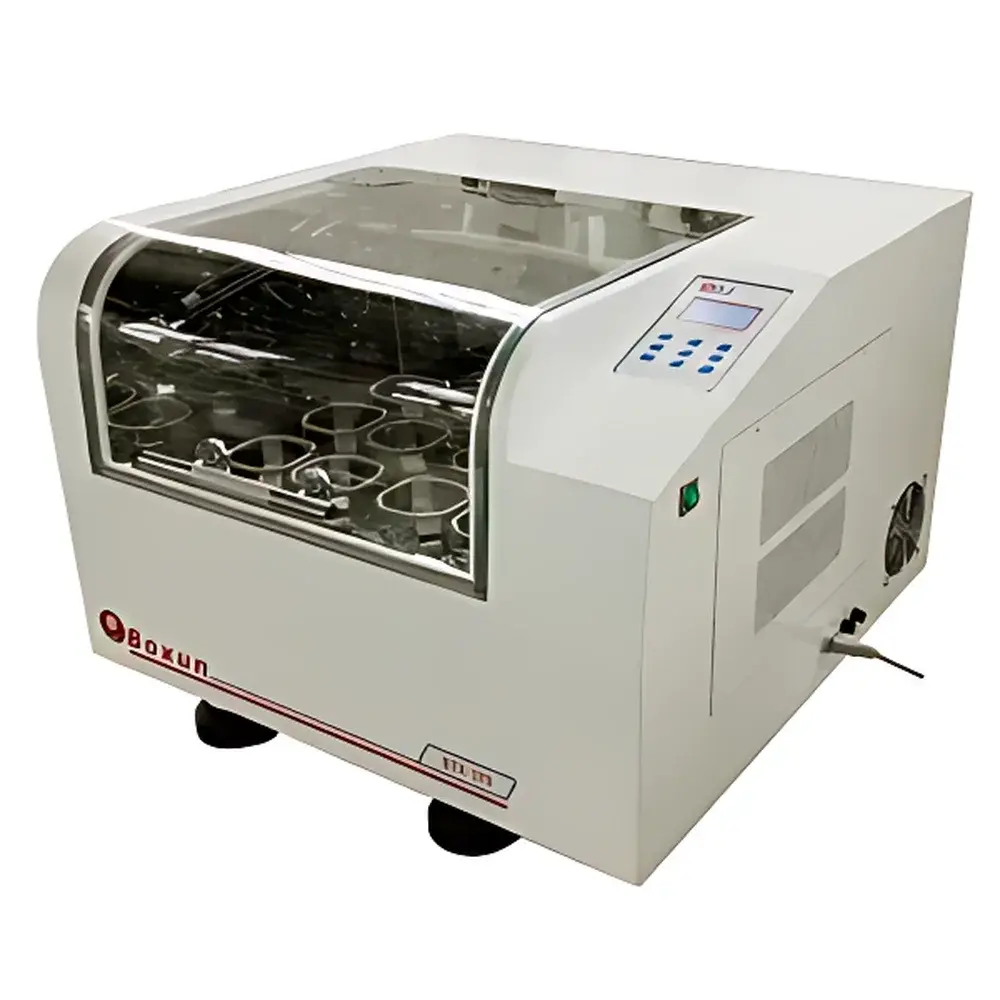
Boxun BSD-TX370 Benchtop Orbital Shaker
| Brand | Boxun |
|---|---|
| Origin | Shanghai, China |
| Manufacturer Type | Direct Manufacturer |
| Product Category | Domestic (China-made) |
| Model | BSD-TX370 |
| Price Range | USD 1,400–2,800 |
| Instrument Type | Air-bath Constant-Temperature Orbital Shaker |
| Timer Range | 0–999 h |
| Oscillation Frequency | 30–250 rpm (up to 600 rpm at amplitude <5 mm) |
| Oscillation Amplitude | Φ0–40 mm (continuously adjustable) |
| Temperature Range | RT+6°C to 60°C |
| Number of Platforms | 1 |
| Temperature Control Accuracy | ±0.1°C |
| Temperature Uniformity | ±1°C (at 37°C) |
| Platform Size | 440 × 390 mm |
| Chamber Volume | 70 L |
| Power Consumption | 700 W |
| Input Voltage | AC 220 V, 50/60 Hz |
Overview
The Boxun BSD-TX370 Benchtop Orbital Shaker is an air-bath constant-temperature orbital shaker engineered for precision cell culture, microbial growth, solubility studies, and biochemical incubation applications requiring simultaneous temperature control and reproducible orbital motion. It operates on the principle of controlled orbital oscillation—generated via a single-axis rotating drive mechanism—combined with PID-regulated air-heating circulation to maintain uniform thermal conditions across the chamber. Unlike water-jacketed or convection-based systems, the air-bath design ensures rapid temperature equilibration, minimal condensation risk, and compatibility with sealed vessels and non-aqueous media. The unit integrates a microprocessor-controlled environmental scanning system that continuously monitors chamber temperature, motor load, and timing status, enabling dynamic compensation for ambient fluctuations and load-dependent thermal drift.
Key Features
- Single-axis orbital drive architecture with continuously adjustable amplitude (Φ0–40 mm), allowing precise tuning of shear stress and oxygen transfer rates for aerobic fermentation, suspension cell culture, or enzymatic reaction kinetics.
- Wide-speed oscillation range: 30–250 rpm standard; extends to 600 rpm when amplitude is set below 5 mm—enabling high-throughput screening under low-shear or high-mixing conditions.
- PID-controlled temperature regulation with ±0.1°C setpoint accuracy and ±1°C uniformity (measured at 37°C), validated per ISO 17025-compliant calibration protocols.
- Brushless DC motor drive: delivers consistent torque across the full speed range, eliminates carbon brush wear, requires zero routine maintenance, and remains stable under ±10% line voltage variation.
- Intelligent safety architecture: includes over-temperature audiovisual alarm, independent power cutoff at thermal failure, auto-restart after power interruption, and soft-start acceleration profile to prevent sample splashing or tube displacement.
- LCD backlit display with real-time readout of setpoints and actual values for temperature, speed, amplitude, and remaining time; all operational parameters can be locked via password protection to prevent unauthorized modification.
Sample Compatibility & Compliance
The BSD-TX370 accommodates standard laboratory vessels—including Erlenmeyer flasks (250 mL × 10 standard configuration), test tubes, deep-well plates, and custom bioreactor bags—on its 440 × 390 mm platform. Its 70 L chamber volume supports up to 31 × 50 mL tubes or 6 × 1000 mL flasks under full-load conditions. The unit complies with IEC 61010-1:2010 for electrical safety in laboratory equipment and meets electromagnetic compatibility requirements per EN 61326-1. While not certified for GMP production environments, its programmable audit trail (via optional RS232/USB data logging) supports GLP-aligned documentation workflows. Temperature and speed stability data are traceable to NIST-calibrated reference standards, facilitating internal validation per ASTM E2500 and USP guidelines.
Software & Data Management
The onboard microcontroller supports non-volatile parameter memory—retaining user-defined protocols even after power loss. Optional PC connectivity (RS232 or USB interface) enables remote monitoring, real-time data export (CSV/TXT), and integration into LIMS or ELN platforms. Firmware supports timestamped event logging (e.g., temperature deviation >0.5°C, speed fluctuation >2 rpm, door open/closed events), satisfying basic FDA 21 CFR Part 11 requirements for electronic records when paired with institutional access controls and electronic signatures. No proprietary software installation is required; raw serial output is compatible with Python, LabVIEW, or MATLAB-based automation scripts.
Applications
- Mammalian and insect cell suspension culture under controlled O2 transfer conditions
- Microbial growth kinetics (E. coli, yeast, Bacillus spp.) in shake-flask bioprocess development
- Protein solubilization and buffer exchange during purification workflows
- Enzyme activity assays requiring defined thermal and mixing environments
- Environmental microbiology—soil extract enrichment, waterborne pathogen cultivation
- Quality control testing of pharmaceutical excipients and biocompatibility matrices
FAQ
What is the maximum flask size supported on the BSD-TX370 platform?
The platform accommodates up to six 1000 mL Erlenmeyer flasks or eight 750 mL flasks simultaneously, provided total mass does not exceed 15 kg.
Does the unit support external temperature probes for vessel-specific monitoring?
No—the BSD-TX370 uses chamber-air sensing only; it does not include ports or firmware support for external PT100 or thermocouple inputs.
Can the timer be programmed to cycle ON/OFF repeatedly?
No—this model implements a single-cycle countdown timer (0–999 h); multi-stage or interval programming requires external programmable relays.
Is the shaker suitable for use with volatile organic solvents?
It is not rated for explosion-proof operation; solvent use requires additional ventilation and compliance with local chemical safety regulations (e.g., OSHA 1910.1200).
How often should calibration verification be performed?
We recommend quarterly verification of temperature uniformity and speed accuracy using traceable NIST-certified sensors, especially prior to critical validation runs.



