
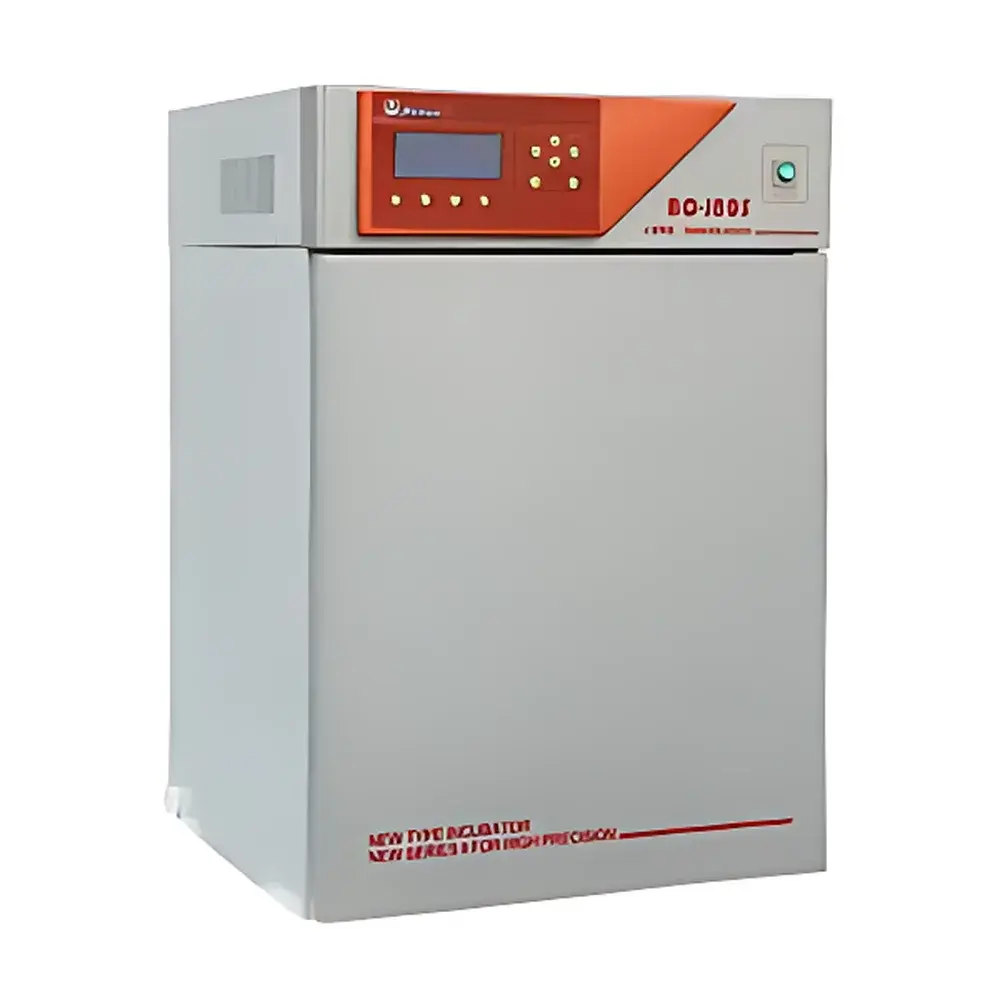
BOXUN BC-J250 CO₂ Incubator (Gas-Jacketed, Infrared CO₂ Sensing)
| Brand | BOXUN |
|---|---|
| Origin | Shanghai, China |
| Manufacturer Type | Direct Manufacturer |
| Country of Origin | China |
| Model | BC-J250 (Gas-Jacketed, Infrared CO₂ Sensing) |
| Temperature Range | Ambient +5°C to 60°C |
| Temperature Uniformity | ≤ ±0.5°C |
| Chamber Volume | 250 L |
| CO₂ Range | 0–20% |
| CO₂ Sensor Type | Infrared (IR) |
| Temperature Resolution | 0.1°C |
| Temperature Fluctuation | ≤ ±0.2°C |
| CO₂ Recovery Time | ≤ (Setpoint %) × 1.2 min |
| Humidification Method | Natural Evaporation |
| Internal Dimensions (W×D×H) | 600 × 600 × 770 mm |
| External Dimensions (W×D×H) | 840 × 775 × 1175 mm |
| Shelf Capacity | 3 Adjustable Stainless Steel Shelves |
| Power Supply | AC 220 V ±10%, 50 Hz ±2% |
| Input Power | 850 W |
| Filtration Efficiency | ≥99.998% for particles ≥0.3 µm (Dual HEPA-grade filters) |
| Interface | RS-485 for external data logging or PC integration |
Overview
The BOXUN BC-J250 CO₂ Incubator is a gas-jacketed, microprocessor-controlled environmental chamber engineered for precise, stable maintenance of mammalian cell cultures under physiologically relevant conditions. It operates on the principle of dual-gas regulation—maintaining both temperature and CO₂ concentration independently via feedback-controlled heating elements and an infrared (IR) CO₂ sensor—ensuring optimal pH stability in bicarbonate-buffered culture media. Designed for routine use in academic laboratories, biopharmaceutical QC/QA environments, and GMP-aligned cell banking facilities, the BC-J250 delivers ISO 13485-aligned thermal and gaseous stability with robust mechanical architecture and fail-safe redundancy. Its gas-jacketed design provides faster temperature recovery and superior uniformity compared to water-jacketed alternatives, while eliminating risks associated with condensation, leakage, or microbial growth in water reservoirs.
Key Features
- Gas-jacketed thermal insulation system with independent heating circuits for rapid, uniform chamber warming and minimal door-opening disturbance
- Infrared CO₂ sensing technology offering high specificity, long-term calibration stability, and immunity to humidity interference—critical for longitudinal culture experiments
- Dual-sensor temperature monitoring with primary/backup control logic; automatic switchover ensures uninterrupted operation during primary controller fault
- Triple-layer safety architecture: audible/visual over-temperature alarm, independent temperature limiter, and real-time CO₂ deviation alert
- Integrated UV germicidal lamp (254 nm) with programmable sterilization cycles for decontamination between runs
- Dual-stage HEPA filtration (≥99.998% efficiency for ≥0.3 µm particles) on both intake and exhaust air paths to prevent cross-contamination
- Door-heating module to eliminate inner-glass condensation—preserving optical clarity for microscopy-compatible observation
- RS-485 serial interface compliant with Modbus RTU protocol for integration into centralized lab monitoring systems or SCADA platforms
- Non-volatile memory retains all setpoints and operational logs during power interruption; auto-resume functionality upon restoration
Sample Compatibility & Compliance
The BC-J250 supports standard T-flasks (up to 175 cm²), multi-well plates (6–96-well), Petri dishes, roller bottles, and custom bioreactor vessels up to 250 mm in height. Its stainless-steel interior (electropolished AISI 304), seamless corners, and removable shelves facilitate cleaning validation per ASTM E2656 and EU GMP Annex 1 requirements. The incubator meets IEC 61010-1 safety standards for laboratory equipment and incorporates design elements aligned with FDA 21 CFR Part 11 for electronic record integrity—when paired with validated third-party data acquisition software. Humidity control via natural evaporation maintains 90–95% RH (non-condensing) without active humidification components that compromise sterility or introduce biofilm risk.
Software & Data Management
While the BC-J250 operates autonomously via its embedded LCD interface, its RS-485 port enables bidirectional communication with external PCs or industrial loggers using open-protocol drivers. Users may configure continuous data logging of temperature, CO₂, and humidity at user-defined intervals (1–60 min), with timestamped CSV export for audit-ready documentation. Optional accessories—including thermal printer modules (curve printout), GPRS-based SMS alerting (for out-of-spec events), and Ethernet-enabled remote supervision—support 21 CFR Part 11-compliant electronic signatures when deployed with qualified software platforms. Audit trail generation, user access levels, and parameter change history are managed externally through validated LIMS or ELN integrations.
Applications
This incubator serves as a core platform for adherent and suspension cell culture workflows across regulatory and research contexts: primary human keratinocyte expansion for dermatological studies; hybridoma maintenance in monoclonal antibody development; stem cell differentiation assays requiring strict CO₂-driven pH control; microbiological co-culture models involving host-pathogen interactions; and long-term stability testing of live biotherapeutics. Its reliability under continuous operation makes it suitable for ISO/IEC 17025-accredited testing labs performing cell-based potency assays per USP and EP 5.2.12. The absence of internal water reservoirs further enhances suitability for low-bioburden environments governed by PDA Technical Report No. 60.
FAQ
What CO₂ concentration range does the BC-J250 support, and how is accuracy maintained?
The BC-J250 regulates CO₂ from 0% to 20% using a factory-calibrated infrared sensor with NIST-traceable reference gas verification. Accuracy is sustained via automatic zero-point compensation and periodic self-diagnostic routines.
Is the incubator compatible with GLP/GMP documentation requirements?
Yes—when integrated with validated data acquisition software, the BC-J250 supports ALCOA+ principles (Attributable, Legible, Contemporaneous, Original, Accurate) through time-stamped event logs, user authentication, and electronic signature capability.
How does the gas-jacketed design improve performance versus water-jacketed models?
Gas jacketing eliminates thermal inertia and microbial niches inherent in water reservoirs, enabling faster temperature recovery (<15 min after 30-sec door opening) and tighter uniformity (≤±0.5°C) without maintenance-intensive fluid refills or antifungal additives.
Can the unit be validated per IQ/OQ protocols?
Yes—the BC-J250 includes a comprehensive factory test report, electrical schematics, and sensor calibration certificates. Its modular construction and standardized interfaces simplify installation qualification (IQ) and operational qualification (OQ) execution by third-party vendors.
What maintenance intervals are recommended for optimal performance?
HEPA filters should be replaced every 12 months or after 2,000 operating hours; UV lamp output is verified annually via radiometer; IR CO₂ sensor recalibration is advised every 24 months or following exposure to >95% humidity for >48 hours.




