
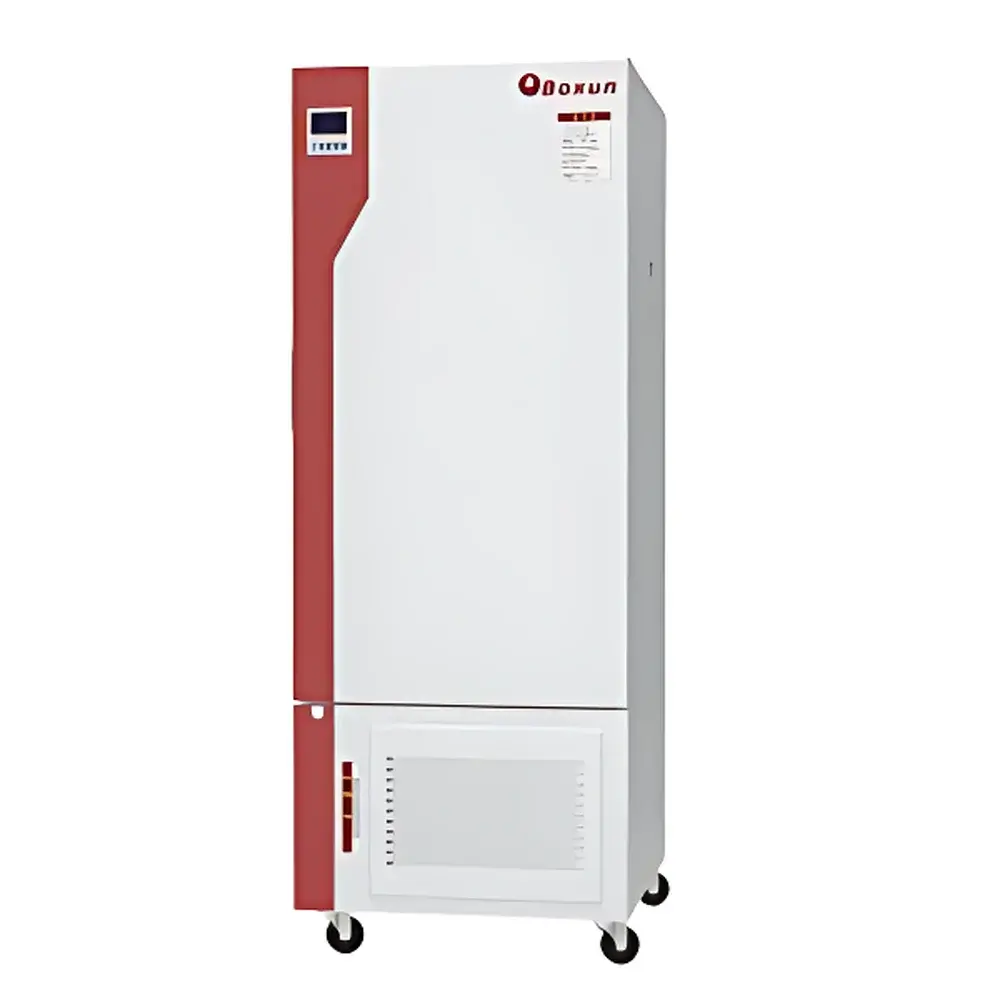
BOXUN BMJ-250C Mold Incubator with Humidity Control
| Brand | BOXUN |
|---|---|
| Origin | Shanghai, China |
| Manufacturer Type | Direct Manufacturer |
| Model | BMJ-250C |
| Temperature Range | 0–60 °C |
| Temperature Uniformity | ±1 °C (at 37 °C) |
| Humidity Range | 50–90 % RH |
| Humidity Fluctuation | ±5 % RH |
| Capacity | 250 L |
| Temperature Resolution | 0.1 °C |
| Temperature Stability | ±0.5 °C |
| Power Input | 1400 W |
| Timer Range | 0–9999 min |
| Inner Dimensions (W×D×H) | 510×450×1100 mm |
| Outer Dimensions (W×D×H) | 650×740×1726 mm |
| Shelf Quantity | 4 adjustable stainless steel shelves |
| Refrigeration | R134a-free compressor system |
| Interface | RS-485 for PC connectivity |
| Programmability | 30 segments × 99 cycles |
| Defrost Method | Energy-free automatic defrost |
| Humidification | Fin-type electric heating humidifier with external 5 L water reservoir |
| Safety | Mechanical door lock, over-temperature alarm, self-diagnostic cooling system |
Overview
The BOXUN BMJ-250C Mold Incubator with Humidity Control is a purpose-engineered environmental chamber designed specifically for the reliable cultivation, isolation, and maintenance of filamentous fungi, yeasts, and other humidity-sensitive microorganisms under strictly regulated thermal and hygric conditions. Unlike general-purpose incubators, this model integrates precision humidity regulation (50–90 % RH) with stable temperature control (0–60 °C), enabling reproducible mycological assays aligned with ISO 15588, ASTM D3273, and USP / microbiological testing protocols. Its engineered air circulation architecture—featuring a centrifugal blower and proprietary multi-directional airflow ducting—ensures uniform distribution of conditioned air across the entire 250 L working volume, minimizing vertical and horizontal gradients critical for colony morphology consistency and spore germination studies.
Key Features
- Integrated dual-control system: independent PID-regulated temperature and humidity loops, each with real-time digital feedback via high-stability platinum resistance sensors (PT100) and capacitive RH transducers from European OEM suppliers
- Energy-efficient refrigeration: hermetically sealed, low-noise compressor using R134a-free refrigerant; coupled with patented passive defrost technology that eliminates thermal interruption during long-term operation
- Robust chamber construction: cold-rolled steel exterior with electrostatic epoxy coating; mirror-finish 304 stainless steel interior; four fully adjustable, load-rated stainless steel shelves (max. 15 kg/shelf)
- Intelligent operational safeguards: over-temperature cut-off, door-open alarm, power-failure data retention with auto-resume functionality, and built-in system diagnostics that continuously monitor compressor status, sensor integrity, and heater duty cycle
- Human-centric interface: backlit LCD panel displaying setpoint/actual values for temperature, humidity, elapsed time, and remaining program duration; intuitive navigation for multi-step ramp-soak profiles
Sample Compatibility & Compliance
The BMJ-250C supports standard microbiological sample formats including Petri dishes (up to 150 mm), slant tubes, broth culture vessels, and membrane filtration assemblies. Its internal dimensions (510 × 450 × 1100 mm) accommodate stacked configurations without compromising airflow or condensation management. The chamber meets essential design criteria for GLP-compliant laboratories: traceable calibration support (NIST-traceable reference probes available), audit-ready event logging (via RS-485), and mechanical interlock preventing unauthorized access during sensitive incubation phases. Optional GPRS alert modules enable remote notification of parameter excursions—critical for unattended overnight or weekend fungal growth monitoring in regulatory environments.
Software & Data Management
Equipped with an industrial-grade RS-485 port compliant with Modbus RTU protocol, the incubator interfaces seamlessly with laboratory information management systems (LIMS), SCADA platforms, or custom Python/MATLAB acquisition scripts. Firmware supports time-stamped storage of up to 10,000 data points (temperature + humidity + timestamp), retrievable via serial command or optional thermal printer module (supporting real-time trend curves and pass/fail annotations). All logged events—including door openings, alarm triggers, and program transitions—are recorded with ISO 8601 timestamps and retained across power cycles. When integrated with validated PC software, the system satisfies FDA 21 CFR Part 11 requirements for electronic records and signatures through user-level access controls, change history tracking, and immutable audit trails.
Applications
This incubator serves as a core platform for standardized mycological procedures across multiple sectors: mold enumeration in pharmaceutical cleanroom environmental monitoring (ISO 14644-1); fungal spoilage assessment in food safety labs (AOAC 997.05); antifungal susceptibility testing per CLSI M38-A3; BOD₅-related microbial respiration assays in wastewater treatment research; and plant pathogen culture maintenance in agricultural biotechnology. Its extended low-temperature capability (down to 0 °C) also enables psychrotolerant fungal strain preservation and chilling-phase studies relevant to post-harvest mycotoxin formation kinetics.
FAQ
What standards does the BMJ-250C comply with for pharmaceutical microbiology?
It supports execution of USP , , and methods when operated within defined humidity and temperature tolerances; full validation documentation packages (IQ/OQ/PQ templates) are available upon request.
Can the incubator maintain stable humidity at 30 °C and 85 % RH simultaneously?
Yes—the system’s decoupled control architecture and high-capacity humidification (5 L external reservoir + fin-heated evaporative surface) ensure stable operation across the full specified range without condensation buildup or drift.
Is remote monitoring supported out-of-the-box?
RS-485 communication is standard; GPRS SMS alerts and Ethernet/WiFi gateways are optional accessories requiring separate configuration.
How is calibration verification performed?
Dual independent probe ports (30 mm inner diameter) allow insertion of third-party reference sensors for periodic performance verification without disrupting active runs.
What safety certifications does the unit carry?
CE marking (EN 61010-1, EN 61326-1), RoHS compliance, and factory-issued electrical safety test reports are provided with each shipment.



