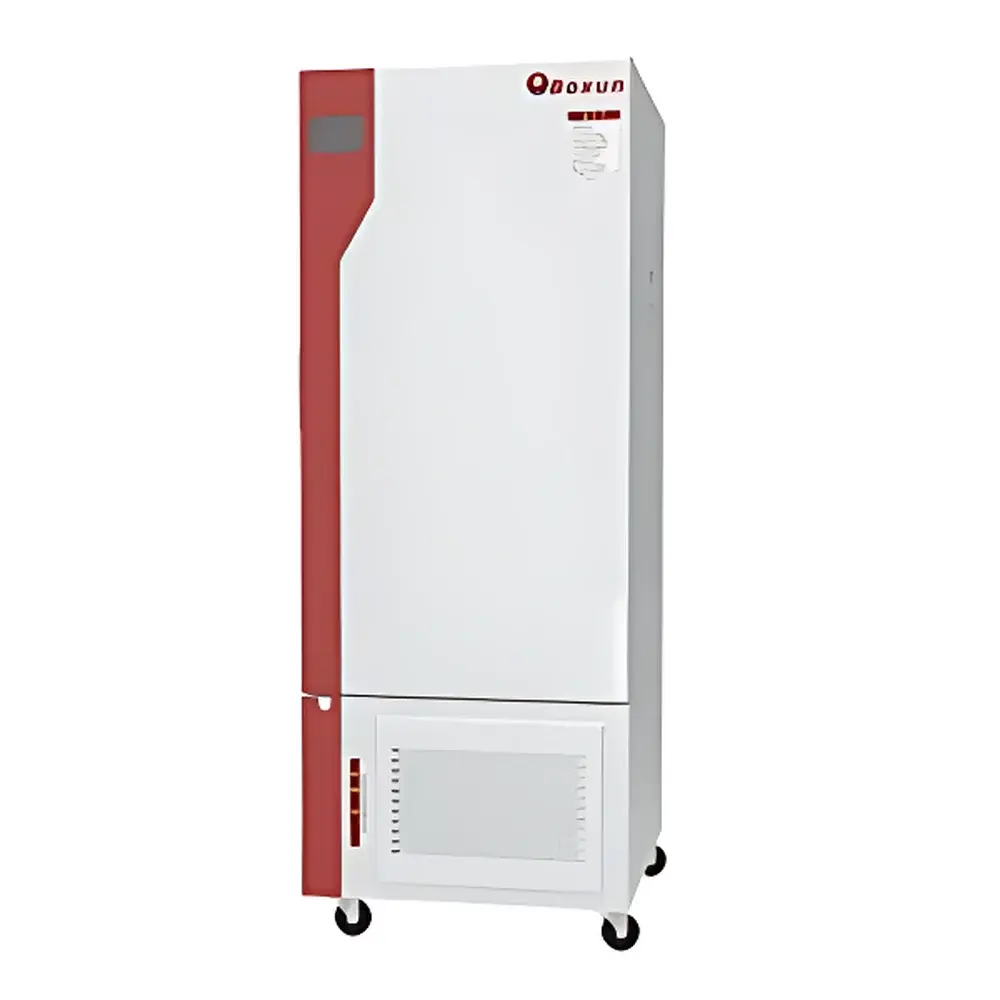
BOXUN BXG-250 Plant Growth Chamber
| Brand | BOXUN |
|---|---|
| Model | BXG-250 |
| Origin | Shanghai, China |
| Manufacturer Type | Direct Manufacturer |
| Control Temperature Range (Dark) | 0–70 °C |
| Control Temperature Range (Illuminated) | 10–70 °C |
| Temperature Resolution | 0.1 °C |
| Temperature Uniformity (at 25 °C) | ±1 °C |
| Temperature Fluctuation (at 25 °C) | ±0.5 °C |
| Illuminance Range | 0–30,000 lux (10-step adjustable) |
| Input Power (Standard) | 1450 W |
| Input Power (Humidity-Enabled) | 2050 W |
| Chamber Interior Dimensions (L×W×H) | 510 × 450 × 1090 mm |
| External Dimensions (L×W×H) | 650 × 740 × 1726 mm |
| Standard Shelves | 2 pcs (max 7) |
| Standard Light Panels | 2 sets (max 3) |
| Data Storage Capacity | 250,000 records |
| Real-time Log View | Last 1600 entries |
| Interface | USB + RS485 |
| Compliance Options | FDA 21 CFR Part 11–compliant software (optional), GMP/GLP audit trail support (optional) |
Overview
The BOXUN BXG-250 Plant Growth Chamber is a precision-engineered environmental control system designed for reproducible, long-term cultivation of photobiological samples under tightly regulated temperature and light conditions. It operates on the principle of active thermoelectric and refrigeration-based thermal management combined with high-efficiency LED or fluorescent light panels to deliver uniform, programmable illumination across defined spectral intensity ranges. Unlike standard incubators, the BXG-250 integrates C.H. (Circulating Heat) energy recovery technology to minimize thermal inertia and accelerate chamber recovery after door opening—critical for maintaining experimental integrity during routine access. Its dual-mode operation supports both dark-phase studies (0–70 °C) and illuminated growth protocols (10–70 °C), making it suitable for seed germination, plant phenotyping, microbial culture maintenance, and photoperiod-dependent physiological assays in academic, agricultural, and pharmaceutical research laboratories.
Key Features
- 4.3-inch TFT 16-bit true-color LCD touchscreen interface running on Windows CE OS with high-frequency CPU and extended onboard memory for stable multitasking and real-time parameter monitoring
- Fuzzy PID temperature control algorithm enabling precise setpoint tracking and multi-stage programming: up to 30 segments per cycle, 99 cycles total, with segment duration configurable from 1 to 9999 hours
- Imported energy-efficient hermetic compressor and high-static-pressure centrifugal fan for rapid cooling and laminar airflow distribution
- Variable-speed refrigeration system ensuring <60-second temperature recovery post-door-opening at 25 °C ambient
- Two standard light panels (expandable to three), each offering 10-step adjustable irradiance (0–30,000 lux), with optional UV-C germicidal lamp integration for sterile chamber conditioning
- Comprehensive safety architecture: independent overtemperature cutoff, door-open alarm, sensor fault detection, and password-protected screen lock with customizable timeout
- Onboard data logging: 250,000 timestamped entries—including temperature readings, operational events (power-on/off, parameter changes, alarms), and system diagnostics—with USB export capability for CSV or binary trace files
Sample Compatibility & Compliance
The BXG-250 accommodates diverse biological specimens requiring photoperiod synchronization or controlled thermal exposure, including Arabidopsis thaliana seedlings, rice callus cultures, fungal spore suspensions, and bacterial colonies on solid media. Its interior chamber (510 × 450 × 1090 mm) supports up to seven adjustable stainless-steel shelves and three independently controllable light panels—enabling vertical stratification of light intensity gradients for comparative photomorphogenesis studies. All firmware and optional monitoring software modules are architected to support regulatory compliance: the FDA Edition includes full 21 CFR Part 11 audit trails (electronic signatures, user access logs, immutable record history), while the GMP Edition adds electronic batch record templates, deviation flagging, and IQ/OQ documentation support. The unit meets IEC 61000-6-3 (EMC) and GB/T 2423.1–2008 (environmental testing) standards; optional humidity control module extends functionality to hygrophilic species cultivation (30–95% RH, ±3% fluctuation).
Software & Data Management
Data acquisition and analysis are facilitated through embedded firmware with dual-interface connectivity—USB 2.0 for direct flash-drive export and RS485 for integration into centralized lab automation networks (e.g., LabVantage, Thermo Fisher SampleManager). Exported datasets include absolute timestamps, sensor IDs, and event metadata (e.g., “Alarm: T_sensor_fail @ 2024-06-12T14:22:08Z”), compatible with MATLAB, Python pandas, and JMP for statistical modeling. Optional PC-based monitoring software provides real-time graphical overlays of temperature/light profiles, remote parameter adjustment via secure TLS-encrypted channels, and automated report generation aligned with ISO/IEC 17025 documentation requirements. All logged data are stored in non-volatile memory with cyclic overwrite protection—ensuring retention of critical calibration and validation records beyond power loss.
Applications
- Controlled-environment plant phenotyping: quantifying hypocotyl elongation, leaf expansion, and flowering time under defined photoperiods and diurnal temperature shifts
- Microbial viability assessment: evaluating colony-forming units (CFUs) of phototrophic bacteria (e.g., Rhodobacter sphaeroides) under variable irradiance regimes
- Seed dormancy release studies: simulating seasonal temperature/light cues to trigger germination in crop species such as wheat and barley
- Pharmaceutical stability testing: supporting ICH Q1B photo-stability protocols for drug substance evaluation under controlled visible/UV exposure
- Algal bioreactor pre-culture: conditioning Chlorella vulgaris inocula under optimized light:dark cycles prior to photobioreactor transfer
FAQ
What is the maximum number of programmable temperature/light cycles supported?
The BXG-250 supports up to 99 repeating cycles, each composed of up to 30 individually defined segments.
Can the unit operate without illumination while maintaining temperature control?
Yes—the dark-mode temperature range is 0–70 °C, fully decoupled from lighting circuits.
Is humidity control available as a factory-installed option?
Yes, the optional humidity module provides 30–95% RH control with ±3% stability and integrates seamlessly with existing firmware.
Does the USB data export include calibration history and sensor drift logs?
Yes—exported .csv files contain all sensor calibration timestamps, coefficients, and diagnostic flags recorded during system self-tests.
Are third-party LIMS integrations supported?
RS485 Modbus RTU protocol enables bidirectional communication with major LIMS platforms when configured with appropriate gateway firmware.