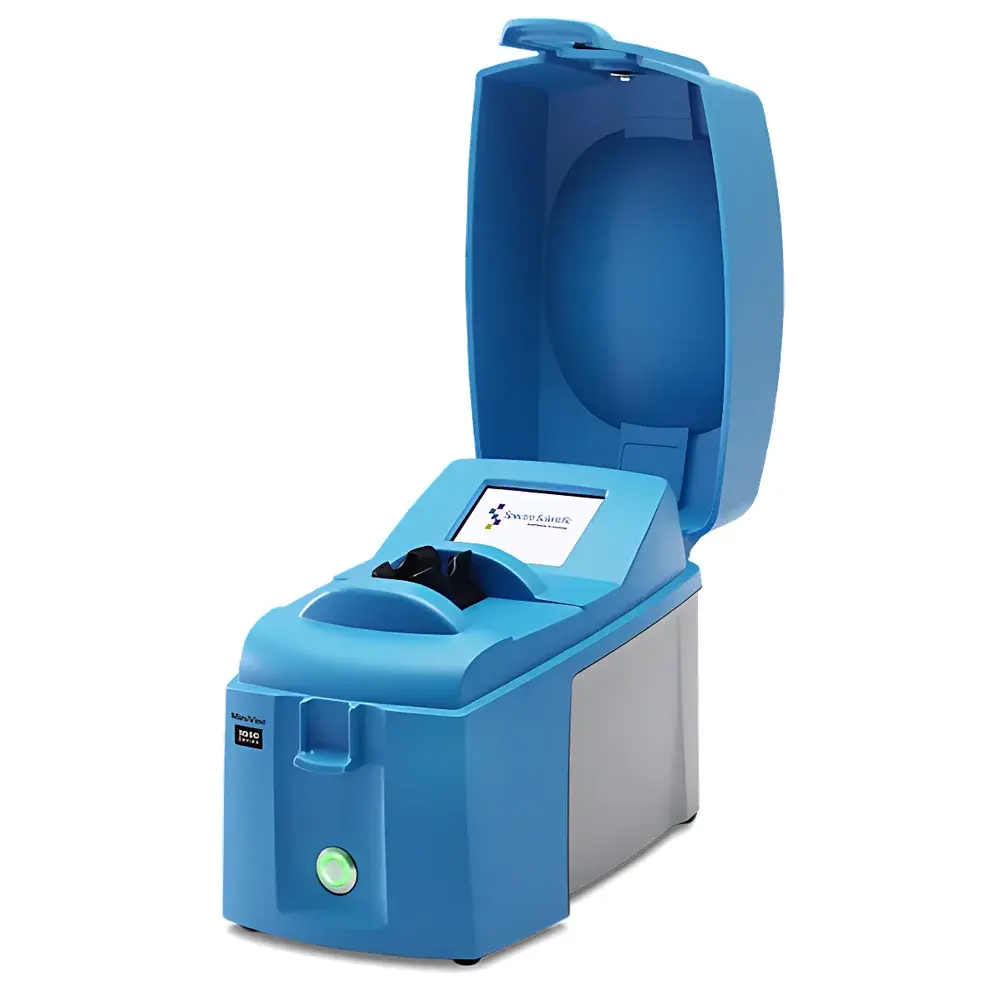
Spectro Scientific MiniVisc 3000 Series Portable Kinematic Viscosity Analyzer
| Brand | Spectro Scientific |
|---|---|
| Origin | USA |
| Manufacturer | Yes |
| Import Category | Imported |
| Model | MiniVisc 3000 |
| Price | Upon Request |
Overview
The Spectro Scientific MiniVisc 3000 Series is a field-deployable, solvent-free, temperature-controlled kinematic viscosity analyzer engineered for real-time lubricant condition monitoring in industrial and mobile equipment environments. It operates on the fundamental principle of gravity-driven capillary flow under precisely regulated thermal conditions—specifically at 40 °C—enabling direct determination of kinematic viscosity (mm²/s or cSt) without requiring density measurement, external temperature calibration, or laboratory infrastructure. Unlike traditional Ubbelohde or Cannon-Fenske viscometers, the MiniVisc 3000 employs a patented Hele-Shaw microchannel geometry within a split-cell capillary assembly, where fluid motion between two parallel heated plates is optically tracked via LED–photodiode transduction. This architecture eliminates reliance on timed efflux through narrow-bore glass capillaries, thereby removing sensitivity to particulate blockage, surface wetting anomalies, and operator-dependent timing errors. The instrument’s core function aligns with ASTM D445 (Standard Test Method for Kinematic Viscosity of Transparent and Opaque Liquids) and supports traceable viscosity reporting compliant with ISO 3104 and ISO 2909—making it suitable for predictive maintenance programs governed by ISO 55000 and API RP 546.
Key Features
- Patented split-cell capillary design enabling rapid, low-volume (60 µL) sample introduction and complete optical accessibility for cleaning
- Integrated PID-controlled heating system maintaining sample cell temperature at 40 °C ± 0.1 °C—no pre-equilibration required
- Self-contained operation: rechargeable lithium-ion battery (≥6 h runtime), built-in high-resolution touchscreen interface, and embedded microprocessor
- Solvent-free cleaning protocol: single-step wipe with lint-free tissue; no hazardous solvent transport, storage, or waste disposal
- Universal fluid compatibility: validated for transparent, semi-transparent, and fully opaque oils—including heavily sooted diesel engine oils, oxidized turbine fluids, and contaminated hydraulic fluids
- Dual-reporting capability: direct measurement at 40 °C plus calculated kinematic viscosity at 100 °C using ASTM D341 interpolation algorithms
- Compact form factor (1.8 kg) optimized for handheld use in confined spaces—e.g., wind turbine nacelles, marine engine rooms, and rail depot pits
- Optical flow detection via infrared photodiode array with sub-millisecond temporal resolution for high repeatability (CV < 1.5% per ASTM D445 repeatability criteria)
Sample Compatibility & Compliance
The MiniVisc 3000 Series accommodates a broad spectrum of petroleum-based and synthetic lubricants, including but not limited to: mineral-based hydraulic oils (ISO VG 10–68), turbine oils (ISO VG 32–46), engine oils (SAE 5W–50), gear oils (EP formulations), and transformer fluids. Its open-path optical detection system remains unaffected by suspended soot, varnish precursors, or metallic wear debris—eliminating the need for filtration or dilution prior to analysis. From a regulatory standpoint, the device supports data integrity requirements under FDA 21 CFR Part 11 when paired with Spectro’s optional LabManager™ software (audit trail, electronic signatures, user access controls). All firmware and calibration routines are documented per ISO/IEC 17025:2017 clause 7.7 (Equipment Calibration and Verification), and hardware design conforms to IEC 61000-6-2 (EMC immunity) and IEC 60529 IP54 (dust and splash resistance).
Software & Data Management
While fully functional as a standalone analyzer, the MiniVisc 3000 integrates seamlessly with Spectro’s LabManager™ desktop application for centralized fleet-level trend analysis, alarm threshold configuration, and report generation (PDF/CSV). Raw sensor timestamps, temperature logs, and photodiode voltage waveforms are stored locally with time/date stamping and can be exported via USB-C or Bluetooth 5.0. Instrument firmware supports over-the-air updates and includes configurable data retention policies aligned with GLP/GMP documentation practices. Each measurement record contains embedded metadata: operator ID, location tag (manual entry), ambient temperature/humidity (optional external sensor input), and calibration verification status—ensuring full traceability across multi-site maintenance operations.
Applications
- On-site verification of oil viscosity before commissioning new equipment or after oil change events
- Routine trending of in-service lubricants in critical rotating assets (pumps, compressors, generators)
- Field triage of suspected contamination events—e.g., fuel dilution, coolant ingress, or incorrect oil top-up
- Supporting ISO 4406 particle count correlation studies where viscosity shifts indicate additive depletion or oxidation onset
- Condition-based maintenance validation in remote or offshore installations where lab turnaround exceeds operational tolerance windows
- Training and competency assessment for maintenance technicians performing Level I oil analysis per ISO 18473
FAQ
Does the MiniVisc 3000 require calibration with reference oils?
Yes—initial factory calibration is performed using NIST-traceable viscosity standards (e.g., Cannon Standard Oils). Field users may perform periodic verification using certified reference materials; calibration certificates are issued per ISO/IEC 17025.
Can the instrument measure viscosity at temperatures other than 40 °C?
No—the thermal control system is fixed at 40 °C to ensure compliance with ASTM D445 standard test conditions. Viscosity at 100 °C is mathematically derived using the ASTM D341 equation and requires input of the 40 °C result.
Is the split-cell design susceptible to clogging from sludge or carbon deposits?
No—unlike conventional capillary viscometers, the Hele-Shaw channel geometry (gap height > 100 µm) prevents occlusion by particles up to ISO 4406 24/22/19 contamination levels.
How is measurement uncertainty quantified for field use?
Repeatability is ≤1.2% RSD (n=10, same operator, same sample); reproducibility across instruments is ≤2.0% RSD per inter-laboratory study data published in Spectro Technical Bulletin TB-2022-08.
Does the device support wireless data transfer to enterprise CMMS platforms?
Yes—via optional MQTT or OPC UA gateway modules compatible with SAP PM, IBM Maximo, and Siemens Desigo CC.