
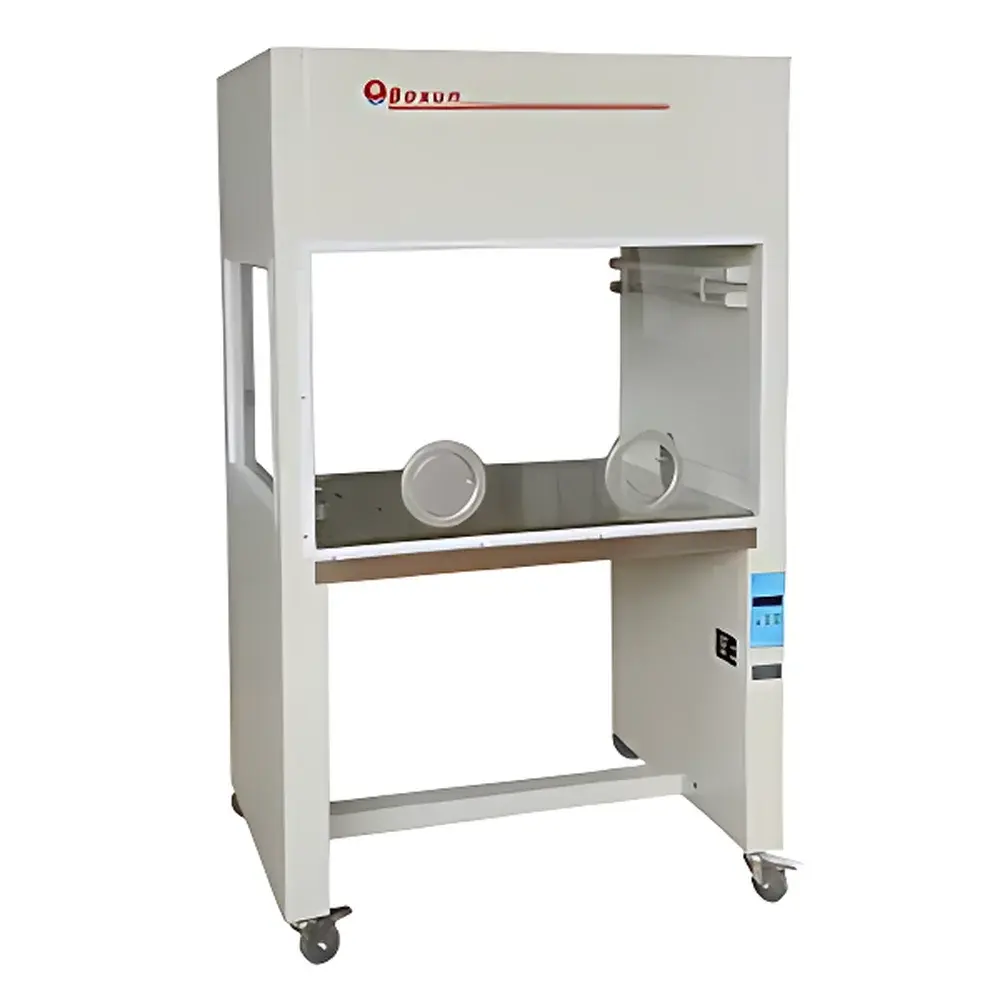
BOXUN SW-CJ-1F Vertical Flow Clean Bench
| Brand | BOXUN |
|---|---|
| Origin | Shanghai, China |
| Manufacturer Type | Direct Manufacturer |
| Product Category | Domestic |
| Model | SW-CJ-1F |
| Instrument Type | Vertical Flow Clean Bench |
| Cleanliness Class | ISO Class 5 (100-grade, ≥99.99% filtration efficiency for particles ≥0.5 µm) |
| Noise Level | ≤67 dB(A) |
| User Capacity | Single-operator, dual-front access |
| Airflow Pattern | Vertical downward laminar flow |
| Working Area Air Velocity | 0.3–0.6 m/s (adjustable in six steps) |
| Vibration Peak-to-Peak | ≤5 µm (X/Y/Z axes) |
| Illumination | ≥300 lux |
| Working Chamber Dimensions (W×D×H) | 870 × 700 × 520 mm |
| Overall Dimensions (W×D×H) | 990 × 724 × 1650 mm |
| HEPA Filter Specification | 820 × 615 × 50 mm × 1 unit |
| Pre-filter | Medium-efficiency panel filter |
| UV Lamp | 20 W × 1 (timer-controlled, 0–999 min) |
| Fluorescent Lamp | 20 W × 1 |
| Net Weight | 110 kg |
| Power Consumption | 0.15 kW |
| Electrical Supply | AC 220 V ±10%, 50/60 Hz |
Overview
The BOXUN SW-CJ-1F Vertical Flow Clean Bench is an ISO Class 5-certified laminar flow workstation engineered to deliver a controlled, particle-free microenvironment for non-sterile but contamination-sensitive procedures. It operates on the principle of vertical unidirectional airflow: ambient air is drawn through a pre-filter and then forced downward through a certified HEPA filter (EN 1822 H14, ≥99.99% efficiency at 0.5 µm), generating a consistent, low-turbulence laminar curtain across the work surface. This design isolates the operator from process-generated aerosols while protecting samples from roomborne particulates—making it suitable for applications where sterile containment is not required (e.g., no open flame or volatile solvent use), but particulate control is critical. Unlike biosafety cabinets, the SW-CJ-1F does not recirculate air nor provide personnel protection against biohazards; its primary function is sample protection via directional airflow management and high-efficiency particulate filtration.
Key Features
- Robust structural architecture: Cold-rolled steel outer casing with electrostatic powder coating; 304 stainless steel work surface for corrosion resistance, chemical compatibility, and ease of decontamination.
- Stable aerodynamic performance: Centrifugal blower system with six-step adjustable speed control (0.3–0.6 m/s), enabling optimization for specific procedural requirements such as cell culture setup or precision instrument calibration.
- Integrated human-machine interface: LCD display with tactile membrane switches for intuitive operation of airflow, lighting, and UV sterilization functions.
- Dual independent lighting system: 20 W fluorescent lamp (≥300 lux at work surface) for task illumination and 20 W UV-C germicidal lamp (254 nm) with programmable timer (0–999 minutes) for surface decontamination between operations.
- Enhanced environmental isolation: Vertically oriented, quasi-enclosed work chamber with sliding sash window and auxiliary small access door—minimizing cross-contamination risk and reducing operator exposure to odorous or mildly irritant vapors.
- Extended filter service life: Dual-stage filtration architecture comprising a washable medium-efficiency pre-filter upstream of the main HEPA unit, significantly reducing particulate loading on the final filter and lowering long-term maintenance frequency.
Sample Compatibility & Compliance
The SW-CJ-1F supports routine handling of non-hazardous biological specimens (e.g., bacterial cultures, plant tissue explants), pharmaceutical intermediates, optical components, and microelectronic assemblies where ambient particulate levels must be reduced to ≤3,520 particles/m³ (≥0.5 µm). It conforms to ISO 14644-1:2015 for cleanroom classification and meets the airflow uniformity and velocity stability criteria specified in IEST-RP-CC002.3 for laminar flow devices. While not compliant with NSF/ANSI 49 or EN 12469 (as it lacks negative-pressure containment and exhaust ducting), its design aligns with GLP-relevant environmental controls for non-GLP laboratory workflows involving material inspection, formulation preparation, and analytical sample staging. Routine validation—including airflow visualization (smoke studies), filter integrity testing (DOP/PAO challenge), and velocity mapping—is recommended per ISO 14644-3.
Software & Data Management
The SW-CJ-1F operates via embedded firmware without external software dependency. All operational parameters—including fan speed setting, UV exposure duration, and lamp status—are logged locally in non-volatile memory with timestamped records retained for ≥1,000 cycles. The system supports manual audit trail generation via LCD menu navigation, fulfilling basic documentation needs for internal quality review. Though not FDA 21 CFR Part 11-compliant out-of-the-box, the unit can be integrated into facility-wide monitoring systems via optional analog voltage output (0–10 V) for real-time airflow velocity feedback, enabling centralized logging in validated SCADA or LIMS environments when paired with third-party data acquisition modules.
Applications
- Cell culture setup and passaging in academic and industrial biotechnology labs where open-flame sterilization is absent.
- Preparation of media, reagents, and standards in QC laboratories supporting pharmacopeial testing (USP & EP chapters).
- Assembly and inspection of micro-optical components, semiconductor wafers, and precision mechanical subassemblies.
- Environmental microbiology sample processing—including water and air filter analysis—prior to incubation or enumeration.
- Electronics manufacturing support tasks requiring ESD-safe, low-particulate staging zones (used in conjunction with grounded work surfaces).
FAQ
Is the SW-CJ-1F suitable for handling pathogenic microorganisms?
No. It provides product protection only—not personnel or environmental protection. Biosafety Level 1 (BSL-1) non-pathogenic work is appropriate; BSL-2 or higher agents require certified Class II biological safety cabinets.
What is the recommended HEPA filter replacement interval?
Under typical laboratory usage (8 hrs/day, moderate particulate load), replace the HEPA filter every 18–24 months—or sooner if pressure drop exceeds 250 Pa or airflow velocity falls below 0.25 m/s after adjustment.
Can the unit be installed in a non-air-conditioned environment?
Ambient temperature should be maintained between 15–30°C and relative humidity below 70% to prevent condensation on internal components and ensure stable motor performance and filter integrity.
Does the UV lamp require periodic intensity verification?
Yes. UV-C output degrades over time; annual radiometric measurement using a calibrated UV meter (254 nm) is advised to confirm irradiance ≥40 µW/cm² at 1 m distance.
Is electrical grounding mandatory?
Yes. A dedicated earth-ground connection is required for operator safety, electromagnetic compatibility, and reliable operation of the touch-control interface and lamp ballasts.



