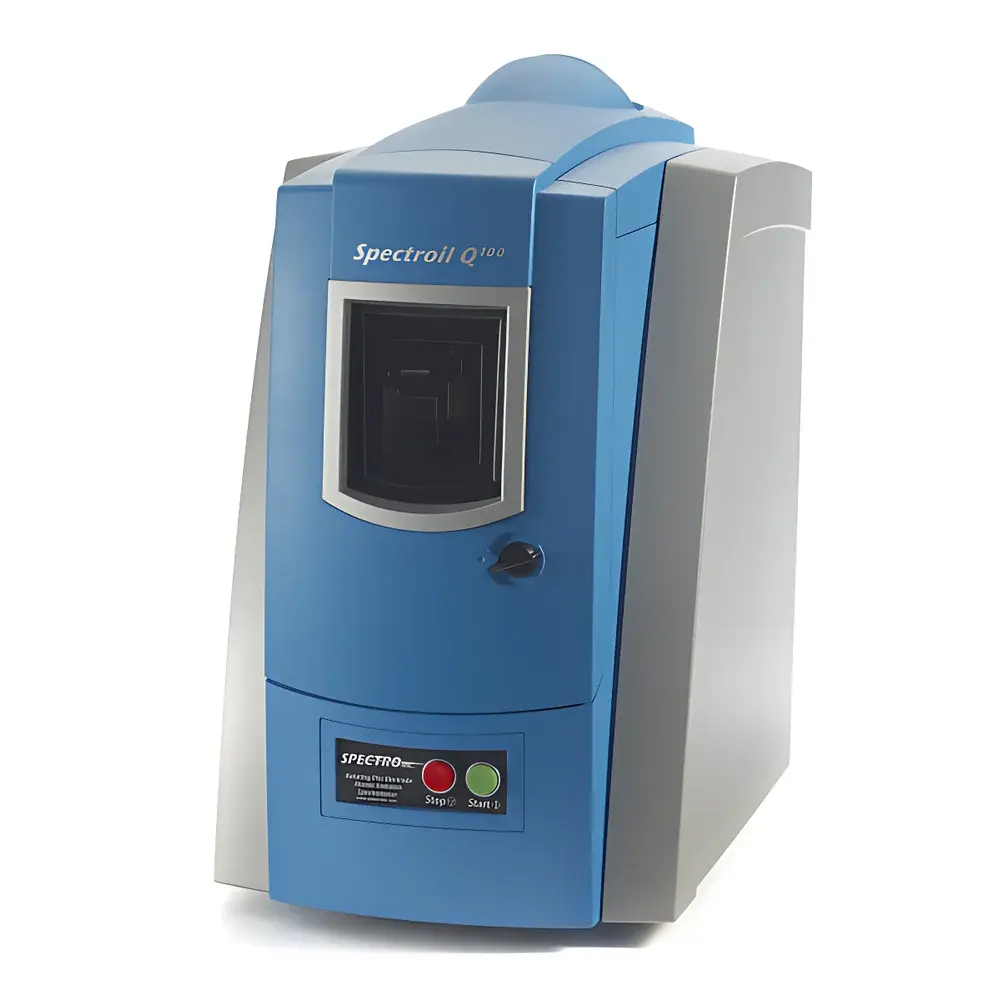
Spectro Scientific N99903 RDE Spectrometer for Coolant Elemental Analysis
| Brand | Spectro Scientific |
|---|---|
| Origin | USA |
| Manufacturer | Spectro Scientific, Inc. |
| Country of Origin | Imported |
| Model | N99903 |
| Pricing | Available upon Request |
Overview
The Spectro Scientific N99903 is a dedicated Rotating Disc Electrode (RDE) optical emission spectrometer engineered for rapid, on-site elemental analysis of engine coolants and antifreeze solutions. Unlike general-purpose oil analyzers, the N99903 integrates a proprietary coolant-specific calibration matrix optimized for ethylene glycol– and propylene glycol–based formulations. It operates on the principle of arc emission spectroscopy: a precisely metered coolant sample is deposited onto a rotating graphite electrode, vaporized by a controlled DC arc, and the resulting atomic emission spectrum is resolved by a high-resolution Czerny-Turner monochromator with photomultiplier tube detection. This enables quantitative measurement of metallic and non-metallic elements critical to coolant health—including corrosion inhibitors (e.g., Si, B, Na, K, Ca, Mg), wear metals (e.g., Fe, Cu, Al, Pb), and contamination markers (e.g., Na, Cl, S)—without chemical digestion or dilution.
Key Features
- Single-platform capability for antifreeze/coolant, lubricating oil, fuel oil, and grease—eliminating need for multiple instruments in maintenance labs.
- Full-spectrum RDE analysis delivering results in ≤30 seconds per sample, with no sample preparation, no carrier gas, and zero organic solvent consumption.
- Factory-calibrated coolant method covering 13 elements: Al, B, Ca, Cu, Fe, K, Mg, Na, Pb, Si, Sn, Zn, and S—with detection limits optimized for ASTM D6595 and ISO 21478 compliance contexts.
- Rugged, portable chassis (12.5 kg) with integrated battery option for field deployment at power plants, rail depots, and marine engine rooms.
- Self-diagnostic optical path alignment and electrode wear monitoring ensure long-term measurement stability and repeatability (RSD < 3% at 10 ppm level).
Sample Compatibility & Compliance
The N99903 accepts undiluted, as-received coolant samples—including conventional silicate-based, OAT (organic acid technology), HOAT (hybrid OAT), and Si-OAT formulations—across pH ranges of 7.5–11.0. It complies with the analytical framework of ASTM D6595 (Standard Test Method for Determination of Wear Metals and Contaminants in Used Lubricating Oils and Coolants by Rotating Disc Electrode Atomic Emission Spectrometry) and supports data traceability requirements aligned with ISO/IEC 17025:2017 and GLP documentation workflows. While not FDA-regulated, its audit-ready data logs meet internal QA/QC protocols for Tier-1 OEMs and fleet maintenance programs subject to ISO 55001 asset management standards.
Software & Data Management
Equipped with Spectro’s SpectroSoft™ v5.2 platform, the instrument provides intuitive method selection, real-time spectral visualization, automated interference correction (e.g., molecular band rejection for OH/N₂ bands), and customizable reporting templates. All analyses are timestamped, user-ID logged, and stored with full raw spectral data, calibration history, and electrode usage metrics. Export formats include CSV, PDF, and XML; integration with LIMS via ASTM WK53212-compliant API is supported. Audit trail functionality satisfies 21 CFR Part 11 expectations for electronic records and signatures when configured with role-based access control and password-protected method locking.
Applications
- Monitoring inhibitor depletion (e.g., borate, silicate, molybdate) in heavy-duty diesel engine coolants to prevent liner pitting and water pump seal failure.
- Detecting cross-contamination from lube oil (Fe, Cr, Ni) or combustion byproducts (SO₄²⁻ surrogate via S signal) indicating head gasket leakage.
- Quantifying hard-water ingress (Ca, Mg, Na) and chloride exposure (Cl inferred via Na/K ratio trends) in industrial closed-loop cooling systems.
- Supporting predictive maintenance strategies per SAE JA1012 and ISO 17359 by correlating elemental trends with TBN depletion, glycol oxidation, and nitrite loss.
- Validating batch consistency during coolant formulation and reclamation processes in manufacturing and remanufacturing facilities.
FAQ
Does the N99903 require argon or other shielding gases during analysis?
No. The RDE arc operates in ambient air; no external gas supply is needed.
Can it analyze concentrated antifreeze (100% glycol) without dilution?
Yes. The coolant method is validated for neat ethylene glycol and propylene glycol solutions, as well as pre-diluted 50/50 mixtures.
How often must the graphite electrode be replaced?
Electrode lifetime averages 500–800 analyses under standard coolant testing conditions; the system alerts users at 90% wear threshold.
Is method validation support available for ISO 17025 accreditation?
Yes. Spectro provides documented method verification packages—including precision studies, spike recovery data, and limit-of-detection reports—for laboratory accreditation submissions.
Does the instrument support remote diagnostics or firmware updates?
Yes. Over-the-air firmware updates and secure remote support sessions are enabled via encrypted Ethernet or Wi-Fi connection with customer-configurable firewall rules.