
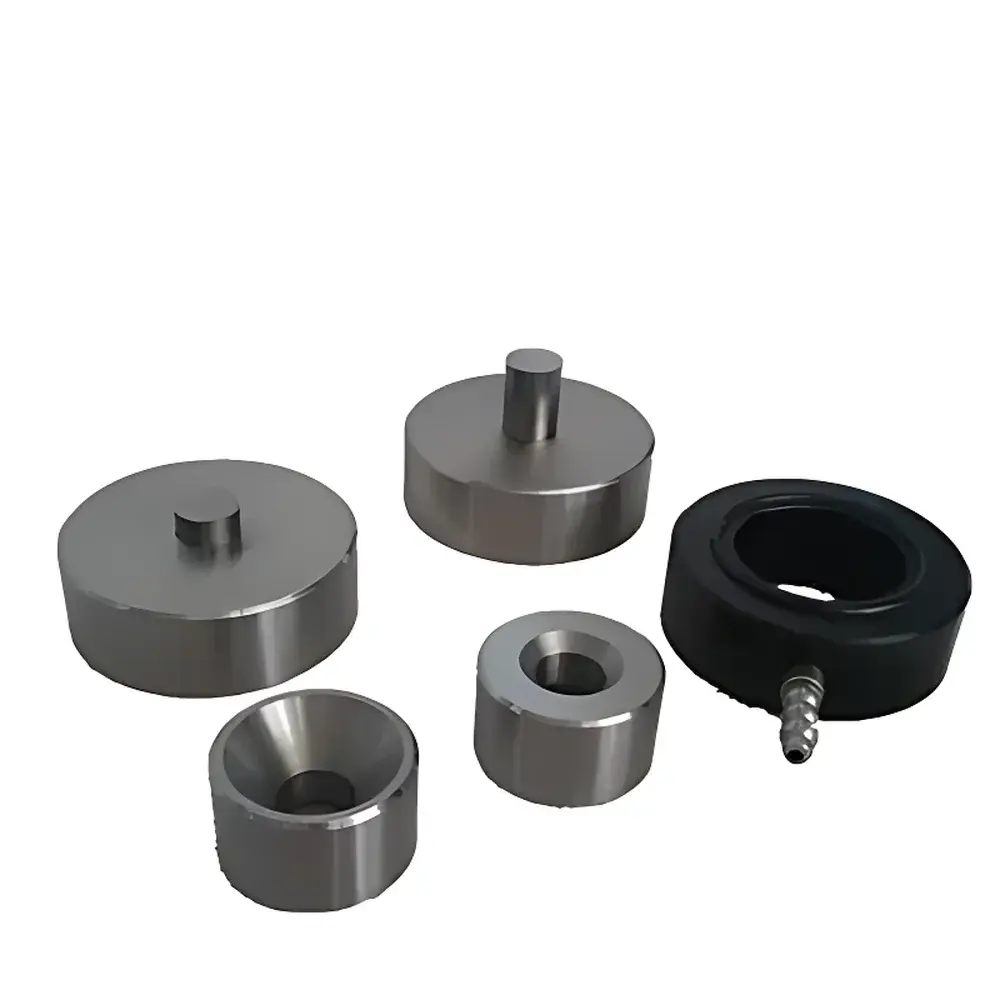
HF-2A Manual Pellet Press by TOP (Tianjin)
| Brand | TOP (Tianjin) |
|---|---|
| Origin | Tianjin, China |
| Manufacturer Type | Direct Manufacturer |
| Product Category | Domestic |
| Model | HF-2A |
| Instrument Type | Manual Pellet Press |
| Compatible Die Diameter | 13 mm |
| Maximum Pressure Capacity | 15 metric tons |
| Required Accessory | HF-6 Tablet Holder Insert |
Overview
The HF-2A Manual Pellet Press is a precision-engineered laboratory instrument designed specifically for the preparation of uniform, high-density solid pellets from fine powder samples—primarily for Fourier Transform Infrared (FTIR) spectroscopy analysis. Built on a robust mechanical lever-arm architecture, it operates on the principle of static hydraulic compression, delivering consistent force transmission without reliance on electrical or pneumatic systems. This makes it ideal for controlled, repeatable sample preparation in environments where power stability, electromagnetic interference sensitivity, or regulatory simplicity are critical—such as QC labs operating under GLP-compliant workflows or academic research settings requiring traceable manual protocols. The press is optimized for use with standardized 13 mm diameter die sets and integrates seamlessly with the HF-6 tablet holder insert to ensure precise alignment, minimal edge chipping, and reproducible pellet geometry across batches.
Key Features
- Manual lever-driven mechanism ensures full operator control over compression rate and dwell time—critical for pressure-sensitive or cohesive powders.
- Non-ejecting (non-release) die design maintains pellet integrity post-compression, eliminating ejection-induced cracking or delamination common in spring-assisted systems.
- Structural frame rated for sustained 15-ton (147 kN) compressive load, engineered with hardened steel components to minimize elastic deformation and maintain dimensional stability over extended service life.
- Optimized for 13 mm diameter punches and dies—compatible with ISO/ASTM-standardized FTIR pellet tooling and widely adopted in pharmaceutical, polymer, and mineralogical laboratories.
- Compact footprint (280 × 180 × 320 mm) and low-maintenance mechanical design support benchtop deployment in fume hoods, glove boxes, or shared instrumentation suites.
Sample Compatibility & Compliance
The HF-2A accommodates a broad range of dry, free-flowing to moderately cohesive powders—including KBr, NaCl, microcrystalline cellulose, metal oxides, catalysts, and pharmaceutical actives—provided particle size distribution falls within typical FTIR prep guidelines (D90 < 45 µm). It does not support volatile, hygroscopic, or thermally labile materials without pre-conditioning (e.g., vacuum drying or inert-atmosphere handling). While the unit itself carries no CE or UL certification (as a Class I manual mechanical device), its operation aligns with ISO 17025 clause 6.4.3 (equipment suitability) when used with calibrated load indicators or verified die sets. Documentation supports audit readiness for FDA 21 CFR Part 11–aligned SOPs when paired with traceable logbooks and operator training records.
Software & Data Management
As a purely mechanical instrument, the HF-2A does not incorporate embedded electronics, firmware, or digital interfaces. All operational parameters—including applied force, dwell duration, and sample mass—are recorded manually per defined SOPs. This analog architecture eliminates cybersecurity concerns, firmware validation requirements, and software lifecycle management overhead. Laboratories implementing electronic lab notebooks (ELNs) or LIMS can assign unique batch IDs to each pellet set and link metadata (e.g., operator ID, date/time, powder lot, die serial number) directly to spectral acquisition files in OPUS, OMNIC, or GRAMS platforms—ensuring full chain-of-custody without digital dependency.
Applications
- Preparation of KBr or polyethylene dispersion pellets for qualitative and quantitative FTIR analysis of organic compounds, polymers, and APIs.
- Consolidation of geological or ceramic powders for X-ray diffraction (XRD) sample mounting—where flat, crack-free surfaces improve diffractometer alignment and intensity reproducibility.
- Standardized compaction of reference standards (e.g., NIST SRMs) in metrology labs validating spectrometer performance.
- Teaching laboratories demonstrating fundamental principles of powder rheology, compaction behavior, and solid-state interfacial interactions.
- Pre-formulation studies in pharma R&D where excipient compatibility and compressibility profiles must be assessed prior to roller compaction or tableting scale-up.
FAQ
Is the HF-2A compatible with 6 mm or 25 mm dies?
No—the HF-2A is mechanically constrained to 13 mm diameter tooling. Use of non-specified dies may compromise structural safety and void warranty.
Does the press include a pressure gauge or load indicator?
Not by default; it is supplied as a bare press. Users must integrate an external calibrated load cell or use a torque-calibrated lever arm system to quantify applied force.
Can the HF-2A be used for cold isostatic pressing (CIP)?
No—it delivers uniaxial compression only. Isostatic methods require fluid-transmitted pressure and sealed elastomeric molds, which this design does not support.
What maintenance is required?
Monthly inspection of lever pivot points and die cavity cleanliness; annual lubrication of threaded components with ISO VG 68 mineral oil; replacement of worn punches/dies based on visual wear assessment.
Is the HF-6 tablet holder insert included with the HF-2A?
No—the HF-6 is a separate accessory item. Its use is mandatory to achieve concentric alignment and prevent die tilt during loading.



