
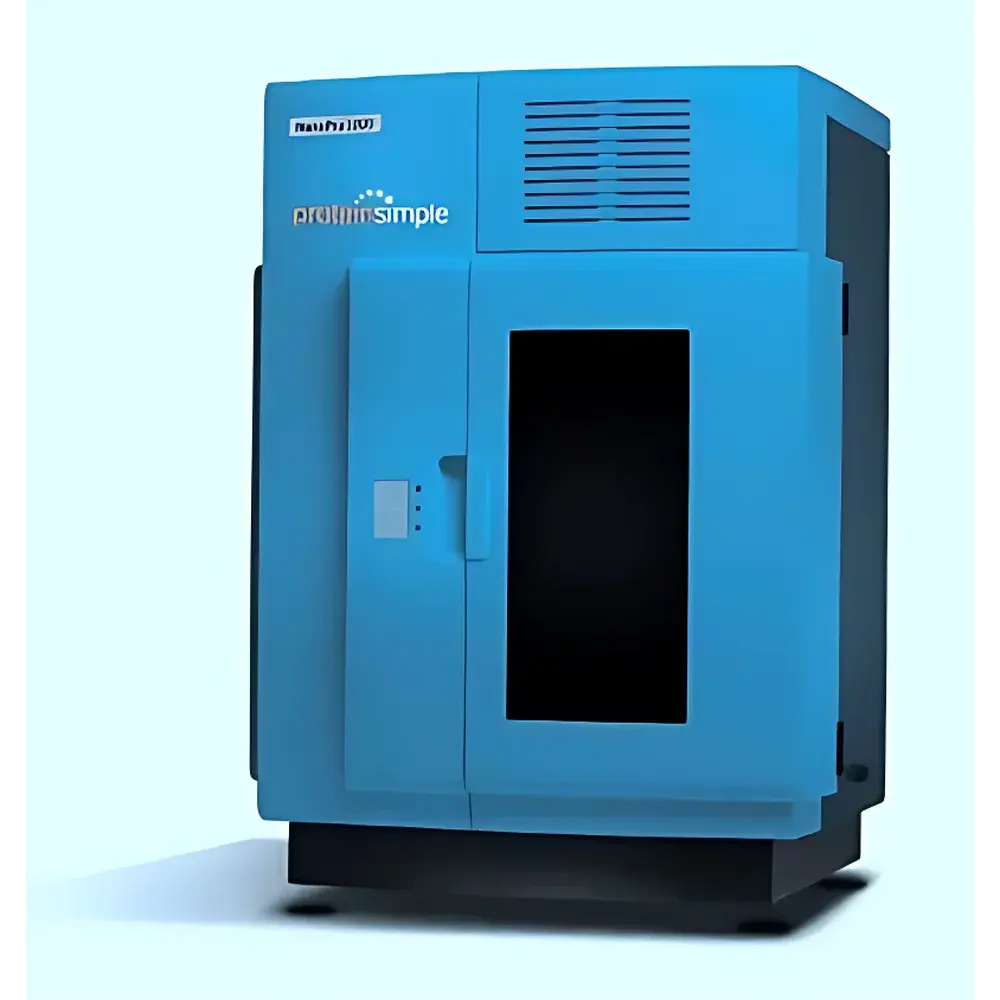
ProteinSimple NanoPro 1000 Capillary Isoelectric Focusing-Based Signal Transduction Protein Phosphorylation Analysis System
| Brand | ProteinSimple |
|---|---|
| Origin | USA |
| Model | NanoPro 1000 |
| Regulatory Classification | Import (Class I/II Research-Use-Only Instrument) |
| Intended Use | Quantitative, conformation-sensitive detection of post-translational modifications (e.g., phosphorylation, ubiquitination, cleavage) in ultra-low-input biological samples |
Overview
The ProteinSimple NanoPro 1000 is a research-use-only capillary isoelectric focusing (cIEF) coupled with chemiluminescent immuno-detection system engineered for high-resolution, quantitative analysis of signal transduction proteins and their functional isoforms. Unlike conventional bulk-protein methods—such as 2D gel electrophoresis, mass spectrometry, or standard Western blotting—the NanoPro 1000 leverages nanoliter-scale cIEF to resolve subtle conformational and charge-state differences arising from post-translational modifications (PTMs), including phosphorylation, deamidation, proteolytic cleavage, and glycosylation. These modifications induce minute shifts in protein isoelectric point (pI), which the system detects with single-digit pI-unit resolution across a pH 3–10 range. By immobilizing resolved isoforms directly on the inner capillary wall via UV-activated covalent chemistry, the NanoPro 1000 eliminates gel-handling artifacts and enables highly reproducible, antibody-based chemiluminescent quantification without transfer or stripping steps. Designed for functional proteomics, it bridges the gap between discovery-level PTM mapping and hypothesis-driven pathway validation—particularly where sample scarcity, heterogeneity, or dynamic signaling kinetics preclude traditional approaches.
Key Features
- Ultra-low sample requirement: As few as 25 cells per assay (≤400 nL total volume), enabling analysis of FACS-sorted subpopulations, laser-capture microdissected tissue sections, primary tumor biopsies, and stem cell isolates.
- Capillary isoelectric focusing with on-capillary immobilization: Patented UV-activated surface chemistry covalently anchors resolved protein isoforms to the capillary wall, preserving spatial separation integrity throughout immunodetection.
- Chemiluminescent immuno-detection with CCD imaging: High-sensitivity, linear-dynamic-range detection (≥4 logs) using standard HRP-conjugated antibodies and luminol-based substrates; no film development or digital scanner required.
- Automated, walk-away operation: Integrated fluidics handle sample loading, ampholyte mixing, focusing, UV fixation, blocking, antibody incubation, wash cycles, substrate delivery, and image acquisition—all under software control.
- Conformation-resolved quantification: Generates electropherogram-like output (pI vs. signal intensity), allowing direct comparison of modified/unmodified isoform ratios across conditions—critical for kinase inhibitor profiling or biomarker validation.
Sample Compatibility & Compliance
The NanoPro 1000 accepts lysates from mammalian cells, fresh-frozen or FFPE-derived microdissected tissues, exosomes, and purified recombinant proteins—provided solubilized in compatible cIEF buffers (e.g., 1–2% CHAPS, 0.5% IPG buffer, ≤0.5% DTT). It complies with laboratory quality standards supporting GLP-aligned workflows: audit-trail-enabled software (NanoPro Software v4.x+) records all instrument parameters, reagent lots, user actions, and raw image metadata. While not FDA-cleared for clinical diagnostics, data generated are suitable for IND-enabling pharmacodynamic studies and align with ICH M10 guidance on bioanalytical method validation for PK/PD assays. The system meets CE marking requirements for in vitro diagnostic research equipment (IVDR Annex II Class A) and supports 21 CFR Part 11-compliant electronic signatures when deployed with validated network authentication and role-based access controls.
Software & Data Management
NanoPro Software provides end-to-end workflow management—from experimental design and run scheduling to automated peak calling, pI calibration, relative quantification (normalized to total protein or internal pI standards), and statistical comparison across replicates. Raw chemiluminescence images are stored in vendor-neutral TIFF format with embedded EXIF metadata. Quantification algorithms apply baseline subtraction, Gaussian curve fitting, and inter-capillary normalization to correct for minor focusing drift or antibody binding variance. Export options include CSV, Excel, and PRIDE-compatible XML for integration with pathway analysis tools (e.g., Ingenuity IPA, Cytoscape). Audit logs capture timestamped operator IDs, parameter edits, and result exports—enabling full traceability for regulatory submissions or peer-reviewed publication.
Applications
- Kinase inhibitor screening: Resolve and quantify drug-induced shifts in phosphorylation status of EGFR, AKT, ERK, or STAT isoforms in dose-response matrices.
- Biomarker discovery & verification: Detect disease-specific pI shifts in tau, α-synuclein, or p53 isoforms from CSF or plasma exosomes—without enrichment or amplification.
- Tumor signaling heterogeneity: Profile phospho-protein landscapes across single-cell-derived clones or spatially resolved tumor regions to map resistance mechanisms.
- Translational PTM validation: Confirm mass spec-identified modifications by orthogonal, antibody-based conformational resolution—addressing false positives from spectral ambiguity.
- Stem cell differentiation monitoring: Track time-resolved activation/inactivation of SMAD, β-catenin, or OCT4 isoforms during lineage commitment.
FAQ
What sample types are compatible with the NanoPro 1000?
Primary cells, immortalized lines, microdissected tissue, fine-needle aspirates, and exosome preparations—all lysed in non-denaturing, reducing-agent-controlled buffers optimized for cIEF stability.
Can the system detect multiple PTMs simultaneously?
Yes—each antibody probe reports on a specific epitope; sequential stripping/reprobing is unnecessary due to on-capillary immobilization, enabling multiplexed interrogation of co-occurring modifications (e.g., pTyr + pSer) within the same run.
Is method validation required for regulated studies?
Yes—while the platform supports GxP workflows, users must perform in-house validation per ICH Q2(R2) guidelines covering specificity, linearity, accuracy, precision, and robustness for each target analyte and matrix.
How does NanoPro compare to traditional Western blotting in terms of reproducibility?
Inter-assay CVs are typically ≤12% for isoform ratios (vs. ≥25% for conventional blots), attributable to elimination of gel pouring, transfer inefficiency, and film saturation artifacts.
Does the system support custom antibody validation?
Yes—the open assay format permits use of any HRP-conjugated monoclonal or polyclonal antibody; ProteinSimple provides application notes and pI-shift reference datasets for common signaling targets (e.g., phospho-STAT3 S727).
Related Products





