
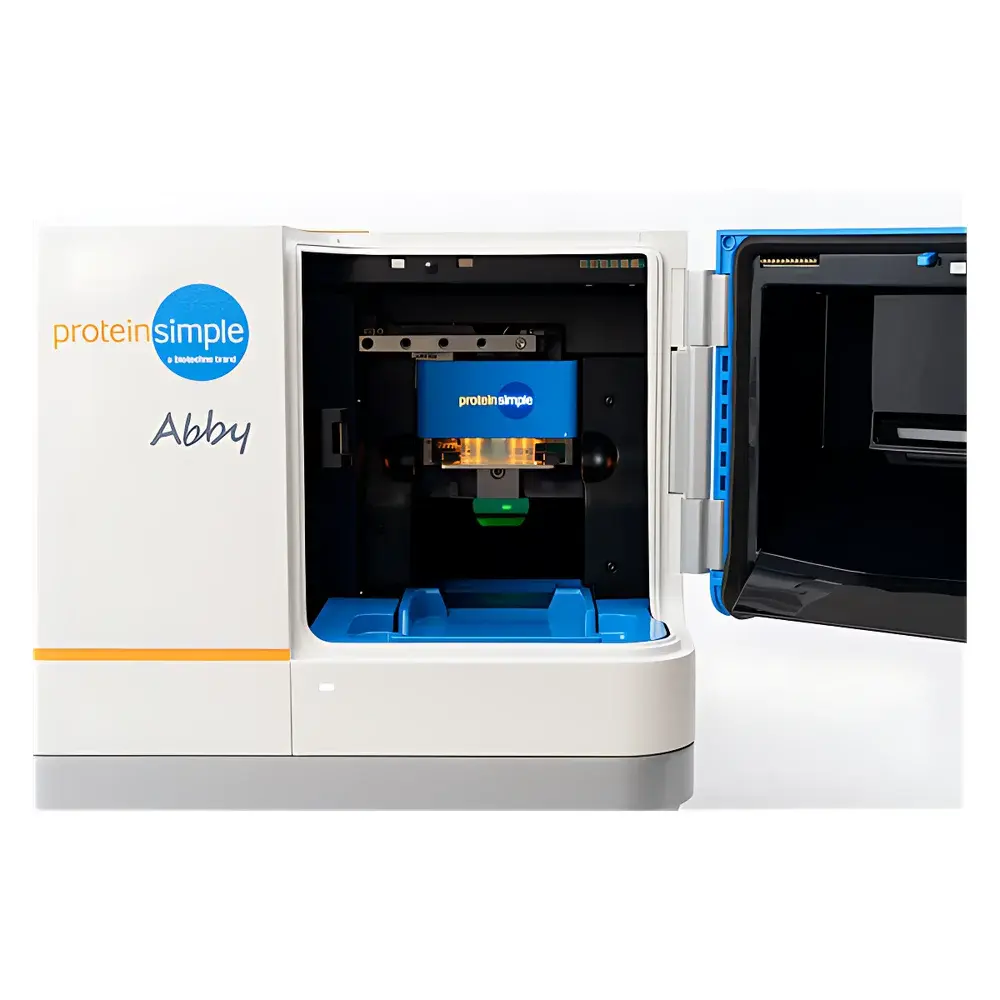
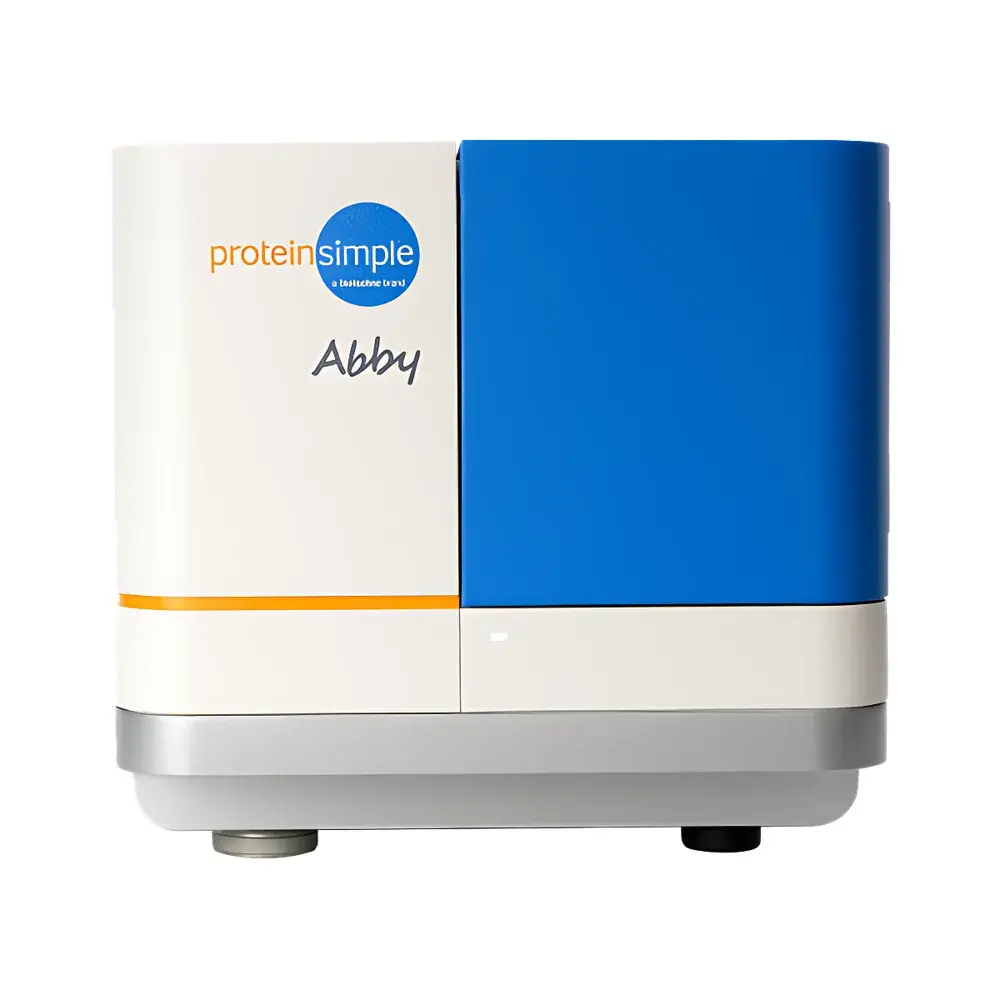
ProteinSimple Abby Automated Digital Western Blotting System
| Brand | ProteinSimple |
|---|---|
| Origin | USA |
| Instrument Type | Fully Automated Digital Western Blotting System |
| Automation Level | Fully Automated |
| Sample Volume | 3 µL |
| Molecular Weight Range | 2–440 kDa |
| Detection Mode | Chemiluminescence |
| Quantification Method | Absolute (Standard Curve), Relative (Total Protein Normalization), and Internal Control-Based Quantification |
| Multiplex Capability | RePlex Technology (Automated Stripping & Reprobing in Same Capillary) |
| Throughput | Up to 25 samples per run |
| Run Time | ~3 hours per assay |
| Compliance | Designed for GLP/GMP-aligned workflows |
Overview
The ProteinSimple Abby Automated Digital Western Blotting System is an integrated, capillary-based digital immunoassay platform engineered for precision, reproducibility, and minimal sample consumption in protein detection and quantification. Unlike conventional slab-gel Western blotting—which relies on manual transfer, membrane blocking, antibody incubation, and film-based chemiluminescent detection—the Abby system employs microfluidic capillary electrophoresis coupled with proprietary surface chemistry to perform electrophoretic separation, immunocapture, and digital chemiluminescent detection in a single, sealed capillary. This eliminates gel casting, wet transfer, membrane handling, and film development, reducing hands-on time by >90% while improving inter- and intra-assay CVs to <15%. The system operates on the principle of size-based electrophoretic mobility within coated fused-silica capillaries, followed by on-capillary immunobinding using covalently immobilized capture antibodies or streptavidin surfaces, enabling direct, label-free or labeled target detection with digital CCD imaging.
Key Features
- Fully automated workflow: Sample loading, electrophoretic separation, immunocapture, antibody incubation (primary and secondary), washing, substrate addition, and digital chemiluminescent imaging are executed without manual intervention.
- Ultra-low sample requirement: As little as 3 µL of lysate (typically 0.1–1 µg total protein) suffices per assay—reducing dependency on scarce clinical or primary cell samples.
- Broad molecular weight coverage: Resolves proteins from 2 kDa (e.g., cytokines, peptides) to 440 kDa (e.g., dystrophin, multimeric complexes) with consistent resolution and transfer efficiency.
- Digital quantification architecture: Integrated CCD detector captures linear-range chemiluminescent signals; software applies pixel-intensity integration with background subtraction for precise band quantitation.
- RePlex multiplexing technology: Enables sequential, automated stripping and re-probing of the same capillary—allowing two independent targets to be quantified from one sample run, conserving material and improving cross-target correlation.
- Total protein normalization (TPN): Uses pan-protein fluorescent or chemiluminescent staining within the same capillary to normalize target signal against total loaded protein—eliminating reliance on housekeeping proteins subject to regulation.
Sample Compatibility & Compliance
The Abby system accepts clarified lysates from mammalian cells, tissues, serum, plasma, CSF, exosomes, organoids, and laser-capture microdissected specimens. It is routinely validated for applications in stem cell characterization, tumor microenvironment profiling, immunophenotyping, developmental biology, and translational biomarker studies—including fine-needle aspirates and biopsy-derived material. The instrument and associated Compass Software comply with analytical method validation frameworks aligned with ICH Q2(R2) and USP . Audit trail, electronic signature, and user-access controls support compliance with FDA 21 CFR Part 11, EU Annex 11, and GLP/GMP documentation requirements when configured in regulated environments.
Software & Data Management
Compass for Western Software provides end-to-end data acquisition, visualization, and reporting. It includes built-in standard curve fitting (four-parameter logistic, linear regression), comparative analysis across groups, statistical testing (t-test, ANOVA), and export to CSV, PDF, or XML for LIMS integration. All processing steps—including exposure time, gain settings, background correction parameters, and RePlex cycle logs—are recorded automatically. Raw image files (.cif) and processed result sets are stored with immutable metadata, supporting full traceability from raw signal to final normalized value.
Applications
- Quantitative validation of CRISPR/Cas9 knockouts or overexpression models
- Phospho-protein signaling dynamics in kinase inhibitor studies
- Biomarker verification in clinical trial cohorts using limited FFPE or liquid biopsy material
- Host-cell protein (HCP) monitoring in bioprocess development
- Comparative analysis of isoform expression in neurodegenerative disease models
- Multi-target pathway profiling in tumor-immune co-cultures and organoid systems
FAQ
What sample types are compatible with the Abby system?
Cell lysates, tissue homogenates, serum, plasma, cerebrospinal fluid (CSF), exosome preparations, and laser-microdissected samples—all require standard RIPA or SDS-based lysis and brief centrifugation prior to loading.
Can the Abby system replace traditional Western blotting entirely?
Yes—for most quantitative applications requiring reproducibility, low sample input, and regulatory-compliant reporting. It does not replicate native-PAGE or non-reducing conditions, nor does it support post-transfer modifications such as glycosylation probing without assay redesign.
Is RePlex compatible with all antibody pairs?
RePlex performance depends on antibody epitope stability during acidic stripping; validation is recommended for each new primary/secondary combination. ProteinSimple provides optimized RePlex-validated antibody kits for common targets.
How is data integrity ensured during long-term studies?
Compass Software enforces version-controlled analysis pipelines, stores raw images with embedded instrument metadata, and generates timestamped PDF reports with embedded digital signatures—meeting ALCOA+ (Attributable, Legible, Contemporaneous, Original, Accurate, Complete, Consistent, Enduring, Available) principles.






